
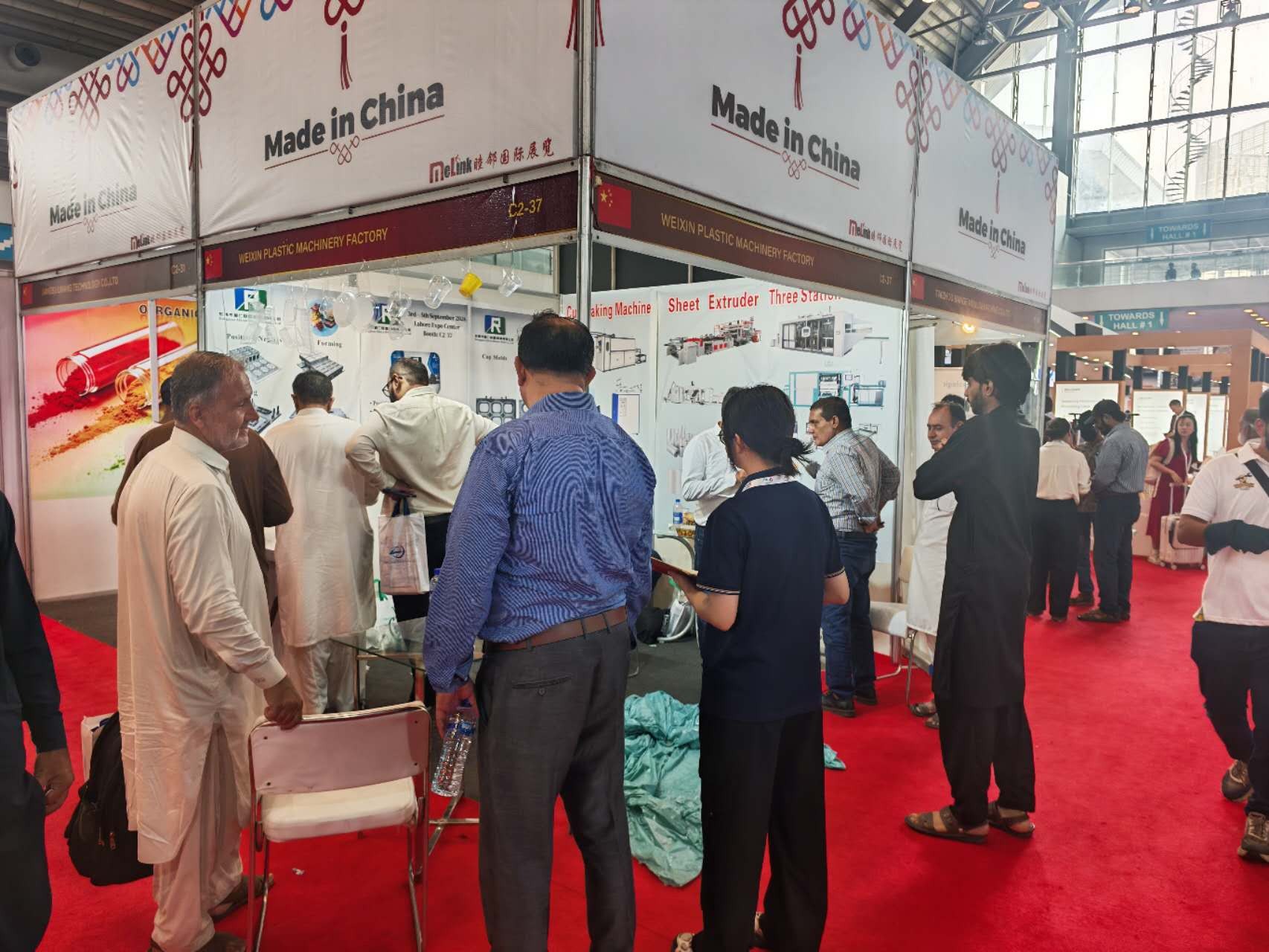
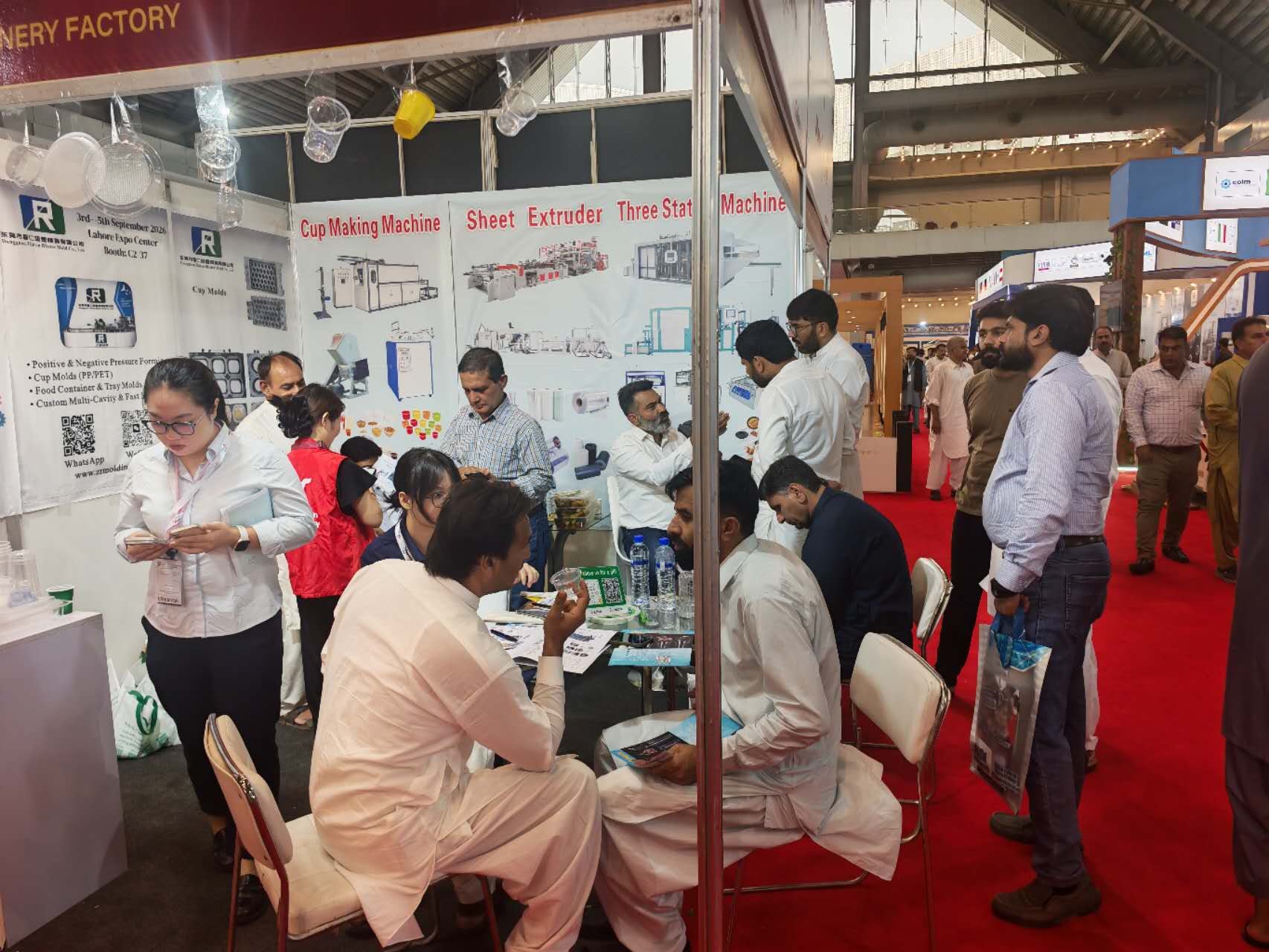
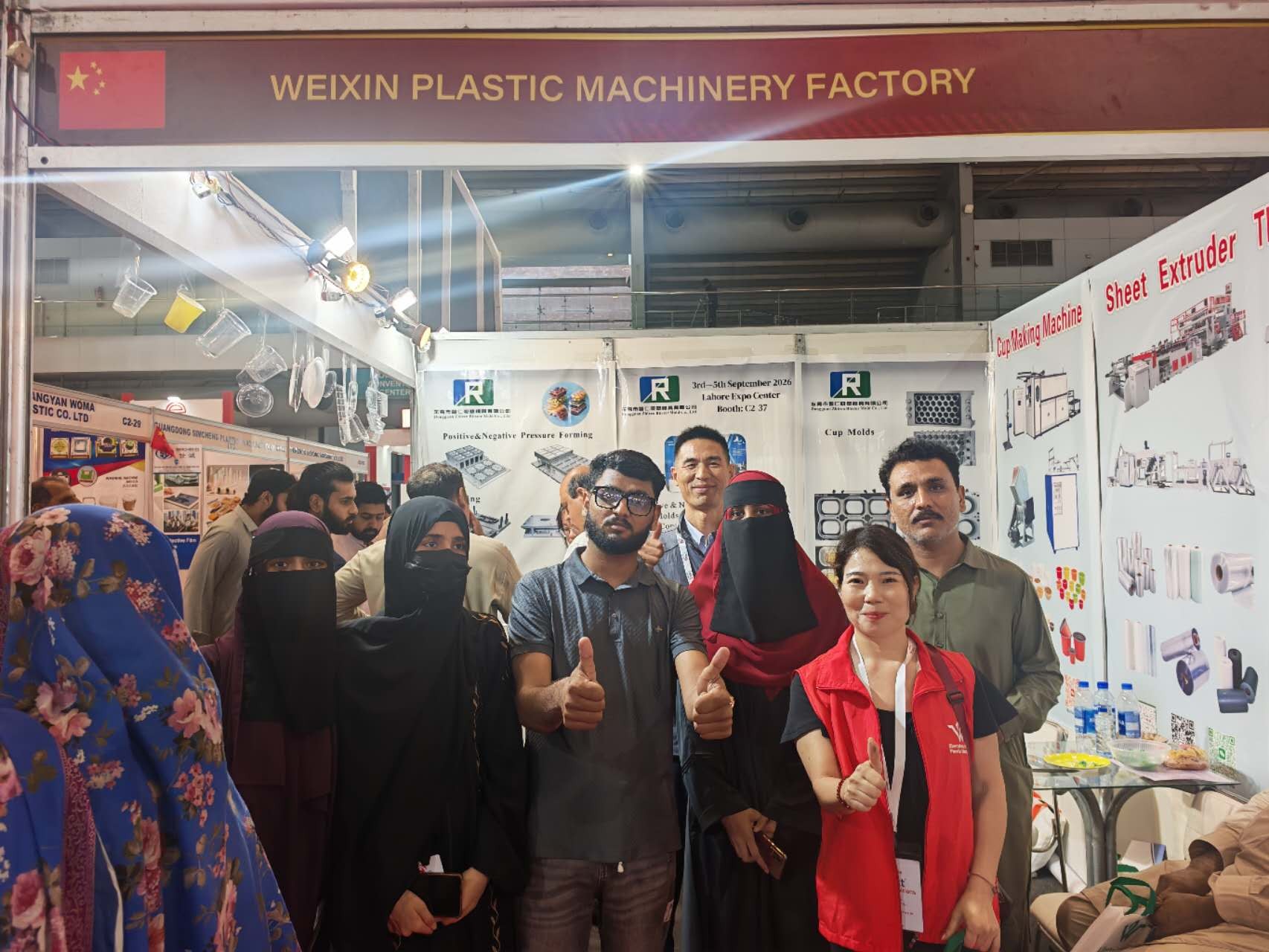
From 3 to 5 September 2026 we exhibited at 3P Plas Print Pack Pakistan 2026 at the Expo Centre Lahore, in the Made in China pavilion at booth C2-37. This page summarises what stood on the booth, and the four technical decisions that come up in almost every Pakistani cup, bowl and tray project we discuss.
If you are evaluating a plastic cup making machine in Pakistan, those four decisions matter more than the headline cycle speed on any brochure.
The show, in facts
- Exhibition: 3P Plas Print Pack Pakistan 2026 — also listed as the Pakistan Rubber, Plastics, Printing & Packaging Exhibition
- Dates: 3–5 September 2026
- Venue: Expo Centre Lahore, Lahore, Pakistan
- Our stand: booth C2-37, inside the Made in China pavilion organised by MeLink
- What we brought: machine documentation, mould samples, and formed PP and PET cups, bowls and food containers
What stood on the booth
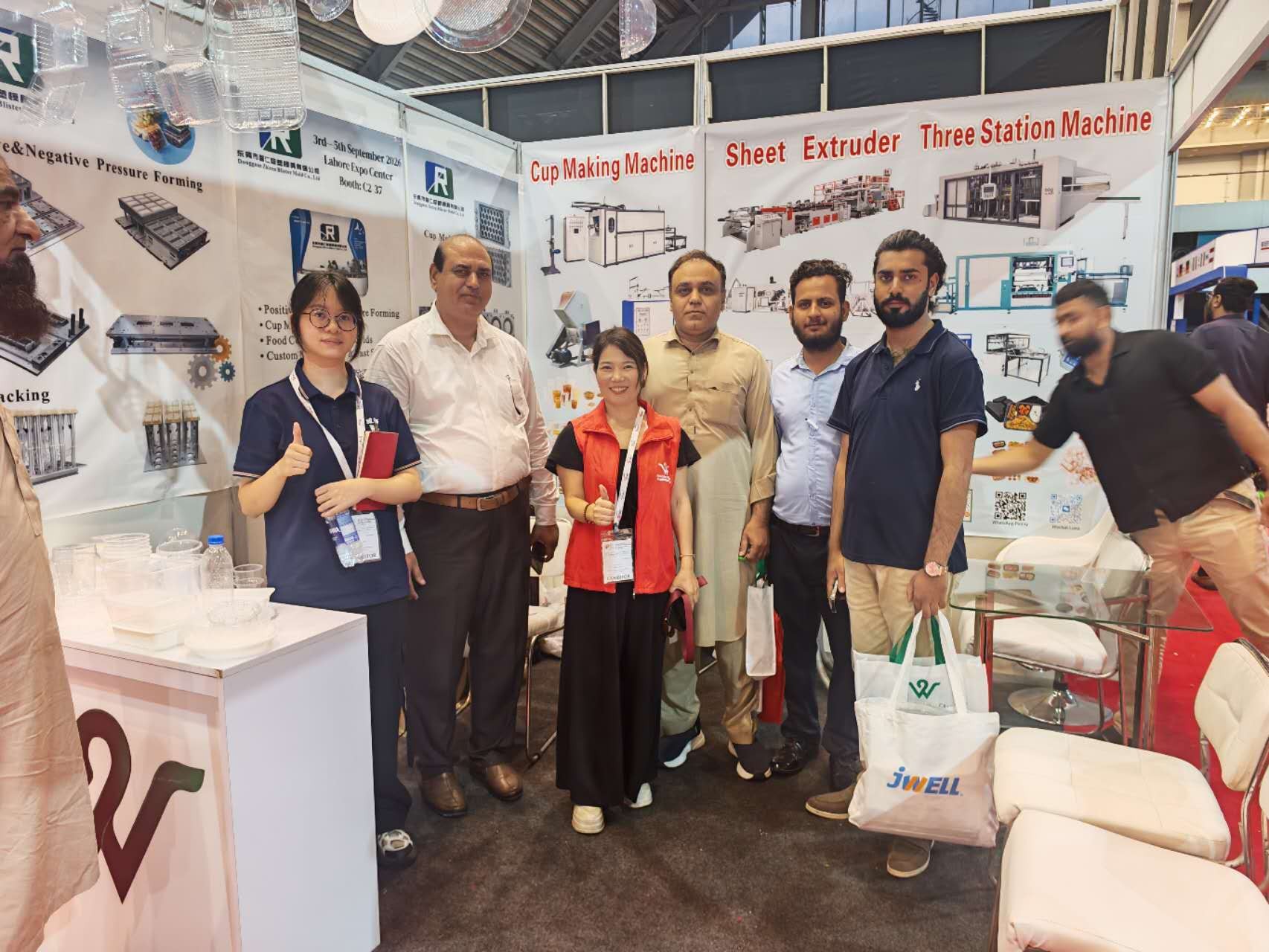
The booth backdrop showed five lines, and they are the five things a packaging producer normally needs to buy — not three separate suppliers:
- Cup Making Machine
- Sheet Extruder
- Three Station Machine
- Cup Molds (PP / PET)
- Food Container & Tray Molds — positive and negative pressure forming, custom multi-cavity, fast changeover
On the table and hanging from the frame we had the output itself: PP and PET cups, bowls and food containers from the cup machine and three-station lines. Visitors picked them up, checked wall thickness and rim finish, and compared them against whatever they are running today.
Four decisions that decide a cup or tray project in Pakistan
Decision 1 — Your incoming power supply
The single most common cause of a delayed installation is a mismatch between the machine’s specified supply and what the factory actually has. Before we quote, we ask for the real numbers from your site: incoming voltage, number of phases, frequency, and the size of your existing distribution board.
Our standard cup machine specification is written as AC 380 V, 50 Hz, three-phase, four-wire, and heating power is a major part of the connected load. If your site differs — in voltage, in frequency, or in available capacity — the starter, heater and control configuration changes with it. Sending a photo of your distribution board and your electricity bill’s tariff category at the enquiry stage saves weeks later.
Decision 2 — Where the sheet comes from
A cup machine converts sheet into cups. It does not make the sheet. In Pakistan this is the decision that most often decides whether a project is profitable, and there are two routes:
- Buy sheet locally from a converter. Lowest capital cost, and the fastest way to start. Your cost per cup then moves with the local sheet price and with whatever thickness tolerance your supplier holds.
- Extrude your own sheet with a sheet extrusion line. Higher capital cost, but you control thickness, width, colour and recycled content — and you capture the margin between resin and sheet.
Which one is right depends on your target volume, your access to resin, and how much of your cost you want to control. We build both, so we can model either route against your numbers rather than push one.
Decision 3 — Cups, bowls and trays: one machine or three?
A cup making machine and a three-station machine are not interchangeable, and buyers often discover this after signing.
- A cup making machine forms and trims cups in one continuous cycle on a dedicated mould. It is the efficient answer when your product is cups at volume.
- A three-station machine runs forming, trimming and stacking as separate stations. It is more flexible for deeper or more awkward parts, and it is the usual route for food containers, trays and boxes.
If your plan is “cups now, food containers in two years”, say so at the enquiry stage. The machine family is chosen on the product you intend to sell in three years, not the one you start with — retrofitting a line afterwards costs more than specifying it once.
Decision 4 — Mould and machine are one specification, not two
Wall thickness, rim finish, stacking height and cycle time are decided as much by the mould as by the machine. A mould built for a different machine, or to a different cavity count, will not deliver the output the machine is capable of.
Because of this we treat the mould and the machine as a single quotation. The practical items to send us are the product drawing or a physical sample, the material, the required cavity count, and the target output per shift. Everything else — forming area, depth, stroke and tooling layout — follows from those.
The cup machine family at a glance
Figures below are reference values from the manufacturer’s parameter sheet for the standard cup machine family. Your configuration is confirmed against the final technical BOM before shipment.
| Item | VihoX-660 | VihoX-720 | VihoX-750 | VihoX-850 |
|---|---|---|---|---|
| Mould size / forming area | 660 × 320 mm | 730 × 420 mm | 750 × 480 mm | 850 × 530 mm |
| Sheet width (max) | 680 mm | 730 mm | 760 mm | 850 mm |
| Sheet thickness | 0.3–2.0 mm | 0.3–2.5 mm | 0.3–2.5 mm | 0.3–2.5 mm |
| Forming depth (max) | 150 mm | 180 mm | 220 mm | 220 mm |
| Forming speed (max reference) | 29 cycles/min | 30 cycles/min | 30 cycles/min | 30 cycles/min |
| Main drive power (reference) | 7.5 kW | 7.5 kW | 15 kW | 15 kW |
| Heating power (reference) | 111.2 kW | 95 kW | 146 kW | 146 kW |
| Air pressure | 0.7–1.0 MPa | 0.6–0.8 MPa | 0.6–0.8 MPa | 0.6–0.8 MPa |
| Air consumption | 4,200–5,000 L/min | 3,000 L/min | 3,000 L/min | 3,000 L/min |
| Machine dimensions | L4200 × W2200 × H2700 mm | L4250 × W2250 × H2700 mm | L4300 × W2300 × H2800 mm | L4500 × W2400 × H2800 mm |
| Weight (reference) | about 6 t | about 6.5–7 t | about 6.5–7 t | about 7 t |
| Suitable sheet | PP / PS / PET / PVC / PLA | PP / PS / PET / PVC / PLA / PE | PP / PS / HIPS / PET / PVC / PLA | PP / PS / HIPS / PET / PVC / PLA |
How to read this table
- The forming speed is a maximum reference, not an output guarantee. Real output depends on your mould’s cavity count, your sheet thickness and how you run the line. Any supplier quoting a guaranteed piece rate from this figure alone is quoting something they cannot control.
- Main drive power and heating power are two separate references and must not be added together. Connected load is confirmed for your configuration, and it is what your electrician needs.
- Cavity count is decided by your mould, not by the machine. This is why they are quoted together.
- The 660 / 720 / 750 / 850 size families are built and quoted in different drive types — cylinder-type and servo-type among them — and their parameters are not interchangeable. Tell us the drive type you need and the quotation carries the confirmed figures for that build.
- Water consumption for the 750 family is deliberately not published here, because our own records conflict. It is confirmed in the quotation rather than published.
Auxiliary equipment has to be sized with the machine, not after it
A cup line is a system. The machine determines what the rest of the equipment has to be:
| Machine family | Suggested chiller (reference) |
|---|---|
| VihoX-660 | 3–5 HP |
| VihoX-720 | 5 HP |
| VihoX-750 | 5–10 HP |
| VihoX-850 | 10 HP |
Beyond the chiller you will normally need an air compressor sized against the air consumption in the table above, an air receiver and dryer, and — depending on your product — a cup stacker, a crusher for edge trim, and a packing line. Buying these separately and late is how projects end up with a machine that cannot run at its rated condition.
FAQ: plastic cup making machine in Pakistan
Which machine fits a small cup project in Pakistan?
There is no single answer, and we will not pretend otherwise. If your product is cups at volume, a dedicated cup making machine in the 660 or 720 family is normally the efficient starting point. If you also intend to run food containers or trays, the three-station route usually costs less over the life of the project. The deciding inputs are your product, your target output and whether you will extrude your own sheet.
Can I visit the machines running before I buy?
Yes. We test every machine before shipment, and we record the test run so you can see the actual output. We also welcome factory visits, and for overseas buyers we can run the test live on a video call.
Do you supply the moulds as well as the machines?
Yes — moulds and machines are quoted together, which is the only way to guarantee the cavity count and cycle time you are being promised.
What sheet materials can the machine run?
The 750 and 850 families run PP, PS, HIPS, PET, PVC and PLA. The 660 runs PP, PS, PET, PVC and PLA, and the 720 adds PE. PP is the usual choice for hot drinks and general beverage cups; PET is common where clarity matters.
Do I need a chiller and a compressor?
Yes, both, and they must be sized against the machine — not bought afterwards from whatever is available locally. Inadequate cooling shows up as inconsistent wall thickness; inadequate air shows up as incomplete forming and unstable ejection.
Does the machine come with CE documentation?
CE-compliant configurations are available for the machines we export to the EU. We confirm the applicable documentation for your destination and machine configuration in the quotation.
How long does installation take?
That depends on your site, your power supply and whether the auxiliary equipment is ready. The most reliable way to shorten it is to send the site details described under Decision 1 before the machine ships, not after.
Send us your product, we will run the numbers
Tell us four things and we will tell you which family fits, and what the mould and auxiliary equipment list should be:
- Product — cup, bowl or tray, with height, rim diameter and wall thickness if you know it
- Material — PP, PS, PET, PLA or another sheet, with thickness if known
- Output target — pieces per hour or per shift
- Destination and supply — country, incoming voltage, phases and frequency
Send your requirement → | WhatsApp: +86 147 7547 6896
Related reading on this site: