Industry News

What Is A Three-Station Thermoforming Machine?

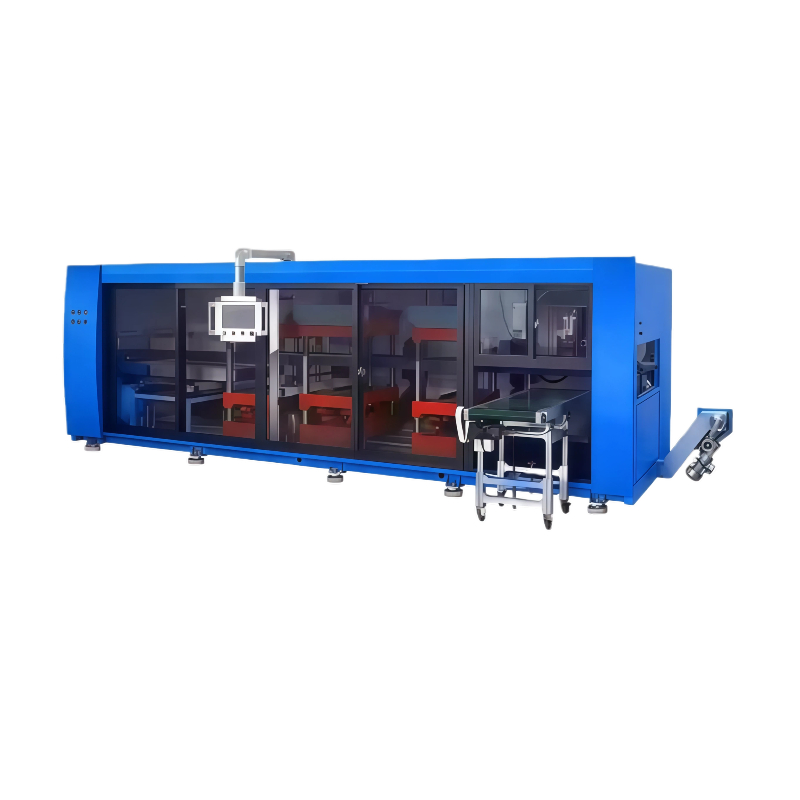
What is a three-station thermoforming machine? A comprehensive introduction to cup making and vacuum forming equipment

The number of single-use food containers has increased at a fast pace in the past decade with the rise of food delivery systems, airline meal deliveries, the packaging of ready-made meals in supermarkets, and distribution systems of central kitchen.

Manufacturers don’t compete on price alone. They compete on output speed, consistency, material efficiency, and uptime. The classic single-station plastic vacuum forming machine is likely to be a bottleneck when the production capacity is higher. The pressure develops instability, cutting disrupts the precision of the product, scrap rate, and long-term mechanical wear decrease the precision.

That’s why three-station thermoforming machines were developed—to remove these structural bottlenecks. In this article, we will describe the way how a three-station thermoforming machine is operated, how its structure increases the stability of the results, what can be produced by this device. So lets get started.

1、What Is A Three-Station Thermoforming Machine?

In the case of manufacturers of disposable food containers, production stability and output efficiency are at the same time the determinants of profitability. With a higher order volume, several factories have found that the conventional methods of plastic vacuum forming machines are starting to reveal their weakness in that pressure formation is not constant, trimming interferes with the dimensional precision and scrap rates increase as the machines operate at faster speeds. These are not only the technical problems; they make the material cost and production predictability less.

These structural weaknesses are aimed to be done away with by an arrangement of a three station thermoforming machine. This structural separation minimizes mechanical interference, enhances mould alignment and ensures uniform forming pressure on a cycle-to-cycle basis. The outcome is improved containers, sharper sides, increased accuracy in stacking, and enhanced long-run production.

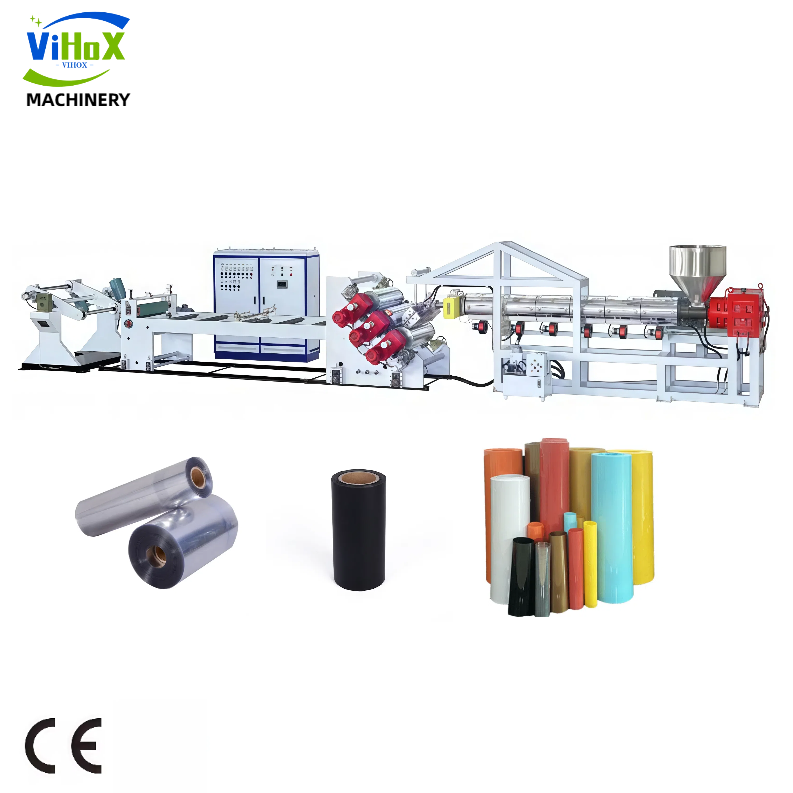
ViHox manufactures its plastic thermoforming systems in a way that is targeted at producing food packaging at the industrial level. ViHox as a professional manufacturer of plastic thermoforming machines, plastic vacuum forming machines, plastic food container making machines, and extrusion systems, therefore, puts emphasis on mechanical stability, precision control and production efficiency. The three-station design isn’t about complexity it’s about control, consistency, and long-term stability.

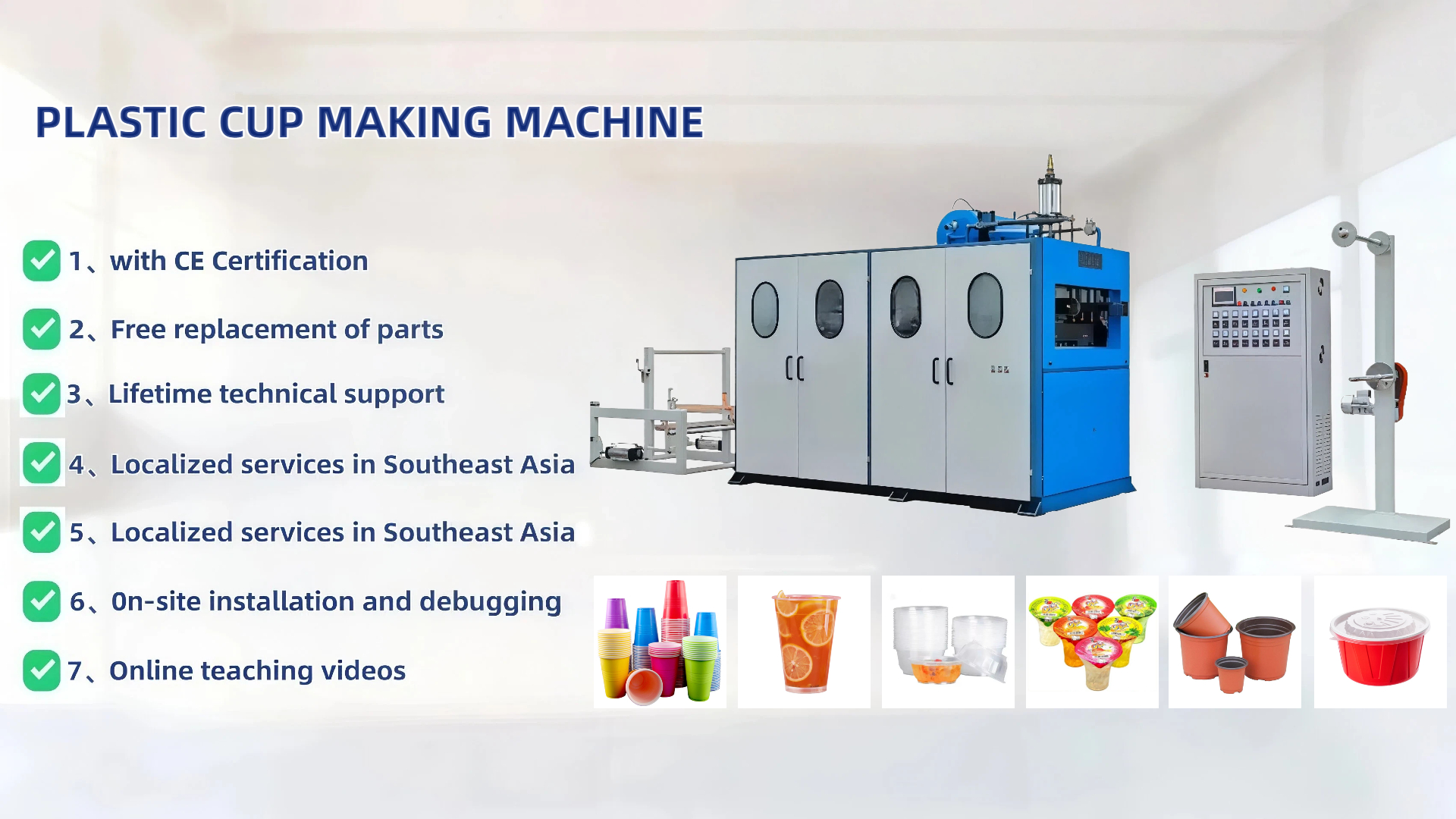
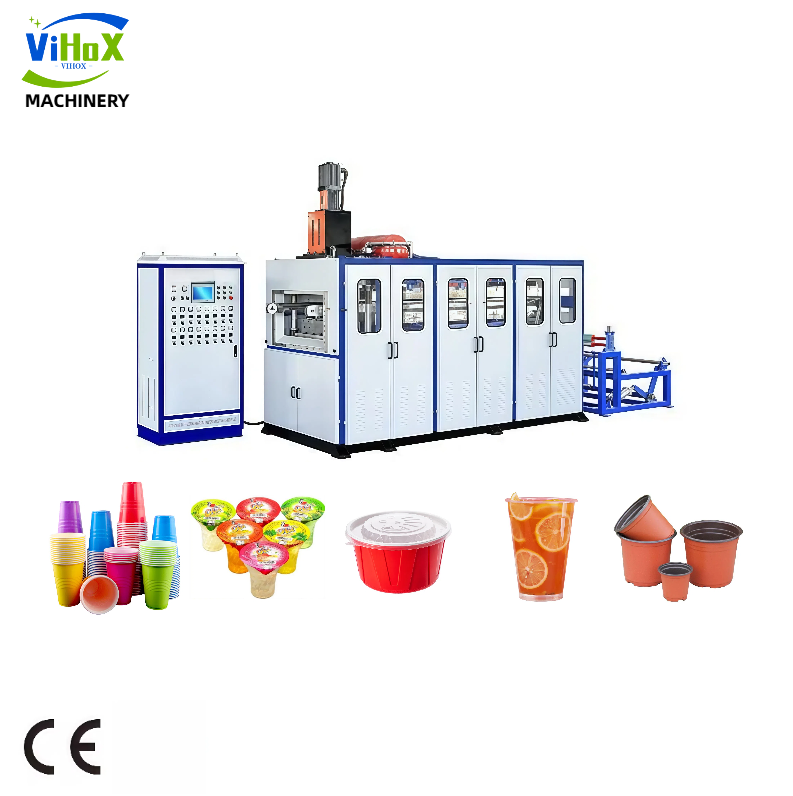
Plastic Vacuum Forming Machine (CE Certified) with 7 Core Advantages & Produced Products

2. Three-Station Structure Explained – Why This Architecture Increases Production Reliability

Whenever manufacturers assess a plastic thermoforming machine, the actual issue does not concern the number of stations. The actual question is whether or not the structure can enable greater output without compromising consistent. There is one reason why there is a three-station design and that is to eliminate those operations compromises that restrict the growth of production.

In most conventional plastic vacuum forming systems, heating, forming and trimming take place in one mechanical cycle. The architecture of that structure causes trade-offs. It is possible that increasing forming pressure could influence the stability of trimming. Increment of cutting speed can cause dislocation of mould. Increasing cycle speed could decrease uniformity of heating. In the long run, such tradeoffs decrease dimensional precision and waste materials.

Isolating each process stage removes those trade-offs by the three-station architecture.

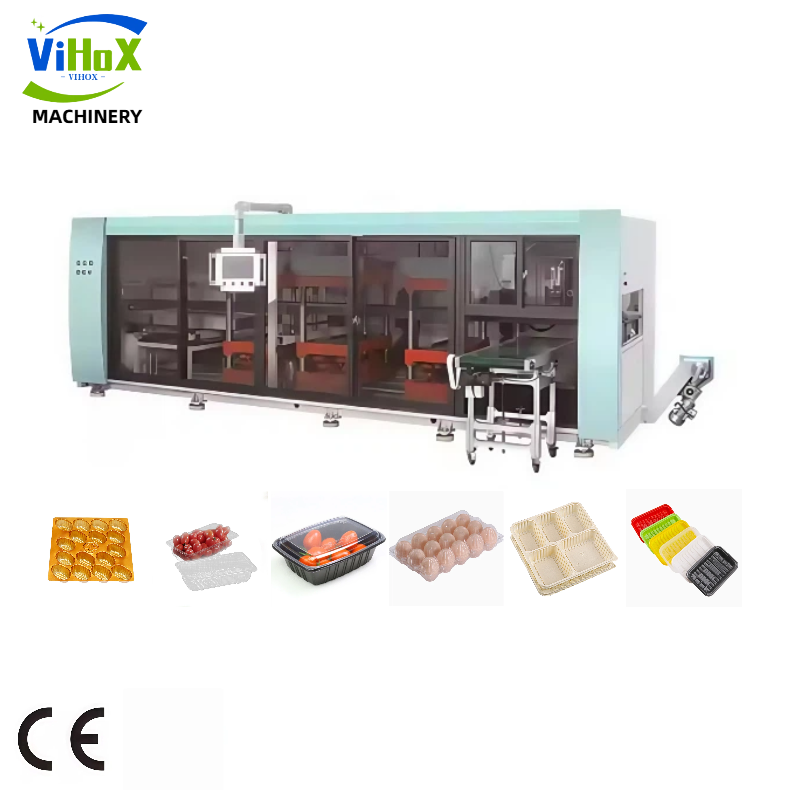
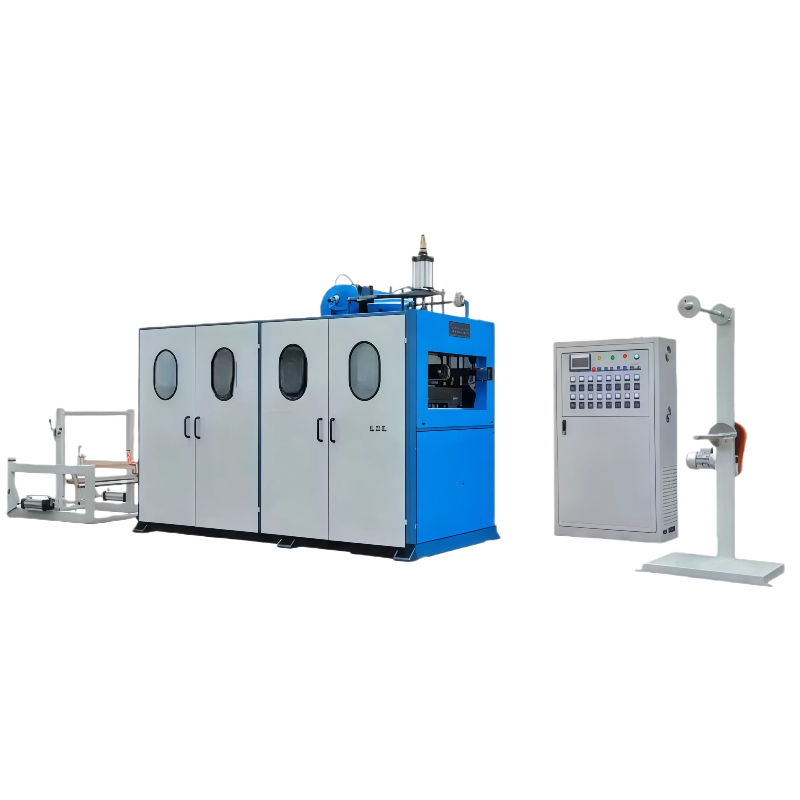
Plastic Vacuum Forming Machine Structural Diagram for Egg Tray & Lunch Box Making

Heating Station: Precision Before Speed

Uneven heating is a hidden case in manufacturing industrial food containers, being one of the most costly. Plastic sheet does not attain uniform forming temperature and this results in a change in wall thickness between cavities. This results in poor bottoms of containers, unsteady stacking and rejection when packing.

A three-station plastic thermoforming machine has a heating unit which is not linked to mechanical forces of forming and trimming. The sheet is preheated in a controlled condition with multi-zone control whereby a perfect balance of temperature is allowed throughout the entire width.

Forming Station: Mechanical Stability Determines Product Strength

At the forming station, the structural accuracy would be observed in the final product. When there is even a slight alteration in the alignment of the mold, there is a change in bottom thickness. In case there is unequal distribution of pressure, there is loss of rigidity in containers. Such problems do not manifest themselves in small batches – but are expensive in mass production.

The three station configuration enables the forming unit to work under special mechanical support. The four column guiding system is the system that supports parallel movement of the upper and lower mold plates. Since cutting shock is segregated in a different station the establishment of accuracy is maintained throughout extended production cycles.

Cutting Station: Protecting Precision Over Time

Trimming generates force. In single station systems, the force is transferred directly into the forming mechanism. Months of operation results in this mechanical stress, which decreases the precision of alignment, and the frequency of mold maintenance.

Cutting is segregated in a three station heat press. The sheet that was formed proceeds and the trimming is done separately. This division enables a greater cutting pressure without compromising the alignment of molds.

To manufacturers this implies:

-Cleaner edges

-Stable product dimensions

-Longer mold lifespan

-Reduced adjustment frequency

Even the slightest dimensional variations can interfere with automated packaging when scale manufacturing disposable plastic food container. The independent cutting provides dimensional reliability shift to shift.

Stacking System: Converting Output Into Usable Inventory

A high cycle speed is useless when there are inconsistencies in stacking. The reasons are poor stacking which causes deformation of containers, batches being counted more than once and poor packaging.

The timings of stacking station on a three-station plastic thermoforming machine are synchronized with the timing of the cycles. Containers are automatically aligned and nested. In case of high-output operations, this decreases manual labor in operation and facilitated the transfer to counting and packaging systems.

In case of manufacturers that have to scale production, automated stacking will assist in maintaining continuous operations and reducing handling errors that contribute to the slackening of operations down the production line.

Why Buyers Upgrade to Three-Station Machines

Factories typically upgrade from plastic vacuum forming machine when they experience:

-Output bottlenecks

-Inconsistent container thickness

-Frequent mold adjustment

-Difficulty increasing cavity numbers

-High rejection rates at higher speeds

The three-station plastic thermoforming machine addresses these operational limitations structurally not cosmetically.

By separating heating, forming, and cutting into independent stations, the system allows manufacturers to increase capacity while maintaining control. That control is what converts equipment investment into predictable production performance.

3. What Products Can Be Made?

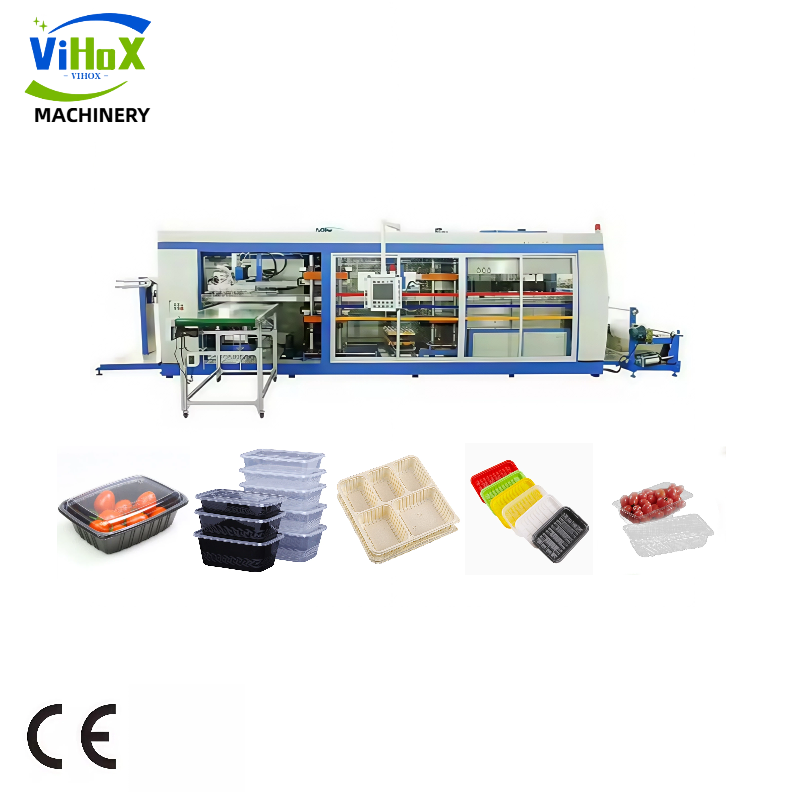
Plastic Vacuum Forming Machine Produced Various Products (Trays, Dishes, Food Containers, etc.)
Products made by plastic vacuum forming machine, including trays, dishes, food containers, demonstrating multi-product manufacturing ability.

A three station plastic thermoforming machine will be used where the manufacturer requires flexibility in the products but does not have to spend on having several machines. Under the condition of mold replacement, the machine platform can be used to manufacture various food packaging products, and thus it can fit the factory in various market segments.

Common products include:

-Disposable lunch boxes

-PP Multi-compartment meal containers

-Takeaway food trays

-PP microwave containers

-Clear PET salad boxes

-Fruit and fresh produce trays

-Plastic bowls

-Lids and shallow trays

This is not its only benefit, which is variety, but scalability. Manufacturers can either replace deep-draw lunch boxes with shallow trays or change the machine by changing its molds. This lowers cost of capital and maximizes the use of equipment.

As an illustration, a factory that provides food delivery brands can produce PP container with pp container making machine during peak takeaway seasons and switch to PET packaging when the contracts with the supermarkets are taken. Quick changeover enhances flexibility to order and safeguarding production flow.

The three-station structure can easily deal with deeper containers as compared to a regular plastic vacuum forming machine, where the stability of the forming is not that good. This becomes relevant with creating thicker PP containers or multi-compartment trays in which bottom strength and edge accuracy have a direct influence on stacking and transportation capabilities.

4. Suitable Materials: Expanding Your Market with PP, PS, PET, PLA, and PVC

The material compatibility when investing in a three-station plastic thermoforming machine is not merely a technical requirement, but it determines the number of markets which your factory can cater to. A disposable plastic food container making machine that can only take one type of material is constraining your business. A polymer-supporting machine provides you with commercial flexibility.

ViHox also designs their plastic thermoforming machines to work with a variety of thermoplastic materials which lets manufacturers adapt to various customer needs with minimal equipment changes.

PP (Polypropylene)

The predominant food delivery and ready-meal packaging material is PP due to its heat resistant properties and the structural strength. It works in the microwave applications and is flexible to hot filled conditions.

PP compatibility is required in the event that your target customers are takeaway chains, central kitchens or airline catering suppliers. An effective PP container manufacturing machine will enable you to get repeat order contracts with large volumes required where durability and heat resistance will be obligatory.

PET (Polyethylene Terephthalate)

PET is very transparent and has a good shelf appeal. Supermarkets like transparent containers in salads, fresh meals and fruit as they give the consumer confidence and retail conversion.

Through trustworthy processing of PET your production line can be used to cater to packaging of supermarkets besides takeaway markets. This spreads your revenue base and has the advantage of not being dependent on one type of customer.

PS (Polystyrene)

PS would continue to be a viable answer to cold food slide trays and price-hypersensitive packaging markets. Its reduced cost of material enables manufacturers to compete in the segments where the price competitiveness is the determinant of the amount of orders.

Sponsoring PS will enable you to balance the premium packaging deals with the high volume cost-sensitive production.

PLA (Polylactic Acid)

Some markets have created the need to position compostable or bio-based packaging. PLA compatibility also enables companies to enter into the environmentally controlled areas without spending money on the separate production lines.

In case the PLA needs are seasonal or region based, such an ability will serve as a strong bargaining tool when you enter into negotiations with overseas customers.

Why Material Flexibility Matters for Investment

Material compatibility directly impacts your sales strategy. A ViHox plastic food container making machine is designed to give manufacturers the freedom to switch between PP, PET, PS, and other materials according to contract demand.

This means you can:

-Produce microwave-safe PP containers for food delivery

-Manufacture clear PET trays for retail chains

-Supply cost-effective PS packaging when price competition is high

-Respond to eco-focused orders when required

Instead of being locked into one packaging segment, your factory gains the ability to adapt production to market demand. That flexibility protects your investment and increases machine utilization throughout the year.

5. Output Calculation: Pieces Per Hour

When investing in a three-station plastic thermoforming machine, output capacity determines how fast your investment returns.

The basic calculation is simple:

Pieces per hour = Cycles per minute × Mold cavities × 60

For example, if the machine runs at 28 cycles per minute with an 8-cavity mold:

28 × 8 × 60 = 13,440 pieces per hour

If cavity increases to 12:

28 × 12 × 60 = 20,160 pieces per hour

But real performance depends on more than numbers. Deep lunch boxes require different cycle timing than shallow lids. PP behaves differently than PET. Mold cooling efficiency affects total cycle speed.

This is where structural design matters. Because heating, forming, and cutting operate independently in a three-station system, the machine maintains stable cycles even at higher speeds. Output does not collapse when production increases.

For manufacturers operating as a plastic food container making machine supplier, stable hourly output means:

-Predictable daily production

-Reliable contract fulfillment

-Lower per-piece production cost

-Faster payback period

ViHox focuses on sustained industrial speed, not theoretical maximums. A machine that runs consistently for long shifts creates more value than one that peaks only during demonstration.

In production, stability equals profitability.

Conclusion

When unstable forming or inconsistent trimming or inability to increase the number of cavities in your production capacity limits your capacity, then an upgrade of your equipment is a strategic decision rather than a technical upgrade. Three station thermoforming machine enables manufacturers to increase production without losing control over precision product, material use, and mechanical stability. It is this structural isolation of heating, forming and cutting that allows performance stability in industrial conditions to be constant under the actual factory conditions.

ViHox offers complete production line systems with extruders, molds and auxiliary equipment but also supplies three station plastic thermoforming machine. To manufacturers intending to expand, sign new packaging deals, and enhance reliability in production, the selection of the appropriate machine structure today is the difference between painful years of production stability and smooth years of manufacturing. It is not a choice of equipment addition but a choice of creating a more predictable and scalable operation.

Plan Your Next Production Upgrade with Confidence

Tell us your product type (PP lunch box or PET tray), sheet width, and target output.
Our engineering team will suggest:

-A customized mold cavity configuration

-Estimated cycle time and production capacity

-Recommended full line layout for optimal efficiency

Let’s design a thermoforming solution that fits your production goals, not just today, but for long-term scalability.

FAQs

1. How much factory space is required for a three-station thermoforming machine?

Space requirements depend on sheet width and configuration, but a three-station system generally requires more layout planning than a single-station vacuum machine. However, because forming, cutting, and stacking are integrated within one production flow, it eliminates the need for separate trimming or stacking equipment, which optimizes total floor utilization.

2. Is it difficult to train operators to run a three-station thermoforming machine?

No. Modern systems are PLC-controlled with recipe storage, allowing operators to switch between products with preset parameters. Once molds are installed and settings saved, daily operation becomes standardized and does not require advanced technical background.

3. How long does it take to change molds when switching products?

Mold change time depends on size and configuration, but three-station machines are designed for structured mold replacement. With proper setup, changeover can be completed efficiently, allowing manufacturers to respond quickly to different order requirements.

4. Can this machine integrate with a complete plastic sheet extrusion line?

Yes. A three-station thermoforming machine can operate as part of a full production line including plastic sheet extrusion, online scrap recycling, stacking, and counting systems. Integration improves production continuity and material control.

5. How do I evaluate whether this machine fits my production targets?

The key factors are expected hourly output, target product type, material thickness, and contract volume. By calculating cavity configuration and cycle speed, manufacturers can estimate daily capacity and determine whether the machine aligns with their expansion goals.

发表回复

您的邮箱地址不会被公开。 必填项已用 * 标注