The Frame That Covers a Growing Forming Cell
As soon as a workshop adds a second forming station, the arithmetic stops being comfortable. The VihoX 20HP answers that step with 2.54 m³/min of free air at standard pressure, driven by a 15 kW permanent-magnet motor that roughly doubles the shaft power of the smallest frame without doubling the floor area it occupies.
Inside the 20HP Screw Block
Permanent-magnet excitation lets the motor hold high efficiency across a wide speed band instead of only at its rated point, which is what makes variable-speed control worthwhile. Software drives the inverter, so delivery matches the real draw of the line. The absence of a belt drive also removes the re-tensioning routine and the alignment checks that go with it.
Receiver, Dryer and Filtration Choices at This Size
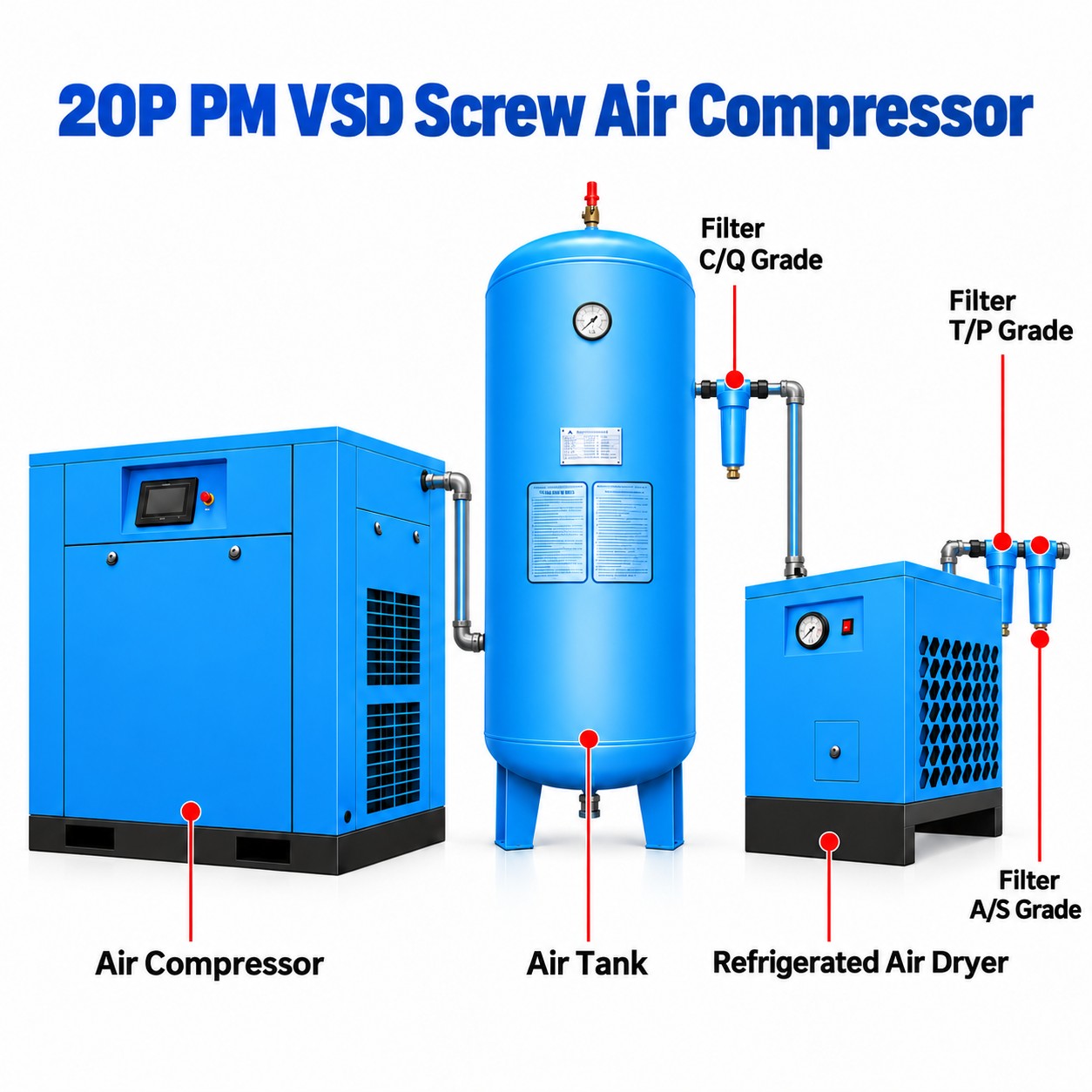
Above the smallest frame the buffer vessel becomes a sizing decision rather than a fixed item, so the receiver is quoted across a 500 to 1000 litre band. A refrigerated dryer of 3.0 m³/min or more keeps pace with full delivery, and the three filter stages handle particulates and oil aerosol. A DN32 main is the usual distribution choice at this flow.
Air Compressor Specifications — VihoX-20PM
| Specification |
VihoX 20HP Data |
Workshop Impact |
| Rated horsepower |
20 HP (20P) |
Mid frame for a growing cell |
| Motor output |
15 kW |
Doubles shaft power over the 10HP |
| Free air delivery at 8 bar |
2.54 m³/min |
Feeds several pneumatic stations at once |
| Usable air after treatment |
2 m³/min |
The basis for sizing tooling and blow-off |
| Discharge outlet |
G1 |
Wider bore for the higher flow |
| Receiver volume |
500–1000 L |
Choose by how sharply demand swings |
| Dryer capacity |
≥3.0 m³/min |
Margin above the compressor’s delivery |
| Distribution pipe |
DN32 |
Keeps velocity sensible at full flow |
| Sound pressure |
Approx. 63–72 dB(A) |
Quiet enough for a production hall |
| Footprint |
Approx. 1100×800×1150 mm |
Modest growth over the 10HP frame |
Choosing Between Frames as Demand Grows
The sensible trigger for moving up is measured demand, not instinct. If your instruments show the cell pulling close to 2 m³/min for sustained periods, this frame is working near its ceiling and the next size deserves consideration. If demand sits well below that, the 20HP simply runs at part speed and saves energy.
Selection and Installation Questions
When should I move up from a 10HP to a 20HP?
When measured demand approaches the usable air of the smaller unit, or when you already know a second forming station is coming.
Why does this frame quote a receiver range instead of one size?
The right buffer depends on how abruptly your demand changes. Fast forming cycles want the larger vessel; steady processes are happy with the smaller one.
What dryer capacity should I pair with a 20HP?
At least 3.0 m³/min, so the dryer never becomes the bottleneck when the compressor reaches full delivery.
Is a 15 kW motor still economical at partial load?
That is precisely what variable speed delivers. The inverter trims motor power as demand falls instead of running the block at constant speed.
Can I install this frame on a mezzanine floor?
Check the point loading first. The bare machine weighs 320 to 450 kg, and the receiver adds considerably more once it is mounted alongside.
What size should the ring main be?
DN32 suits this flow rate. Reducing the bore raises velocity and costs you pressure at the far end of the run.
How is condensate dealt with?
The dryer and filter stages collect it, so fit drains and route the discharge away from the machine base and walkways.
Does it need a cooling water connection?
No. Air cooling is standard, so there is no water circuit to install or maintain.
Talk to VihoX About a 20HP Installation
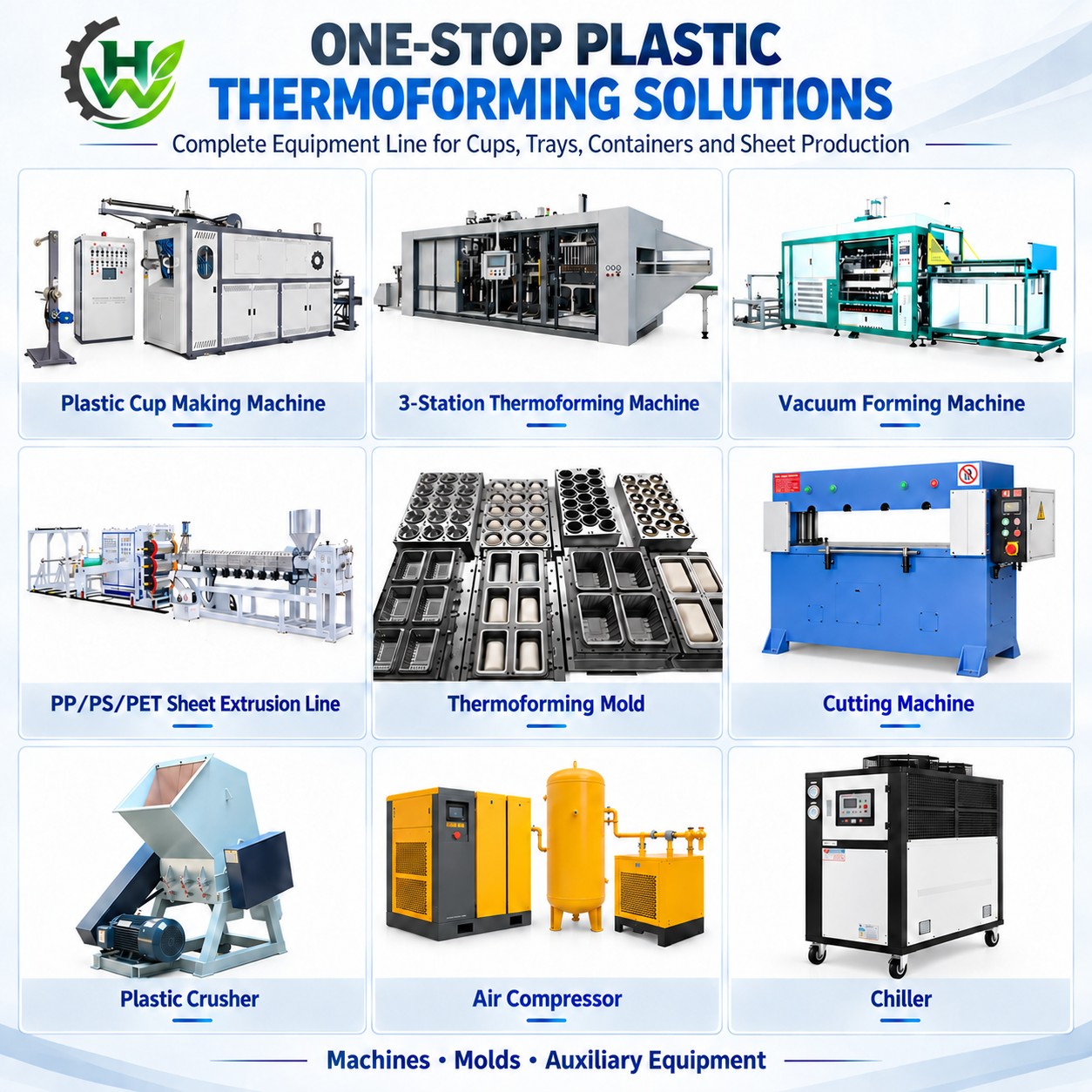
Give us your measured air demand, the number of forming stations and the receiver position you have in mind, and we will check that 2.54 m³/min leaves you proper headroom. You may also want to look at our cup making machines and three-station thermoformers, which are typical users of this frame.
Talk to the factory: +86 147 7547 6896 · VihoX, Shenzhen, China
Choosing the Rest of a 20HP Air System
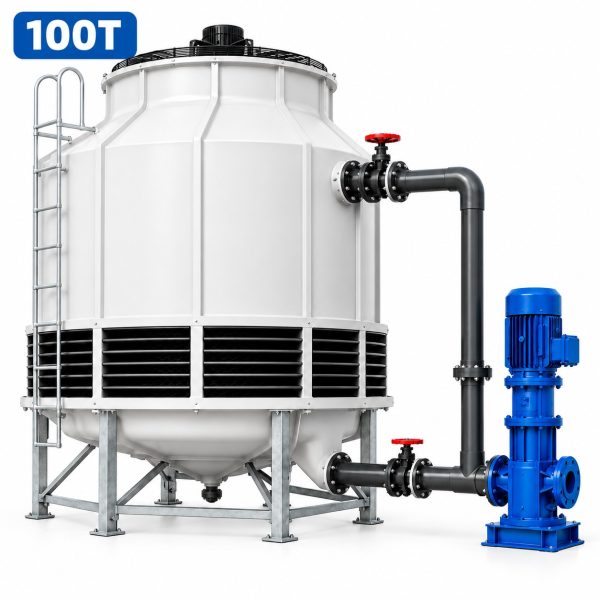
Add a VihoX 60 ton cooling tower where the plant also has to reject process heat, and a 5HP air-cooled chiller for circuits that need a precise temperature. Medium forming equipment, including cup making machines, is the usual consumer.