
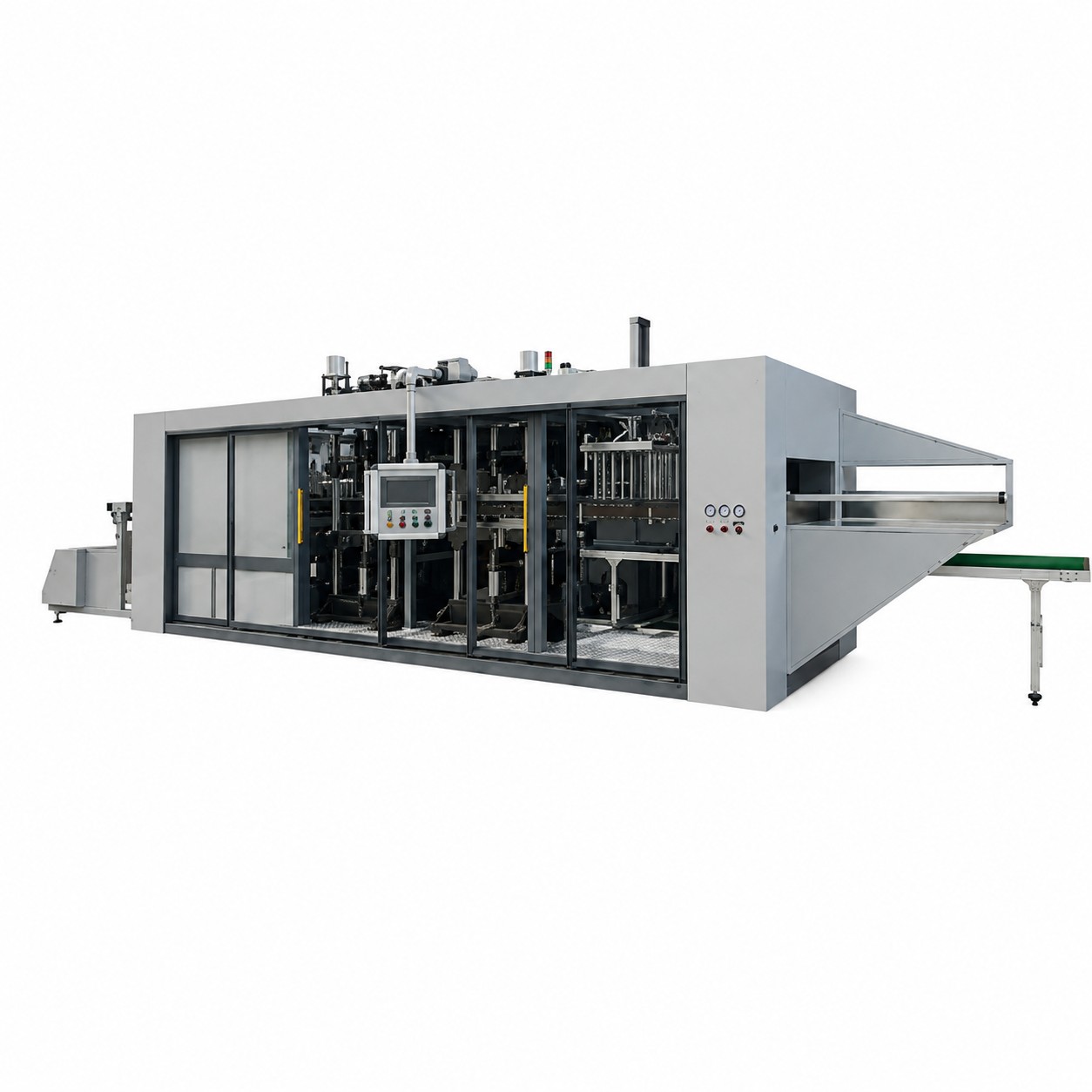
VihoX 710×900 negative pressure 3-station thermoformer for deep, wide parts: 710×900 mm forming area, 150 mm forming depth, 250 mm forming and cutting stroke, 900×710 mm cutting area with knife line approx. 10–15 m, 0.15–2.0 mm sheet, 80 T cutting force, 10–35 cycles/min (reference), 120 kW total power, 25–50 kWh consumption, PP/PS/PET/PVC/OPS/PLA.
The VihoX 710×900 is a negative-pressure 3-station thermoformer: forming, cutting and stacking each occupy their own station on one frame, so the sheet is drawn into the mold under vacuum, blanked by a steel rule die, then stacked.
It is the only vacuum-only model in the VihoX three-station range and the largest and deepest of them — 710 × 900 mm forming area, 150 mm depth, 250 mm stroke. With no pressure box above the sheet, 80 kW of staged upper and lower heating carries the draw, giving a tall wall enough dwell to set before it reaches the 900 × 710 mm die face.
On a single-station machine the mold, die and ejector share one opening, so parts are trimmed hot and cycle time goes into clamping. Separating them lets the forming station travel 250 mm, the cutting station press up to 80 T without loading the mold, and the stacker orient parts for packing. The duties overlap in time, so a cycle ends while the next sheet index enters the heater.
Cups are not this machine’s product: water cups, milk tea cups and yogurt pots belong to the VihoX-660 / 720 / 750 / 850 cup thermoforming machines, where one mold forms and trims the cup. Lids, boxes, trays and blister parts are what this three-station family exists for.
The adjacent envelopes settle most orders, so the table compares nearest neighbours only.
| Position | Model | Forming area | Forming depth | Total power | Weight |
|---|---|---|---|---|---|
| Smallest machine in the family | VihoX 600×400 | 600×400 mm | 100 mm | 30 kW | Approx. 8.5 T |
| Nearest step below this model | VihoX 710×850 | 710×850 mm | 120 mm | 120 kW | Approx. 15 T |
| This model — largest forming area and deepest draw | VihoX 710×900 | 710×900 mm | 150 mm | 120 kW | Approx. 10 T |
It gives 150 mm of draw on a lighter frame than the 710×850, since a vacuum-only forming head is simpler than a pressure box; the 710×850 adds roll capacity instead (Φ700 mm / 500 kg).
Figures below come from the specification sheet, with its qualifiers reproduced rather than smoothed over.
| Machine Type | Negative Pressure 3-Station Thermoformer |
| Working Stations | Forming + Cutting + Stacking |
| Forming Method | Negative-pressure Vacuum Forming |
| Forming Servo | Top + Bottom 5.5 kW |
| Punching Servo | Top + Bottom 7.5 kW |
| Suitable Material | PP / PS / PET / PVC / OPS / PLA |
| Max. Forming Area | 710×900 mm |
| Min. Forming Area | 420×350 mm |
| Max. Cutting Area | 900×710 mm; knife-line length approx. 10–15 m |
| Applicable Sheet Width | 450–760 mm |
| Sheet Thickness | 0.15–2.0 mm |
| Forming Depth | 150 mm |
| Forming / Cutting Stroke | 250 mm |
| Max. Cutting Force | 80 T |
| Production Speed | 10–35 cycles/min (reference) |
| Max. Roll Diameter / Weight | Φ600 mm / 300 kg |
| Air Pressure | 0.7 MPa (7 bar) |
| Air Consumption | Approx. 3.0–3.5 m³/min (reference) |
| Heating Method | Upper & lower staged heating |
| Heating Power | 80 kW (source note: two-stage heating in upper and lower furnaces) |
| Rated / Total Power | 120 kW |
| Actual Power Consumption | 25–50 kWh |
| Cooling Method | Air-cooled chiller |
| Power Supply | AC 380V / 50Hz / 3+N+PE (customizable) |
| Machine Dimension | Approx. L10000×W2400×H2600 mm |
| Machine Weight | Approx. 10 T |
| Typical Applications | Blister trays, food trays, fruit boxes, electronics & hardware packaging |
| Recommended Air Compressor | 20 HP |
| Recommended Chiller | 5–10 HP |
Two limits: the 420 × 350 mm minimum forming area leaves the die face idle on small parts, and a flat thin lid gains nothing here — the 710×520 or 710×610 is the better buy.
Under vacuum alone, hot strength decides how deep a sheet draws before the wall thins.
| Material | Typical parts | Notes for a vacuum-only draw |
|---|---|---|
| PP | Food trays, fruit boxes, hardware trays | Reaches 150 mm once heater zones are balanced across the full width |
| PS | Blister trays, display trays, small boxes | Stiff wall after a moderate draw; most forgiving for a first mold |
| PET | Clear trays and display packaging | Hot enough to avoid haze, cool enough not to thin the stretch |
| PVC | Industrial and specialised trays | Confirm local rules and end use before tooling is ordered |
| OPS | Shrink-resistant food trays and boxes | Its narrow window rewards the staged upper and lower heating fitted here |
| PLA | Plant-based trays and containers | Processes in a tight band; a long even draw suits it better than a fast trim |
Two tools are bought together: the aluminum forming mold that sets the shape and the steel rule die that sets the outline, over a face of up to 900 × 710 mm. Knife-line length, not part count, drives pressing demand, and 80 T is the ceiling.
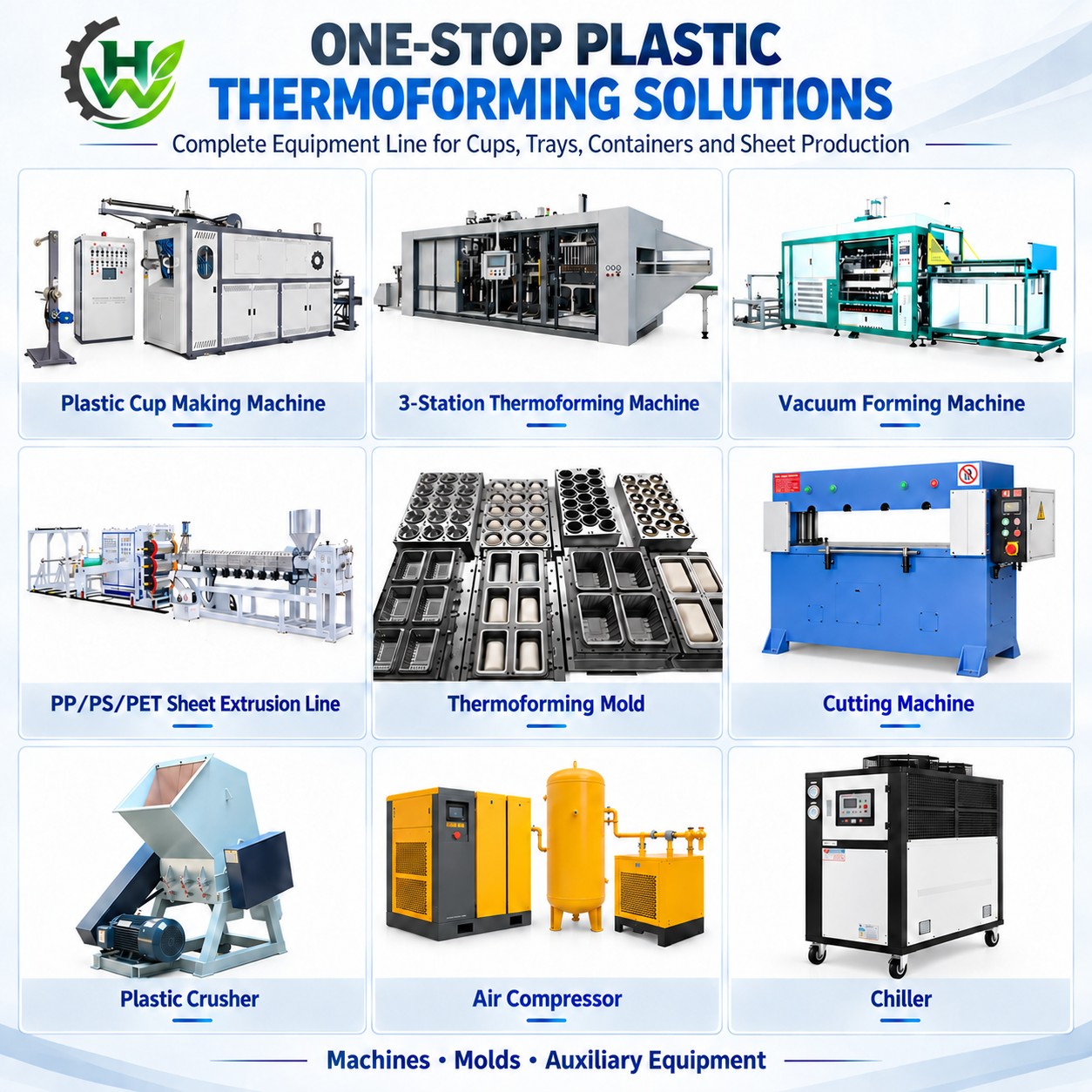
All Three Station Thermoforming Machines shows the rest of the range, molds and cutting dies covers tooling, and auxiliary equipment covers the compressor and chiller package. Plants that would rather make sheet than buy roll should start with the plastic cup production line solution. Installations appear in customer case studies; for background read How to Choose a New Plastic Cup Making Machine and Complete Plastic Cup Production Line Equipment, or look inside our factory.
Each unit is assembled, wired and powered up before dispatch, and the trial is documented: running video, mold trial video on your part, retained samples, drawings, manuals and the spare-parts list. Factory inspection or an independent inspector before the balance payment are also available.
What does “negative pressure” mean here?
The sheet is drawn by vacuum only; no pressure box sits above it, so timing and heating set the draw.
Why is 710×900 the platform for deep trays?
Depth is separated from cutting: at 150 mm a tall wall sets on the mold before it is trimmed.
Can it run OPS and PLA?
Yes, both are listed, and their narrow windows are why heating is staged with zoning.
How does it differ from a cup making machine?
A cup machine forms and trims in one mold; here a separate rule die blanks the part.
How long should my die’s knife line be?
Roughly 10–15 m for this face, matching one long perimeter or a nested layout; knife length sets the 80 T load.
What air supply is needed?
0.7 MPa (7 bar) and about 3.0–3.5 m³/min (reference) from a compressor near 20 HP.
Is it too much machine for shallow lids?
Usually: it earns its cost on depth and area, so a shallow lid suits the 710×520 or 710×610.
What is needed for a quotation?
A part drawing or sample, material and thickness, output per cycle, and your factory voltage and country.
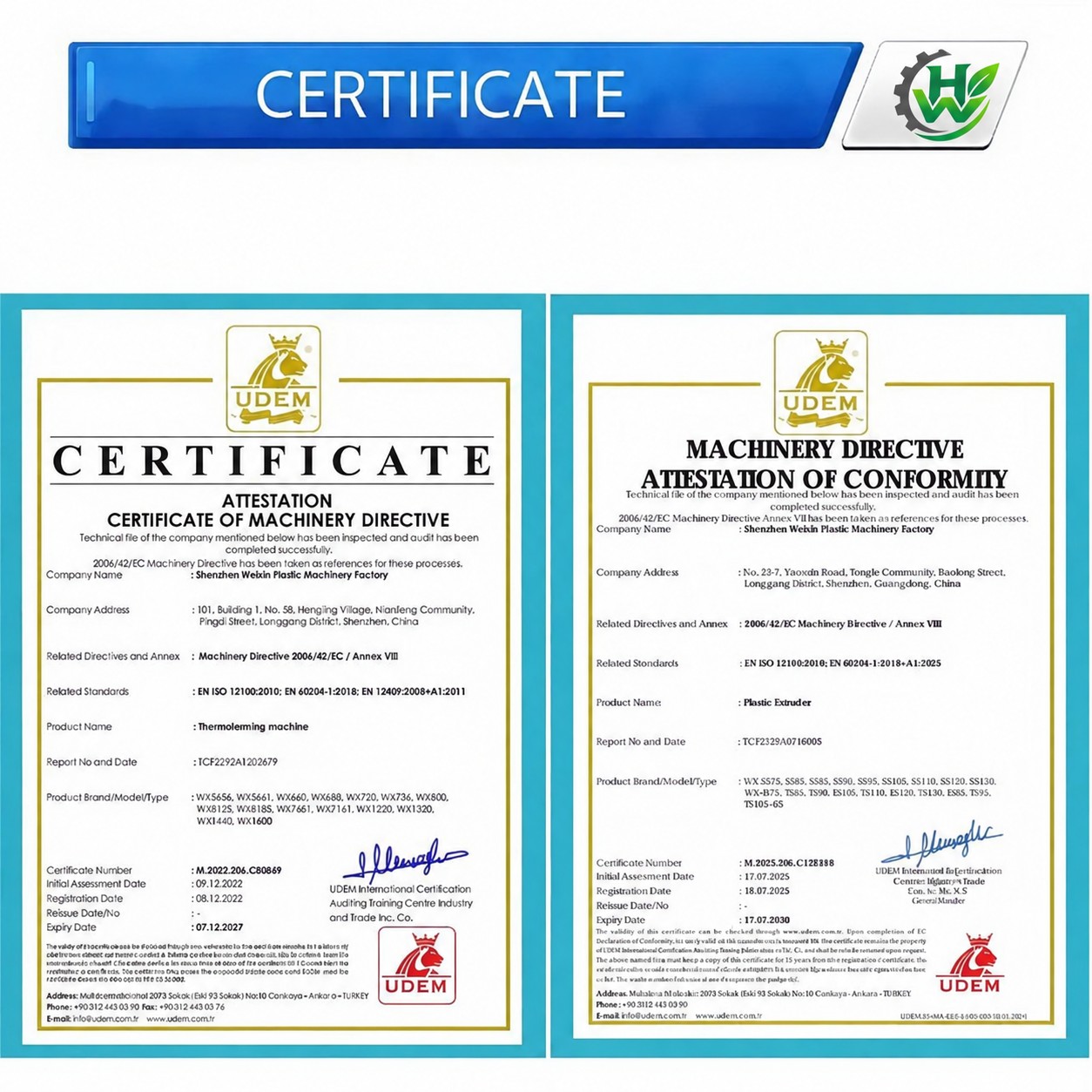
Send the part drawing or sample, the material and gauge, the output you need and your supply details; we will confirm the platform, tooling and auxiliary package. CE documentation available for relevant machines.
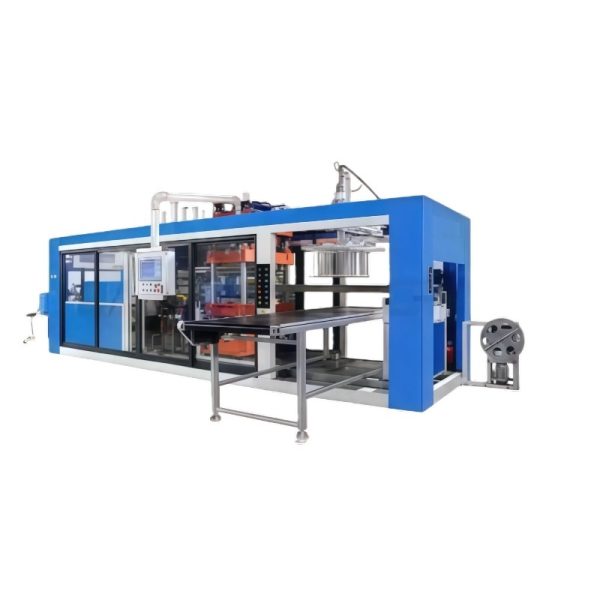
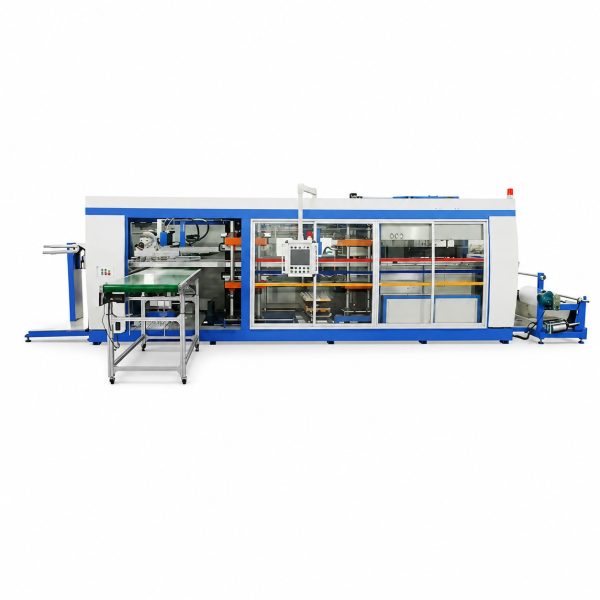
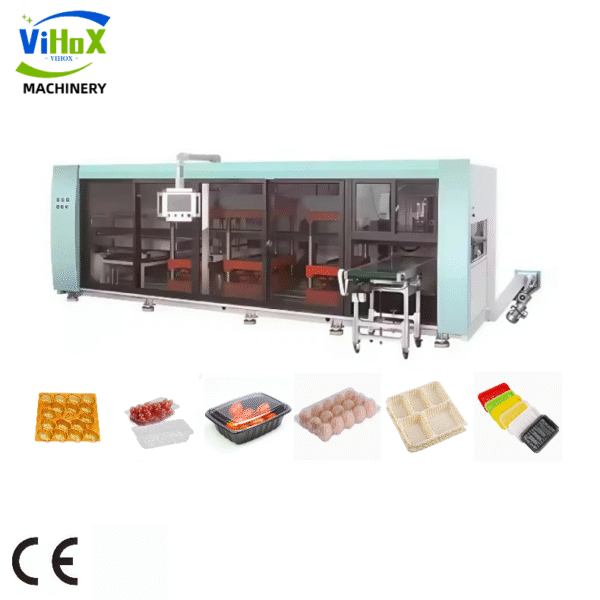
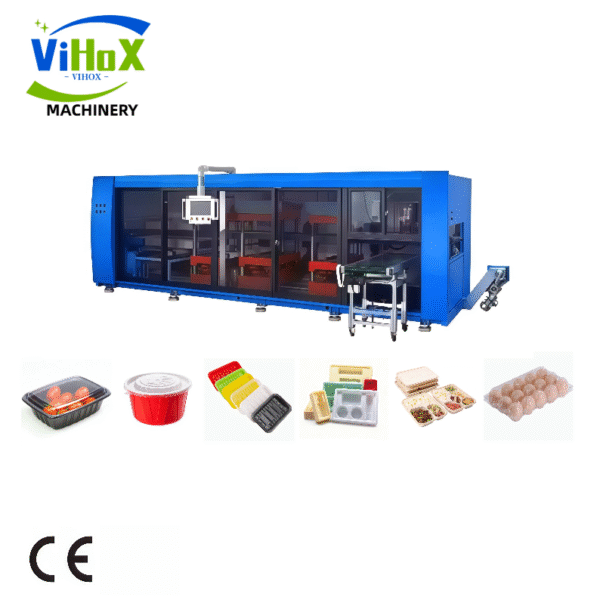
Matched molds and auxiliary equipment — crushers, mixers and recycling units sized to this machine.
See this machine family running in overseas case studies — background, output and on-site photos included.
Request pricing, technical specs or a video machine test — reply within 24 hours.