
Plastic thermoforming machines are essential in the worldwide packaging as well as foodservice sector, which is experiencing a soaring need of disposable cups.
Do you know?
A report by Grand View Research indicates that the disposable cups market will reach USD 17.40 billion globally in 2024 and is expected to rise to USD 22.14 billion in 2030, owing to the influence of quick-service restaurants, takeaway beverages, dairy products, and convenience consumption in the world.
With the growing demand, foreign packaging plants are under pressure to reduce the production size but retain the cost effectiveness, quality control and even regulatory measures.
In this blog, you will find detailed information on the manufacturing processes of plastic cups, the technical features of plastic thermoforming machine, how equipment, molds and auxiliary systems must be paired into a complete production line and why a one-stop solution approach will allow overseas purchasers to avoid risks on integration, manage long-term costs and create a stable and scalable factory operation.
What Is a Plastic Cup Making Machine?
A plastic cup making machine is an industrial machine that is used to produce disposable and semi-disposable plastic products, e.g. cups, bowls, plates, trays, boxes and other thermoplastic containers. These machines are commonly employed in the food packaging and beverage service industry, dairy, and fast-moving consumer goods sectors, where mass production that is highly standardized is critical.
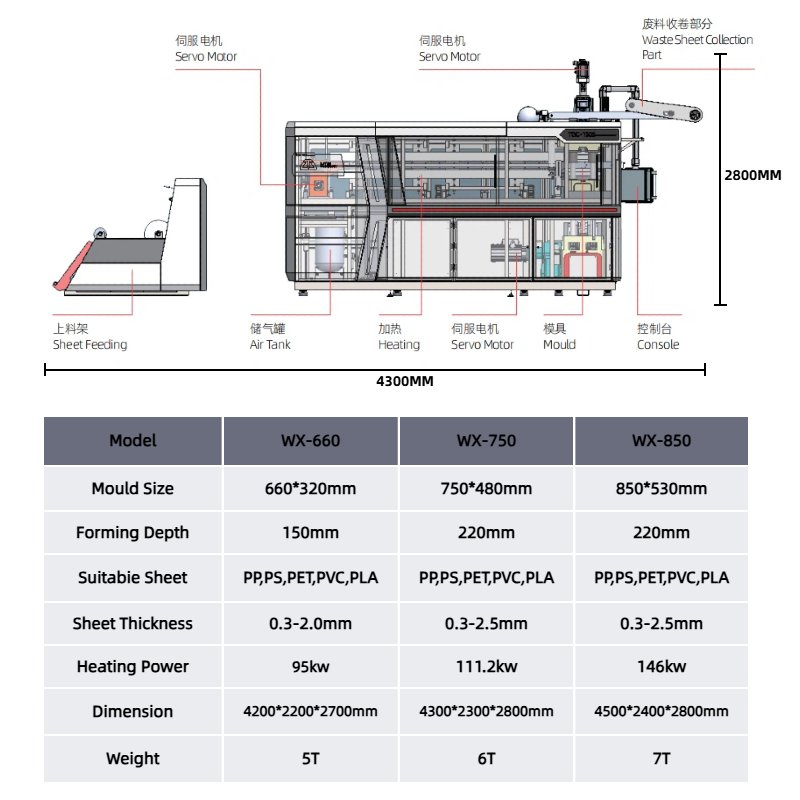
Structurally, a plastic cup making machine normally comprises a machine body, sheet feeding and conveying system, heating unit, forming station, cutting system and finished product stacking mechanism. A combination of these elements allows uninterrupted and automated manufacturing of a plastic sheet to a finished container.
Working Principle of a Plastic Cup Making Machine
A plastic cup making machine works by the thermoforming technology, which involves bending the sheets of plastic, which have been heated, under pressure or vacuum into the required shape of containers. Its process normally consists of a number of basic steps:
Heating and Softening
Plastic sheets are usually fed through the heating zone made of polypropylene (PP), polyethylene (PE), polystyrene (PS), or PET. Heated coils control the temperature of the sheet until it becomes soft and pliable and without interfering with the physical behavior of the material.
Feeding into the Mold
The softened plastic sheet is then placed correctly in the forming mold. A stable, synchronized feeding mechanism is used to provide accurate alignment, which is very important to the uniformity of wall thickness and product quality.
Forming Process
A compressed air pressure, vacuum suction or a combination of both is used to press the softened plastic sheet to adhere to the mold cavity as tightly as possible. The substance assumes the shape of the mold in its exact form, creating cups, bowls or boxes with a certain size.
Cooling and Cutting
The next stage involves cooling of the product to fix its shape. An overcut system is used to remove superfluous amounts to create finished products that are of a standard form. The left over scrap material is normally taken back and reused in the production process, enhancing material efficiency.
Core Equipment Breakdown: What Defines an Effective Machine
The plastic cup machine is not a one-alone machine. It has well-distinguished subsystems that assure stable throughput, quality and automation:
With the knowledge of the working principle of a cup thermoforming machine, manufacturers can maximise its efficiency in production, enhance the quality of products and help establish automated production lines to substitute the manual forms of production as it was previously done.
Heating System Operation in Cup Thermoforming
The heating system is the core of thermoforming process and it directly defines the quality of forming and behavior of materials.
Heating Elements and Zone Heating Strategy
Before molding, thermoplastic sheets need to be heated to an exact temperature of forming. Heating devices that are usually resistive or electric heating tubes- produce thermal energy that is used to soften the plastic substance. Industrial thermoforming machines normally partition the heating area into several autonomous heating sections so that various parts of the sheet could be evenly warmed.
This zone heating plan will also provide even temperature spreads on the sheet surface that is critical in achieving a consistent wall thickness and eliminating flaws in the forming process.
Temperature Control System
The temperature control system keeps a constant check on heating conditions and regulates heating condition throughout the preheating phase. Real-time variations in temperature are sensed and heating is controlled by controllers to maintain the plastic at the optimum temperature to mold without any degradation. Forming stability and material waste are minimized by closely controlling temperature.
Thermoplastic Material Forming Process
The thermoplastic substance once heated, changes to a viscous flowable state out of the solid state, thus making it possible to shape the substance under controlled force.
Material Flow and Mold Guidance
In forming, the softened plastic is guided into the mold cavity at the time of forming by applying pressure and shear forces. The shape and functional needs of the cup are meant to be the shape assumed by the mold. The material is subjected to stretching, vacuum forming, pressure forming, or a combination of both until the material completely fills up the cavity under the direction of the mold.
The behavior of material flow is among the most important properties of cup thermoforming as it has a direct impact on the accuracy of dimensions, surface quality, and the distribution of wall thickness.
Shape Stabilization During Forming
When the plastic is in a flowing state, it has to possess enough mobility to be able to completely fill up the mold without being overly thin or tearing. Forming pressure, temperature and flow of materials can be properly controlled in order to make the cup the predetermined shape and size.
Cooling System Function and Operation
The cooling system plays a vital role in stabilizing the molded product and maintaining production efficiency.
Cooling Medium and Heat Dissipation
Water or air is normally used as a cooling medium in the cooling systems, and it is circulated in the cooling pipes, either around or inside the mold. As the cooling medium passes, it picks up the heat of the molded product and the temperature of the product quickly drops, allowing the plastic to solidify.
Effective cooling prevents deformation, shrinkage, and sticking between the plastic and mold surface, while also improving surface finish.
Cooling Parameter Control
Control of the parameters of cooling such as flow rate, temperature and cooling duration have to be controlled with precision. These variables can be fine-tuned to enable manufacturers to achieve a balance between the cycle time and the quality of the product so that they can ensure that there are consistent results in high-speed production cycles.
Temperature and Time Control During Molding
The crucial elements in the thermoforming process are temperature and time, which directly affect the quality of the products and their repeatability.
Dual Closed-Loop Control System
Thermoforming machines of the modern world take advantage of superior temperature and time dual closed-loop control systems. Heating and cooling temperatures are measured by sensors in real time, and heating elements and cooling media can be changed dynamically to keep the process stable by process controllers.
Cycle Time Management
Time control encompasses the complete molding process which includes the heating time, forming time, cooling time and releasing time. The cup structures are comparatively delicate and complicated; therefore, the time assigned to each phase needs to be assigned with accuracy so that defects are not produced and production remains at a steady rate.
Role of Mold Design and Application
The design of the mold is one of the main factors that determine the appearance of cups, precision and quality of the surface in thermoforming.
Mold Structure and Material Selection
The mold structural design should be able to allow material flow and cavity filling during forming. The choice of mold material has a direct influence on durability, heat transfer efficiency and service life. Correct selection of materials and heat processing increase the strength of molds and wear resistance.
Surface Treatment and Precision
Surface treatment is also a very important factor, particularly with complex cup designs. Surface finishing will also produce high-quality surface finishes that minimize friction, enhance release performance, and increase the life of the mold. Precision machining provides dimensional and consistency of molded products.
Mold Maintenance and Longevity
Mold cleaning, inspection, and maintenance should be regularly implemented so that the defects are avoided, downtime is minimized, and the life of service is prolonged. Adequate care of molds directly leads to a stable level of production and minimal risk of operation.
One-Stop Matching Integration: From Raw Material to Finished Product
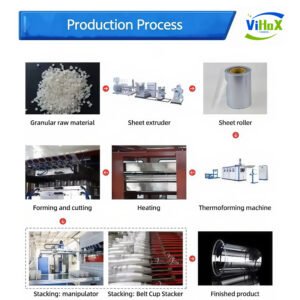
The value of a one-stop system is that integration is precisely to the equipment and process modules, so that a continuous, stable flow of production is secured.
Seamless Equipment Pairing
A typical one-stop line pairs:
- Sheet Extruder calibrated to the forming machine’s throughput capability.
- Thermoformer matched to the mold specifications and production target.
- Trimmer & Stacker Modules synchronized with cycle timing.
This integration eliminates common issues such as mismatched speeds, incompatible mold interfaces, and communication gaps between different vendors’ controls.
Mold & Equipment Compatibility
Risks of performance are reduced by developing a parallel design of molds, with pp cup making machine specifications. Integrated suppliers carry out the process of Mold fitment/cycle performance pre-validation, which ensures quality/uptime. This coordination also entails the finding of the spare parts and also the suggested maintenance intervals.
Capacity Planning & Modular Expansion
One-stop solutions enable buyers to expand capacity by adding modules, be it increasing molding cavities, additional trim stations or automated packaging machines. The outlay planning saves the necessity of making ad hoc purchases on retrofit.
Automated Workflow & Data Integration
Modern systems are provided with centralized PLC/SCADA connectivity, which provides an opportunity to log data, make remote diagnostics, and optimize performance. Such a degree of integration facilitates lean production, predictive maintenance, and traceable quality controls that are essential with regard to compliance in controlled markets.
Main Technical Parameters
These are the key specifications of each machine model, helping you compare performance, size, and power requirements.
| Model | WHX-660 | VHX-720 | VHX-750 | VHX-850 |
| Mould Size (Max.) | 660×320 mm | 720×420 mm | 750×480 mm | 850×530 mm |
| Forming Depth (Max.) | 150 mm | 180 mm | 220 mm | 220 mm |
| Sheet Thickness | 0.3–2.0 mm | 0.3–2.5 mm | 0.3–2.5 mm | 0.3–2.5 mm |
| Forming Speed (Max.) | 29 times/min | 30 times/min | 30 times/min | 30 times/min |
| Air Pressure | 0.7–1.0 mpa | 0.7–1.0 mpa | 0.7–1.0 mpa | 0.7–1.0 mpa |
| Air Consumption | 4200–5000 L/min | 4200–5000 L/min | 4200–5000 L/min | 4200–5000 L/min |
| Water Consumption | 60–70 L/min | 60–70 L/min | 60–70 L/min | 60–70 L/min |
| Sheet Width (Max.) | 690 mm | 720 mm | 750 mm | 850 mm |
| Suitable Sheet | PP, PS, PE, HIPS, PET, PVC, PLA | PP, PS, PE, HIPS, PET, PVC, PLA | PP, PS, PE, HIPS, PET, PVC, PLA | PP, PS, PE, HIPS, PET, PVC, PLA |
| Power Supply | AC380V, 50Hz, Three-phase, Four-wire | AC380V, 50Hz, Three-phase, Four-wire | AC380V, 50Hz, Three-phase, Four-wire | AC380V, 50Hz, Three-phase, Four-wire |
| Rated Power | 7.5 kW | 7.5 kW | 173 kW | 173 kW |
| Heating Power | 111.2 kW | 111.2 kW | 146 kW | 146 kW |
| Dimension (L×W×H) | 4200×2200×2700 mm | 4250×2250×2700 mm | 4300×2300×2800 mm | 4500×2400×2800 mm |
| Weight | About 6 T | About 6.5 T | About 7 T | About 7 T |
Customization and Compliance for Overseas Buyers
The customization is necessary in order to guarantee that a plastic cup and plate making machine is fit to meet the regional requirements, market requirements, and factory requirements.
Custom Engineering for Business Needs
The circumstances of the functioning of every factory are different. Plastic Cup Manufacturing Machine solutions will be customized to include:
- Capacity Requirement: Customized to annual production objectives, cycle time objectives, and floor space limits.
- Modifications to Mold: Individualized cavity numbers, cup dimensions (small beverage cup to large PET models), and customizations (such as textured finishes or logo molds).
- Material Compliance: FDA, EU food-contact Compliance: Machines and molds designed to meet food-contact compliance in other regulatory statements of major export markets.
Customization ensures the production line meets both performance and compliance mandates, reducing regulatory risk for buyers and end-customers alike.
Comprehensive After-Sales Service
A one-stop supplier commits to support that extends beyond delivery:
- Overseas Spare Parts Support: Strategic spare part shipment plans prevent extended downtime.
- Remote Commissioning & Debugging: Expert technicians assist through remote sessions, reducing travel costs and accelerating startup.
- Training & Documentation: Operational manuals, maintenance schedules, and training programs help onsite teams maintain productivity and quality.
- Lifetime Technical Support: Support is provided for all machines, including troubleshooting and process guidance throughout the equipment’s service life.
- Localized Service Support in Southeast Asia: It ensures faster response times and practical on-site coordination.
- Engineer Dispatch Services: These services are available for overseas equipment installation, commissioning, maintenance, and operator training.
Application Fields of Plastic Cup Making Machines
Plastic tea cup making machine, or you can say plastic cup thermoforming machine are used across a wide range of industries due to their flexibility and efficiency.
Disposable Tea Cups and Milk Cups
The popularity of these cups is in beverage stores, catering services, and retail stores, which provide convenience and hygiene to customers.
Jelly Cups
Jelly cups are typical in the food service and FMCG businesses and the precision of forming as well as the appeal is expected to be attractive to satisfy the consumer expectations.
Plastic Flower Pots
Cup making machines produce plastic flower pots, which are widely used in gardening, landscaping, and home décor due to their lightweight, durable, and cost-effective nature.
Fruit Trays and Packaging Containers
The packaging of fruits and fresh produce is in the form of trays, which are better to protect them, facilitate their transportation, and look good on the shelf.
Technological Development Trends in Cup Making Machines
Considering the current trend of constant innovation in packaging technology, plastic cup making machines are changing fast to suit the current production needs.
Increased Production Speed
The new-generation machines are optimally controlled in terms of motion and have increased forming cycles that would greatly enhance the hourly output and the overall production efficiency.
Enhanced Automation
Systems in the modern world combine automated sheet feeding, forming, cutting, stacking, and fault detection, eliminating the use of manual labor and enhancing the stability of the operations.
Improved Product Quality
High-level mold design, accurate temperature regulation, and optimum forming pressure are used to mitigate deformation, enhance surface finish, and reduce scrap rate, which makes products more competitive on the global market.
Building Long-Term Value with the Right Plastic Cup Manufacturing Machine
A plastic thermoforming machine is a long-term industrial investment that directly impacts production efficiency, cost control, and market competitiveness. For overseas factory owners and purchasing managers, a one-stop production line solution reduces integration risk, simplifies procurement, and ensures stable output from raw material to finished cups.
By focusing on complete system engineering, equipment–mold matching, customization, compliance, and global after-sales support, cupmachine1 provides Plastic Cup Manufacturing Machine solutions that help manufacturers build reliable, scalable, and future-ready production lines. Contact us for more details
FAQs
How much does thermoforming plastic cost?
The cost of thermoforming plastic largely depends on the type of plastic you select. On average, you can expect to pay around $35–$45 per sheet. Since thermoforming uses plastic sheets and requires trimming the parts after cooling, you may end up purchasing more material than is actually needed for each individual part.
What is a thermoforming machine used for?
A thermoforming machine is used to heat plastic sheets until they become pliable, then shape them over a mold to create specific forms. Once the plastic cools, it hardens and retains the shape of the mold, producing durable, custom-designed parts or products.
What are the three types of thermoforming?
Thermoforming shapes heated plastic sheets into specific parts using molds. The three main types are vacuum forming (suction pulls the sheet over a mold), pressure forming (air pressure adds detail), and mechanical/twin-sheet forming (force or two sheets create hollow or complex shapes). After forming, parts are cooled and trimmed from the sheet..
What products can be made using a plastic thermoforming machine?
It can produce a wide range of items such as cups, trays, containers, packaging, and plastic flower pots, with shapes and sizes determined by the mold used.