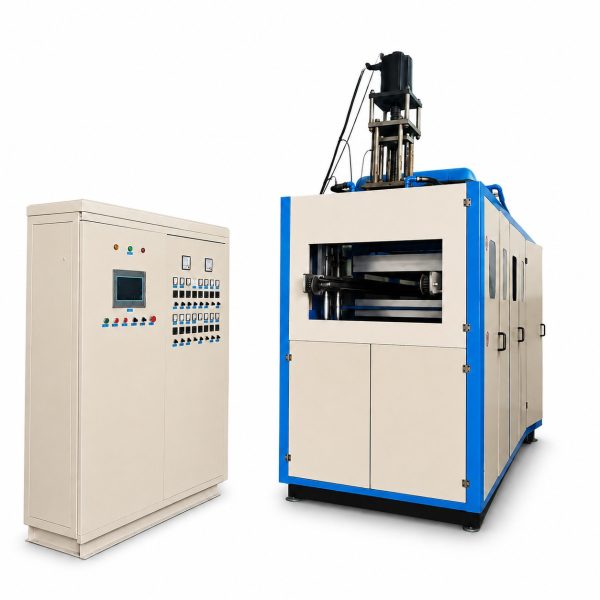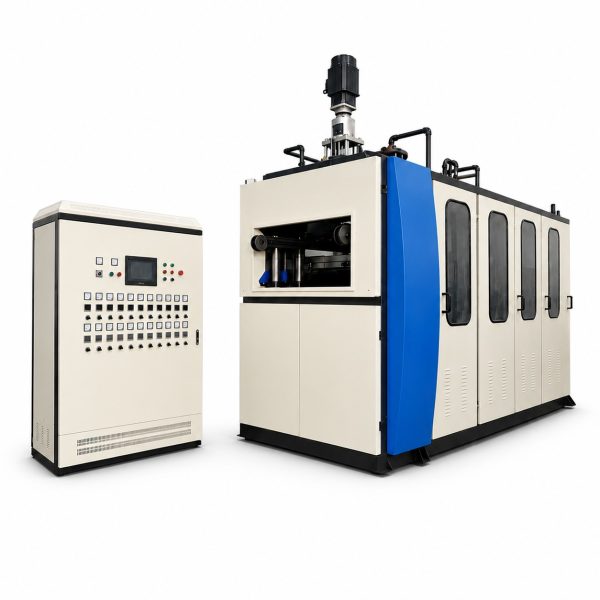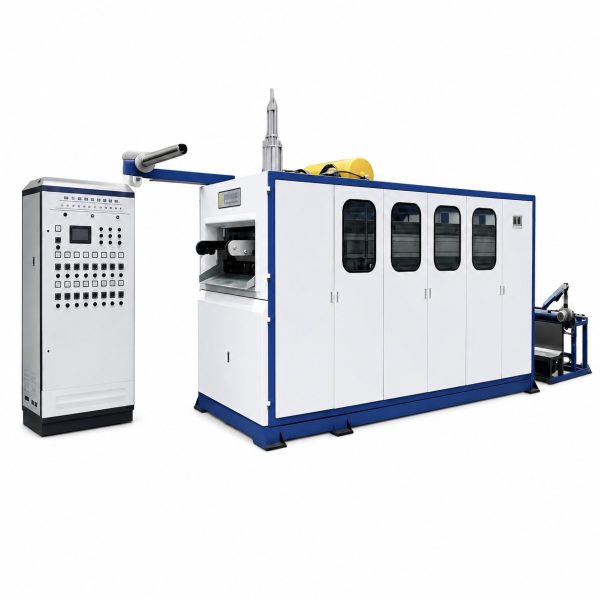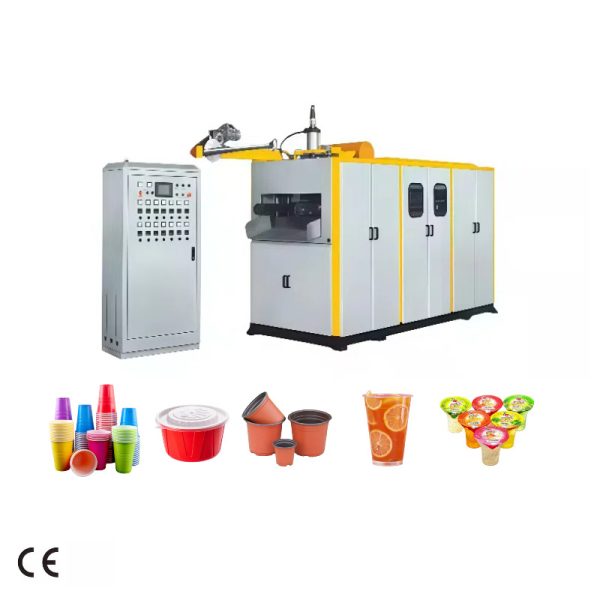
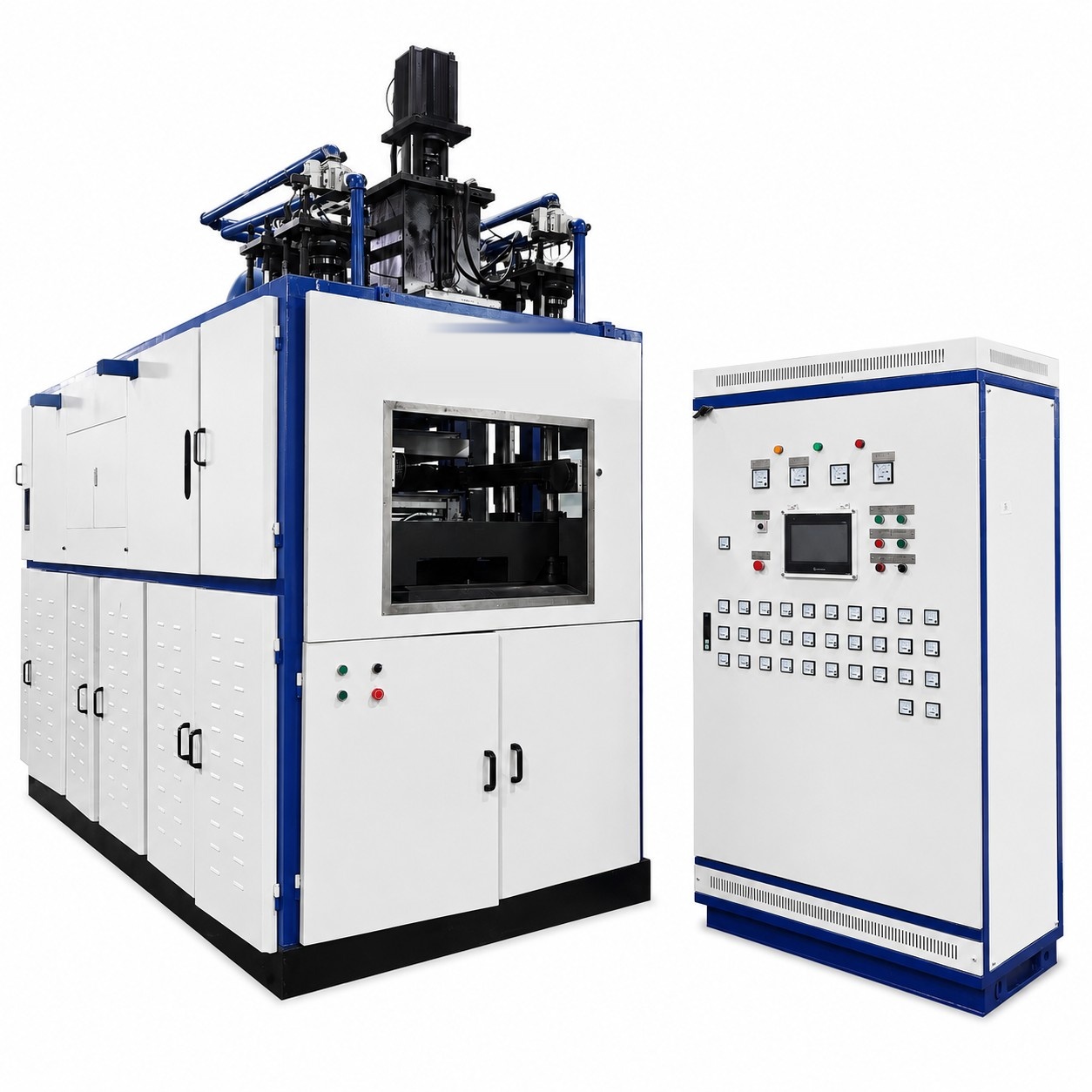
VihoX-850-C full servo automatic cup making machine, 850×560 mm forming area: 11 kW upper stretch servo, 25 kW clamp servo (Inovance), servo sheet feed. 0.3–3.0 mm PP/PS/HIPS/PET/PVC/PLA, 220 mm depth. Total power 190 kW and 45–80 kWh reference, to be confirmed by final servo configuration. Custom mold, test run before shipment.
Product Category: Plastic Cup Making Machines
The VihoX-850-C is a full-servo Type C automatic thermoforming machine on an 850 × 560 mm forming area, with an 11 kW servo stretch axis on the upper mold, a 25 kW clamp servo on the lower mold (servo brand: Inovance / “Huichuan”) and a servo-driven sheet feed. It heats sheet roll and forms each shot under a programmable clamp force.
Two features set it apart: the platen is the largest in the range, serving salad bowls, large-capacity food containers and catering trays; and both mold halves plus the sheet feed sit under servo control, so a forming recipe is stored as a program.
The gap between the three drive architectures shows up sharply on a platform this size, where every stroke moves a heavier mold and a wider sheet.
| Type | Upper mold drive | Lower mold drive | Sheet feeding | Best for |
|---|---|---|---|---|
| A | Cylinder | Hydraulic | Standard | Straightforward volume forming where the part is forgiving and tooling rarely changes |
| B | Servo | Hydraulic | Standard | Good draw control on deep parts; a fixed product mix and occasional mold changes |
| C (this model) | Servo | Servo | Servo | Programmable clamp force, repeatable large-part quality, frequent specification changes |
A 25 kW clamp servo gives an 850 × 560 mm tool the ability to shape the closing-force curve rather than apply one pressure setting to all parts. Force arriving early thins the base wall; force arriving late leaves the rim unfilled. That controlled profile is why several large items can leave one machine to the same standard.
| Machine Type | Type C (Upper Servo + Lower Servo + Servo Sheet Feeding) |
| Forming Area | 850 × 560 mm |
| Upper Stretch Servo Motor Power | 11 kW |
| Clamp Servo Motor Power | 25 kW (servo brand: Inovance) |
| Sheet Feeding Servo Motor Power | To be confirmed |
| Hydraulic Motor Power | N/A on Type C |
| Max. Sheet Width | 880 mm |
| Sheet Thickness | 0.3–3.0 mm |
| Max. Forming Depth | 180 / 220 mm |
| Speed | 15–35 cycles/min (reference) |
| Air Pressure | 0.6–0.8 MPa |
| Air Consumption | Approx. 3.8 m³/min |
| Water Consumption | Approx. 20 L/min |
| Cooling Recommendation | 10 HP Chiller |
| Suitable Material | PP / PS / HIPS / PET / PVC / PLA |
| Power Consumption | 45–80 kWh (reference, to be confirmed by final servo configuration) |
| Total Power (Max.) | 190 kW (to be confirmed by final servo configuration) |
| Power Supply | AC380V / 50Hz / 3 Phase / 4-wire (customizable) |
| Machine Dimension | Approx. L8000 × W2400 × H2800 mm |
| Machine Weight | Approx. 15 T |
| Typical Applications | Salad bowls, large-capacity food containers, catering trays |
Notes on reading the table
The C architecture earns its place when one machine carries a mixed product programme: clamp force, stretch speed and feed length are stored values, so moving from a 220 mm catering tray to a shallow container is a mold change plus a program recall.
Where the 850-C is wrong for you: a plant forming one large item on one mold in a single shift is paying for control it will not use, since the Type B machine makes that part.
| Material | Typical items here | Why servo control matters |
|---|---|---|
| PP | Hot-food bowls, takeaway containers, catered meal trays | Wide forming window; a controlled clamp keeps wall distribution steady when cycle times change |
| PS | Display bowls, cold-food trays | Fast-setting material, so clamp timing shows up directly in rim definition |
| HIPS | Rigid opaque bowls, meal-prep containers | Stiff sheet resists the draw; a programmed force ramp reduces corner tearing |
| PET | Clear salad bowls, transparent catering ware | Transparency exposes any uneven draw, so repeatable clamping counts most |
| PVC | Special and industrial large containers | Confirm local regulation and market acceptance before tooling is cut |
| PLA | Compostable bowls and catering trays | Narrow window; a stored recipe makes trial settings reproducible in production |
Sheet roll → servo sheet feed → oven heating → servo stretch and servo clamp forming → cutting / separation → stacking → counting and packing
An 880 mm sheet of up to 3.0 mm has to reach an even temperature, then be closed on by a clamp whose force is modulated while a separate servo drives the stretch. Coordinating those axes is the point of the C architecture, and the reason the frame weighs 15 T.
Tooling for the 850 × 560 mm platen is designed per project, and servo axes give mold designers more room: the force profile is tuned to the tool instead of the tool being built around a fixed clamp pressure.
With 220 mm of depth, a bowl once split into two shallower parts can often be formed in one draw, and three or four well-spaced cavities still beat a crowded layout.
Plan a 10 HP chiller for the platen load, a compressor sized to real air duty, and denesting suited to deep parts. Servo machines also reward a stable supply and correct earthing.
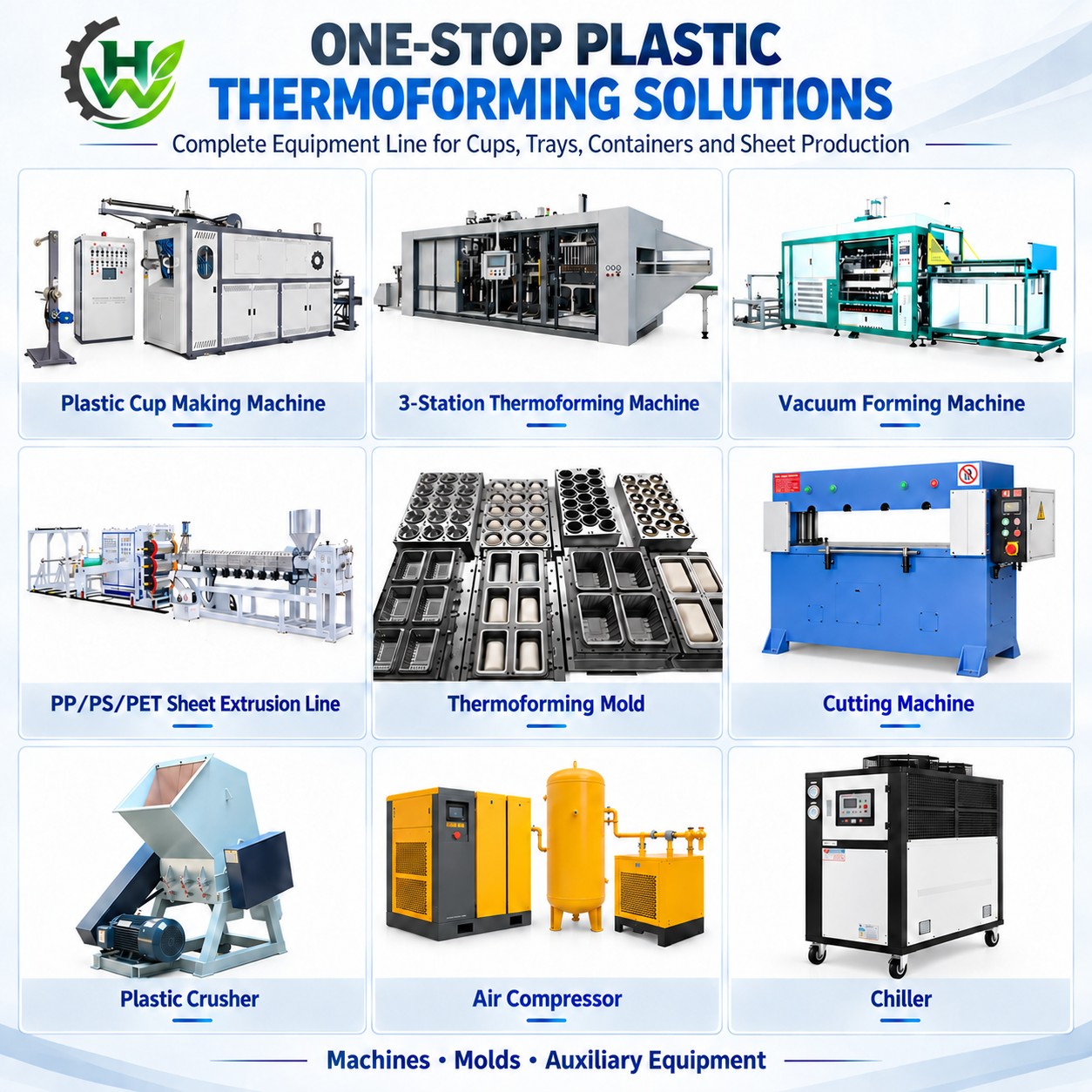
A forming line for bowls and large containers combines sheet extrusion, molds, cooling, air supply, denesting, packing and trim handling. Producers wanting their own sheet specification usually add extrusion.
See our guide to choosing a new plastic cup making machine, the equipment list for a complete plastic cup production line, and the production line solution overview. Molds are catalogued under molds, auxiliary units under auxiliary equipment, and field installations under overseas case studies.
A Type C machine is commissioned and run in our works before packing, with the servo axes tuned and the mold fitted. The handover record includes running footage, forming trials on the actual product, sample parts, cabinet photography and schematics.
What is the sheet-feeding servo motor power on the VihoX-850-C?
It is listed as to be confirmed, and is specified with the rest of the servo package.
Why is the total power marked “to be confirmed by final servo configuration”?
Because the motor set is agreed per project; 190 kW describes the completed configuration.
What does a 25 kW clamp servo change compared with a hydraulic clamp?
It replaces a fixed pressure with a controllable force profile — ramped, held and eased off as the sheet draws. The clamp servo is Inovance (Huichuan).
Can one machine really run both 220 mm bowls and shallow trays?
Yes, within the 850 × 560 mm area and the 180 / 220 mm depth range; settings live in the servo recipe.
At what point is the 850-C worth more than the 850-B?
When molds change often, when several large items must hold one standard, or when production runs continuously.
What output should I plan for?
Plan from your mold, not the cycle reference: theoretical pieces per hour = actual cycles per minute × cavities × 60.
Is sheet roll the only input?
Yes — PP, PS, HIPS, PET, PVC or PLA sheet between 0.3 and 3.0 mm, up to 880 mm wide.
What do you need to size the servo package correctly?
The part with dimensions and depth, material and thickness, number of products, changeover frequency, target output, plant voltage and country.
Tell us what you intend to form, how often the mold will change, and how many hours the machine will run. Those answers decide whether the full-servo platform is justified, or whether Type B is the more sensible purchase.
Matched molds and auxiliary equipment — crushers, mixers and recycling units sized to this machine.
See this machine family running in overseas case studies — background, output and on-site photos included.
Request pricing, technical specs or a video machine test — reply within 24 hours.