
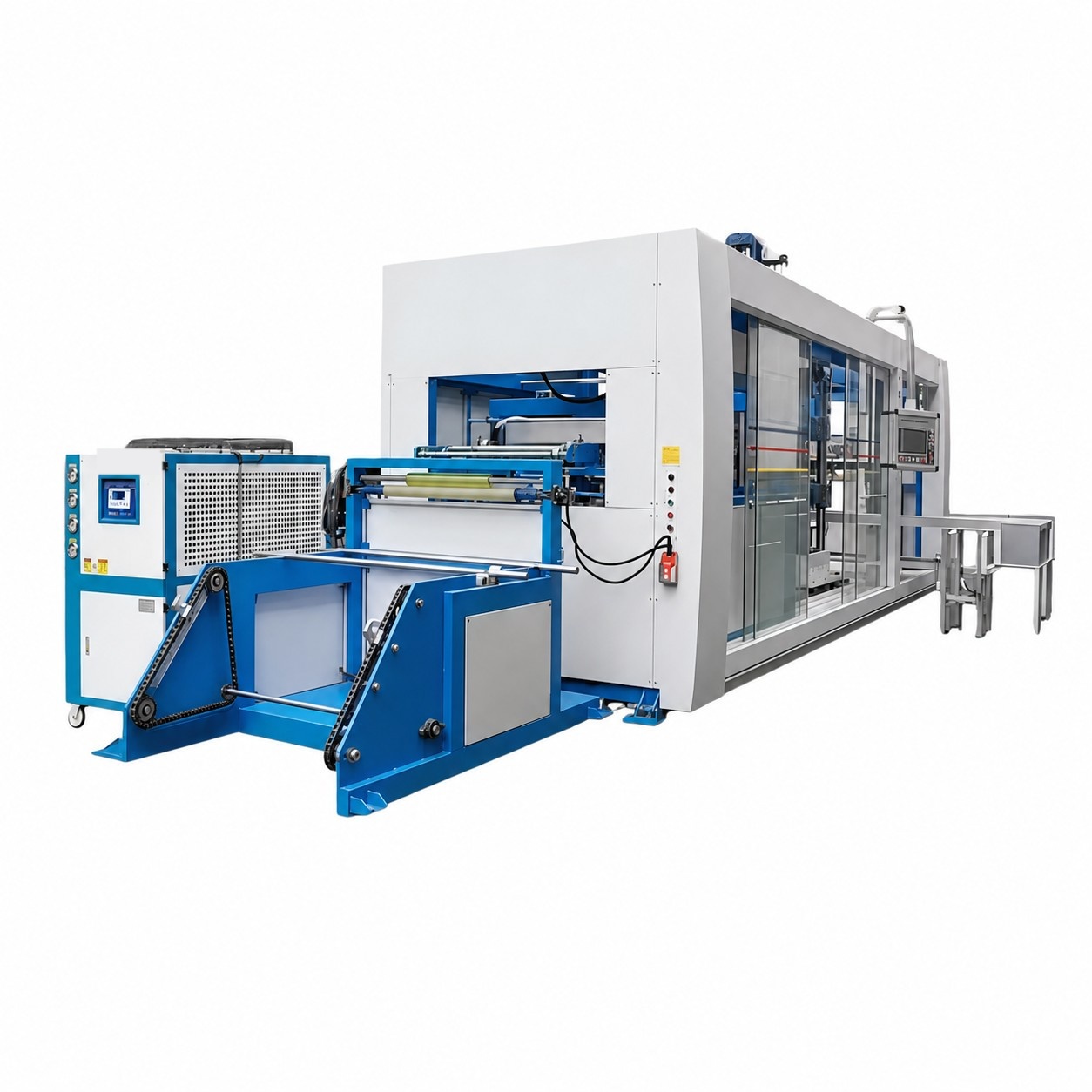
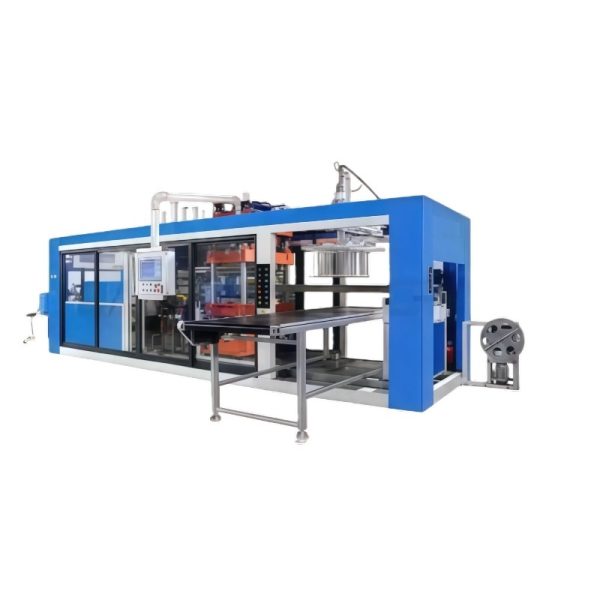
VihoX 710×520 positive & negative pressure 3-station thermoformer for cup lids and shallow boxes: 710×520 mm forming, 690×500 mm cutting, 0.15–2.2 mm sheet, 120 mm depth, 80 T, PP/PS/PET/PVC/PLA, up to 15–35 cycles/min (reference). Matched mold and cutting die quoted with the machine.
The VihoX 710×520 is a positive-and-negative-pressure three-station thermoformer: forming, cutting and stacking run at three consecutive stations on one frame. Cup lids, shallow boxes and small trays are drawn by air pressure against vacuum, trimmed by an independent steel-rule die, and stacked without leaving the line.
It is the entry step of the 710 mm platform, built for wide-but-flat work in sheet from 0.15 to 2.2 mm. If every part you make is a drinking cup, the right machine is a cup making machine, whose mold cuts each cup free inside the tool; this family exists for lidded, boxed and tray-shaped products. And if the product is a shallow lid alone, moving up to the 710×610 or 710×850 buys capacity you will not use.
A single-station press draws the part and releases it in one stroke, so the forming cavity sits inside the die’s shadow and both duties suffer. Split the work and each station specialises: forming owns draw quality, the cutting station presses a steel-rule die through the cooled web with up to 80 T, and the stacker builds a level pile at the press’s pace.
The cut here is deliberately tighter than the draw — 690×500 mm against a 710×520 mm forming area. The blade frame needs travel clearance, so plan cavities inside the cutting figure. Because the die is separate from the mold, a new lid contour usually means a new die rather than a new forming tool.
Only the two neighbouring steps are shown, since those are the realistic alternatives.
| Model | Max. Forming Area | Forming Depth | Rated / Total Power | Machine Weight |
|---|---|---|---|---|
| VihoX 600×400 (small-format step) | 600×400 mm | 100 mm | 30 kW | Approx. 8.5 T |
| VihoX 710×520 (this model) | 710×520 mm | 120 mm | 120 kW | Approx. 10 T |
| VihoX 710×610 (full-footprint cutting) | 710×610 mm | 120 mm | 120 kW | Approx. 12 T |
| Machine Type | Positive & Negative Pressure 3-Station Thermoformer |
| Working Stations | Forming + Cutting + Stacking |
| Forming Method | Positive + Negative Pressure |
| Forming Servo | Top + Bottom 5.5 kW |
| Punching Servo | Top + Bottom 7.5 kW |
| Suitable Material | PP / PS / PET / PVC / PLA |
| Max. Forming Area | 710×520 mm |
| Min. Forming Area | 420×350 mm |
| Max. Cutting Area | 690×500 mm; knife-line length approx. 10–15 m |
| Applicable Sheet Width | 450–760 mm |
| Sheet Thickness | 0.15–2.2 mm |
| Forming Depth | 120 mm |
| Forming / Cutting Stroke | 150 mm |
| Max. Cutting Force | 80 T |
| Production Speed | Max. 15–35 cycles/min |
| Max. Roll Diameter / Weight | Φ600 mm / 300 kg |
| Air Pressure | 0.6–0.8 MPa |
| Air Consumption | Approx. 3.0–3.5 m³/min (reference) |
| Heating Method | Upper & lower 3-section heating |
| Heating Power | 80 kW (source note: two-stage heating in upper and lower furnaces) |
| Rated / Total Power | 120 kW |
| Actual Power Consumption | Approx. 30–50 kWh |
| Cooling Method | Air-cooled chiller |
| Power Supply | AC 380V / 50Hz / 3+N+PE (customizable) |
| Machine Dimension | Approx. L9000–10000×W2300×H2500 mm |
| Machine Weight | Approx. 10 T |
| Typical Applications | Lunch boxes, lids, fruit boxes, trays and food containers |
| Recommended Air Compressor | 20 HP |
| Recommended Chiller | 10 HP |
Cup lids explain the unusual cutting figure: a lid is a shallow shell with a precise rim, and the rim decides whether it seats on a cup or jams a sealing head. Because the die cuts on its own station with the web cooled, rim geometry comes from the die, not from the draw.
When the product becomes a proper box, the sheet usually passes 2.2 mm and the outline wants the whole bed rather than the 690×500 mm cut. That is the moment to move to the 710×610.
Five polymers are supported; here the question is how the rim behaves after cooling.
| Material | Typical parts on this bed | Notes |
|---|---|---|
| PP | Lunch box bases, lids, food trays | Forgiving draw; the usual first choice for lidded boxes |
| PS | General lids, dessert and fruit boxes | Crisp rims and fast cycles; a good pairing with steel-rule dies |
| PET | Clear lids, transparent trays | Clarity is the specification; keep the draw gentle to avoid haze |
| PVC | Industrial and specialised flat parts | Check the application and local rules before committing |
| PLA | Plant-based lids and trays | Narrow window; a stable 3-section furnace profile matters most here |
Tooling comes as a pair, and the die deserves as much attention as the mold. The 10–15 m knife-line figure is the total blade length a die can carry — a nested lid layout runs long, a simple tray outline runs short. Longer blade lines need more force to break the web and wear faster, so a die that sits comfortably inside 80 T outlasts one at the limit. Design both tools together: the mold fixes where the part sits in the web, the die fixes the trim left behind.
A 20 HP compressor covers the 0.6–0.8 MPa supply, sized against the approximate 3.0–3.5 m³/min figure above — a reference value, so leave headroom for other air users. An air-cooled chiller in the 10 HP class steadies the cutting station through long lid campaigns, and rolls to Φ600 mm and 300 kg fit the standard unwind.
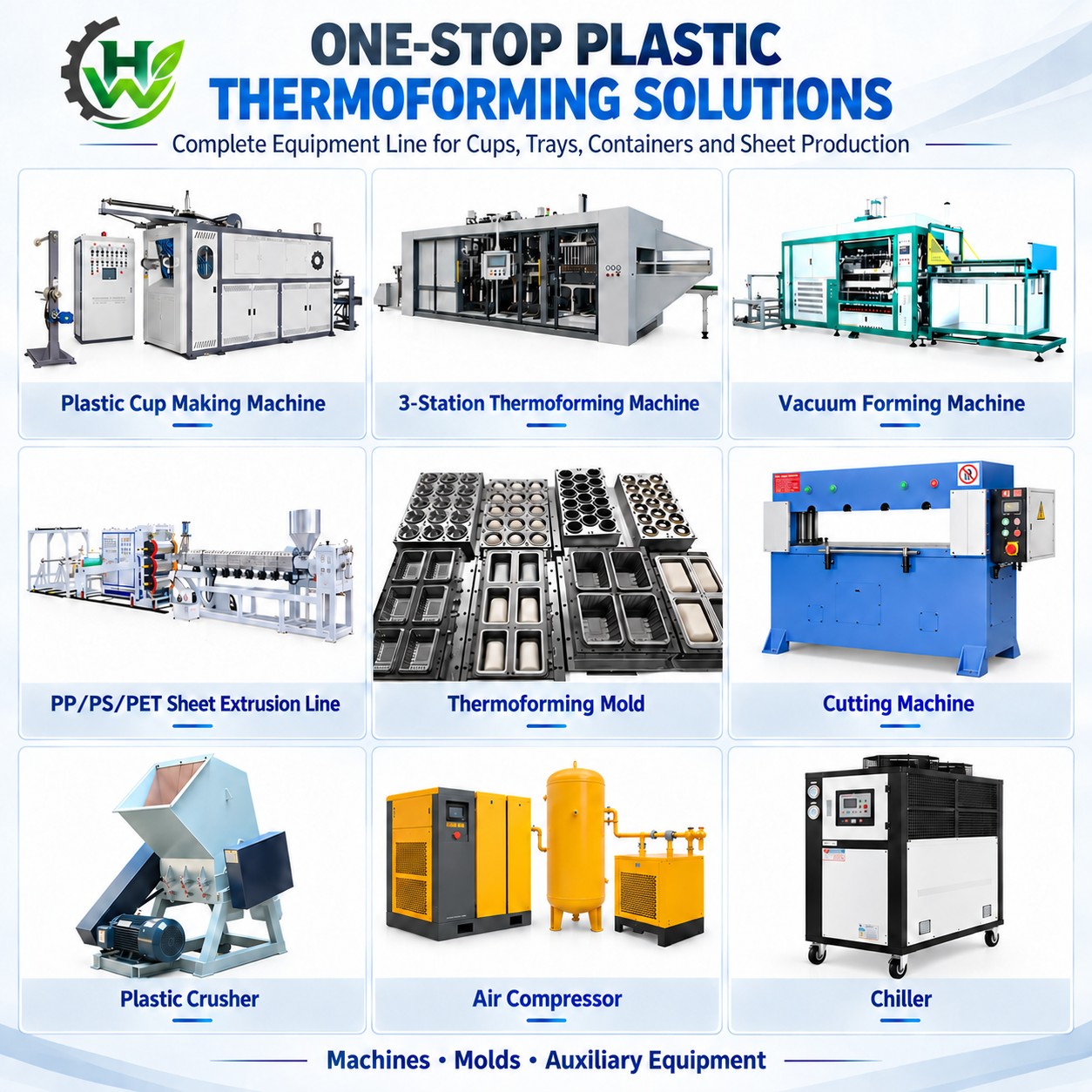
Feeding, drying, cooling, air supply, stacking and scrap recovery all sit around the press, and where you buy sheet decides whether an extrusion line belongs in the project. Useful pages: the three-station thermoforming machine range · cup making machines, for cup-only production · auxiliary equipment · how a full forming line is laid out · customer case studies · inside our factory.
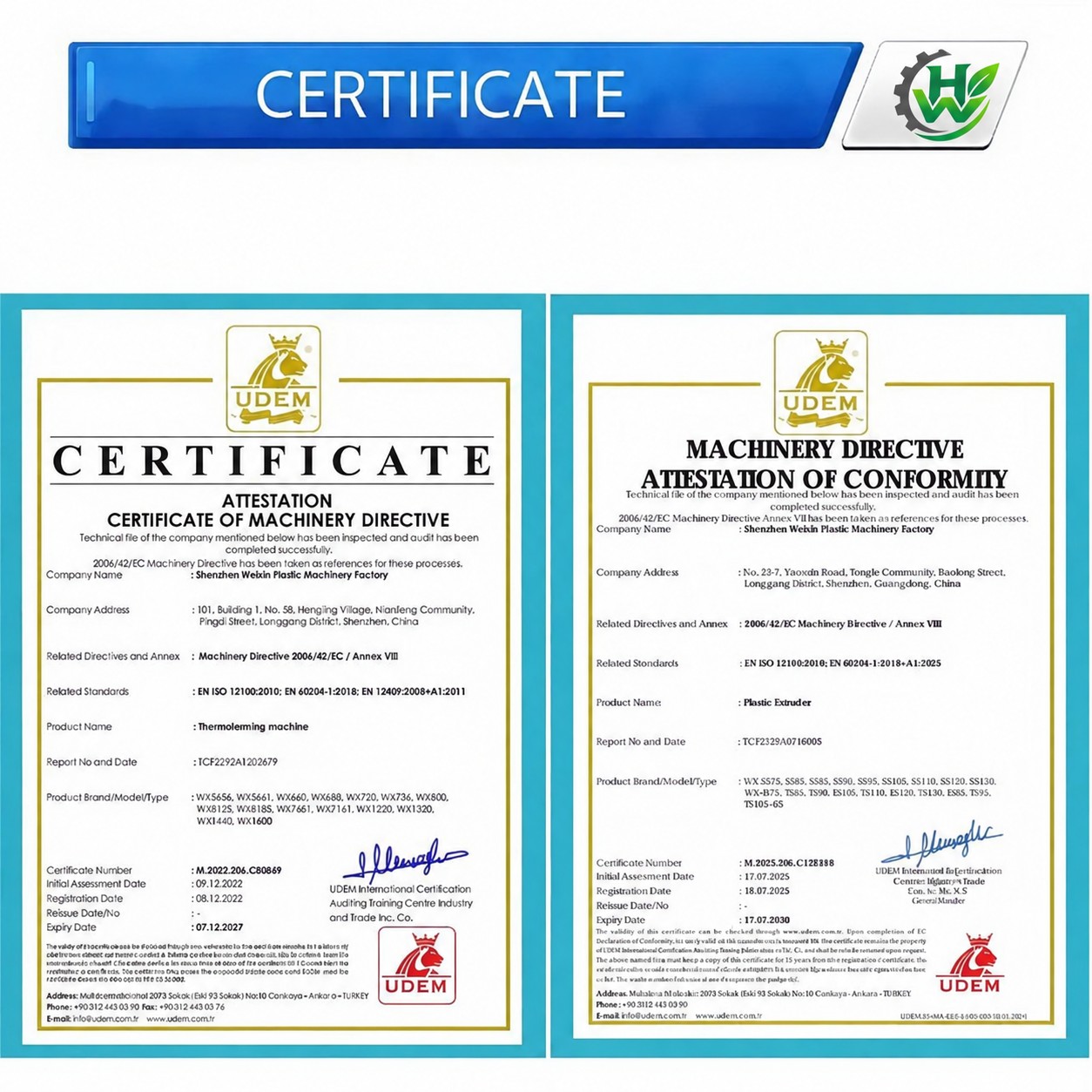
Every machine is assembled, wired and run under power before packing, and the trial is recorded: running video, a mold trial, samples, cabinet photographs, drawings, manuals and the spare-parts list. For a lid tool the trial should confirm a clean rim cut and a level stack at your fastest intended cycle. Inspect on site, watch the trial live by video, or appoint your own inspector before settling the balance.
Is this a cup making machine?
No. If your product list is drinking cups only, a cup making machine is the cheaper and correct answer, because its mold cuts each cup loose inside the tool. This machine serves lids, boxes and trays.
Why is the cutting area (690×500 mm) smaller than the forming area (710×520 mm)?
The blade frame has to travel and clear the web, so the useful cut sits inside the draw. Lay out lid outlines and cavities to the cutting figure. If your part really needs the whole 710×520 mm cut, step up to the 710×610, which cuts at full footprint.
What is the maximum sheet thickness, and what happens above it?
0.15–2.2 mm. Above 2.2 mm the 710×610 and 710×850 are rated to 2.5 mm and are the right starting point; forcing thicker sheet through a lid tool is how rim distortion and die wear begin.
When is the 710×610 worth the extra weight?
When the product is a real box rather than a lid: a full lunch container or a wide salad box wants the full-footprint die only the larger bed provides. For shallow lids the 710×520 already covers it, and the extra 2 T buys nothing.
How do I calculate realistic output?
Take actual cycles per minute, multiply by cavities and by 60, then cut the total for changeover, lid-release faults, stacker interruptions and scrap. Cavity count moves output far more than a small change in cycle time.
Can the machine run PET and PLA as well as PP and PS?
Yes, together with PVC. PET lids reward a gentler draw because clarity is easily lost to haze, and PLA has the narrowest window of the five, which is where the 3-section upper and lower furnace earns its keep.
What air supply does this machine need?
0.6–0.8 MPa at roughly 3.0–3.5 m³/min as a reference. A 20 HP compressor is recommended, and it should carry spare capacity if other machines share the receiver.
What do you need from me to prepare a quotation?
Send the part drawing or sample with outline dimensions, depth, material and sheet thickness, your target output, shift pattern, factory voltage and country — and say whether you want the press only or a whole line with tooling and auxiliaries.
Send us the lid or box you intend to produce, the material and thickness you plan to buy, your target output and your factory voltage. Our engineers will confirm whether the VihoX 710×520 is the right step of the 710 mm platform, and quote the matched forming mold, cutting die and auxiliary package with it.
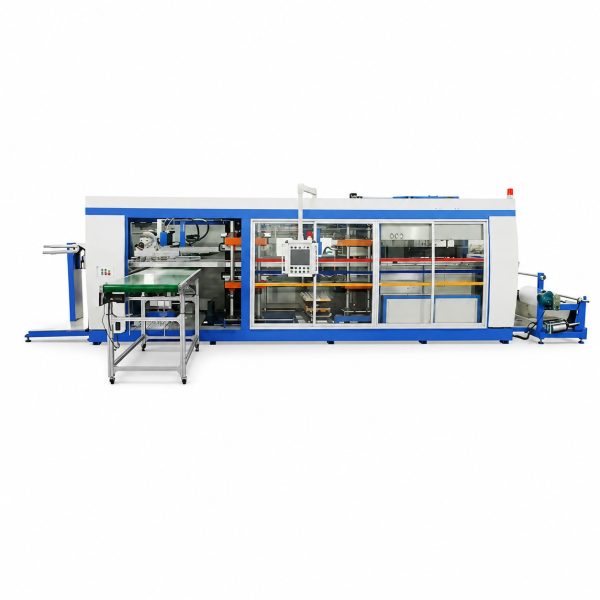
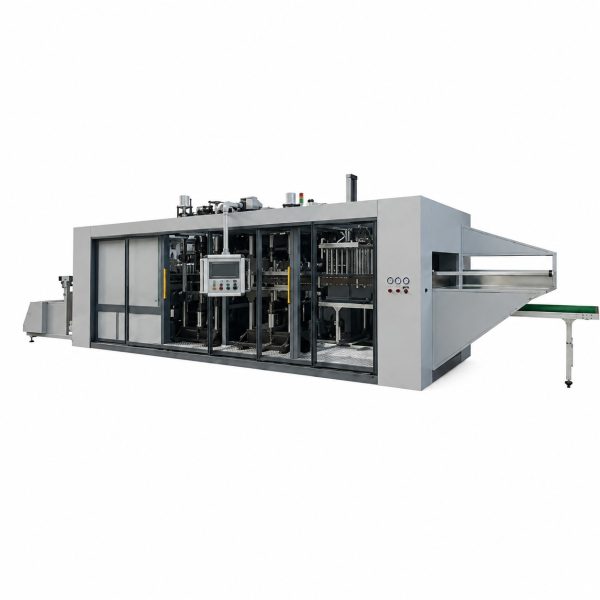
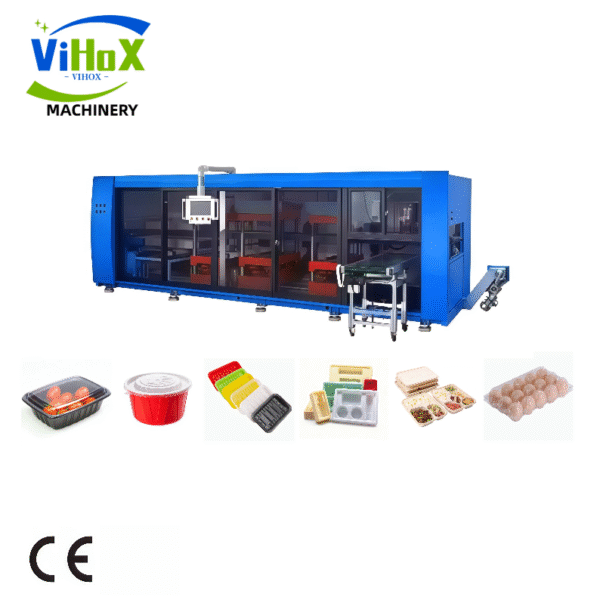
Matched molds and auxiliary equipment — crushers, mixers and recycling units sized to this machine.
See this machine family running in overseas case studies — background, output and on-site photos included.
Request pricing, technical specs or a video machine test — reply within 24 hours.