
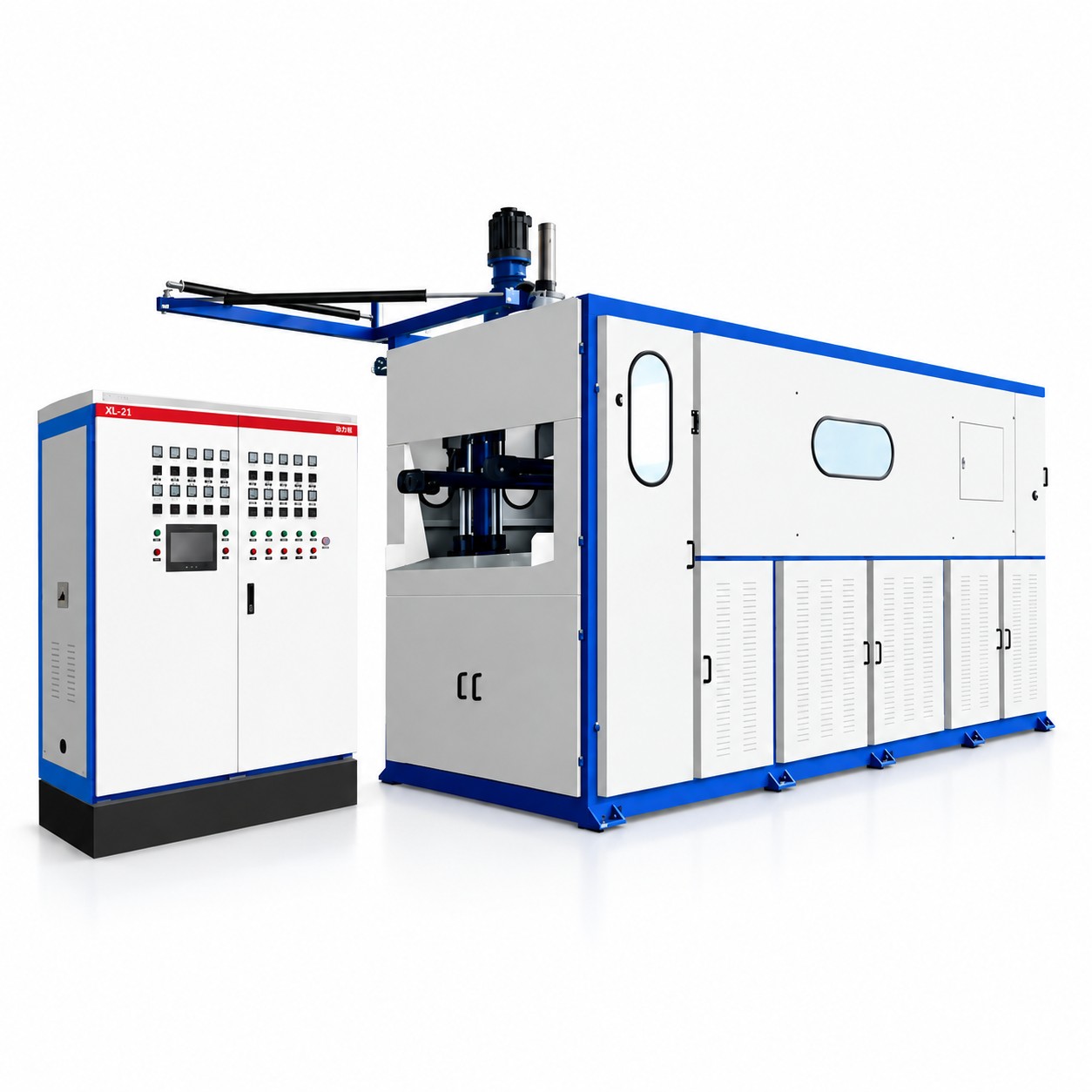
VihoX-750-B Type B automatic plastic cup thermoforming machine: 750×520/750×560 mm forming area, 11 kW upper stretching servo, 18.5 kW hydraulic clamp, 0.3–3.0 mm sheet, 180/220 mm depth, PP/PS/HIPS/PET/PVC/PLA, up to 15–35 cycles/min (reference), 165 kW max power. Factory tested before shipment.
Product Category: Plastic Cup Making Machines
The VihoX-750-B is a Type B automatic plastic cup thermoforming machine with a 750 × 520 / 750 × 560 mm forming platform, an 11 kW servo upper stretching axis and an 18.5 kW hydraulic lower clamp, forming sheet from 0.3 mm to 3.0 mm in one continuous cycle.
It exists for heavy-gauge, deep-draw work: once the draw reaches 180 or 220 mm, stretching decides whether a cup keeps its wall thickness or tears at the base corner. The 750-B therefore suits factories running one settled thick-wall product for months.
Three drive layouts share this platform; what changes is which mold motions and which sheet-feed movement run under servo control.
| Type | Upper mold drive | Lower mold drive | Sheet feeding | Best for |
|---|---|---|---|---|
| A | Cylinder | Hydraulic | Standard | Budget-led projects with a settled, undemanding product |
| B (this model) | Servo (stretch axis) | Hydraulic | Standard | Thick or deep products where wall distribution has to hold |
| C | Servo | Servo (clamping) | Servo | Long uninterrupted runs that need identical cycles hour after hour |
Type B is a deliberate middle position. On a deep cavity the material moves mainly along the stretching axis, so that is the axis worth controlling in closed loop, while an 18.5 kW hydraulic unit seals the lower mold repeatably without servo cost.
Two buyers should look elsewhere: if your deepest product is a 150 mm cup in 2.0 mm sheet, the lighter VihoX-720-B or VihoX-660-B already covers it; if whole-line servo consistency and energy behaviour outrank budget, evaluate the VihoX-750-C. Where the range is fixed and budget leads, the hydraulic VihoX-750-A gives the same forming area for less.
| Machine Type | Type B (Upper Servo + Lower Hydraulic) |
| Forming Area | 750 × 520 / 750 × 560 mm |
| Hydraulic Motor Power | 18.5 kW |
| Upper Stretching Servo Motor Power | 11 kW |
| Max. Sheet Width | 780 mm |
| Sheet Thickness | 0.3–3.0 mm |
| Max. Forming Depth | 180 / 220 mm |
| Speed | 15–35 cycles/min (reference) |
| Air Pressure | 0.6–0.8 MPa |
| Air Consumption | Approx. 3.8 m³/min |
| Water Consumption | Approx. 20 L/min |
| Cooling Recommendation | 5–10 HP Chiller |
| Suitable Material | PP / PS / HIPS / PET / PVC / PLA |
| Power Consumption | 40–80 kWh (reference) |
| Total Power (Max.) | 165 kW |
| Power Supply | AC380V / 50Hz / 3 Phase / 4-wire (customizable) |
| Machine Dimension | Approx. L7400 × W2300 × H2700 mm |
| Machine Weight | Approx. 12 T |
| Typical Applications | Water cups, milk tea cups, beverage cups, food containers, bowls, etc. |
How to read these figures
Mold design sets the real ceiling, not the frame. A small shallow cup makes this platform oversized — the 660 or 720 family runs it with a lighter mold and less floor space. Draws beyond 220 mm, or sheet above 3.0 mm, fall outside this specification and need an engineering discussion first.
Behaviour diverges as thickness rises, so fix the material before the mold is cut.
| Material | Typical cups | Notes |
|---|---|---|
| PP | Thick beverage cups, hot-drink cups, food containers | Tough and heat resistant; draws predictably across the thickness range |
| PS | General food and dessert cups | Consistent forming behaviour and clean release |
| HIPS | Opaque thick-wall cups, bowls, containers | Holds stiffness at higher thickness; suits solid-colour finishes |
| PET | Clear cold-drink cups, transparent containers | High clarity; needs tighter temperature control on heavy sheet |
| PVC | Industrial and specialised parts | Confirm local market rules and end use before selection |
| PLA | Plant-based cups and containers | Narrow window; drying and heat profile must be proven by trial |
Sheet roll → feeding → heating → servo stretching and forming → cutting → stacking → counting and packing
The stretching stage carries the quality load. Because the upper axis is servo-driven, the plug follows a programmed profile: slow approach, fast draw through the mid-wall, then hold while the part cools against the mold. That keeps wall thickness even from rim to base and release dependable on a deep cavity. Cutting and stacking must keep pace, since a jammed stacker hides good forming.
Molds are built to your cup drawing, with vacuum and cooling channels arranged around the sheet thickness you actually run. On 2–3 mm sheet a dense cavity layout still has to heat evenly and release cleanly, and a plate that runs every shift beats one needing constant attention.
Typical matching equipment: a 5–10 HP chiller, a compressor sized against approximately 3.8 m³/min air consumption, cooling water near 20 L/min, and stacking, counting and packing units suited to your automation level. Thick sheet yields more reclaimable offcut, so plan trim handling early.
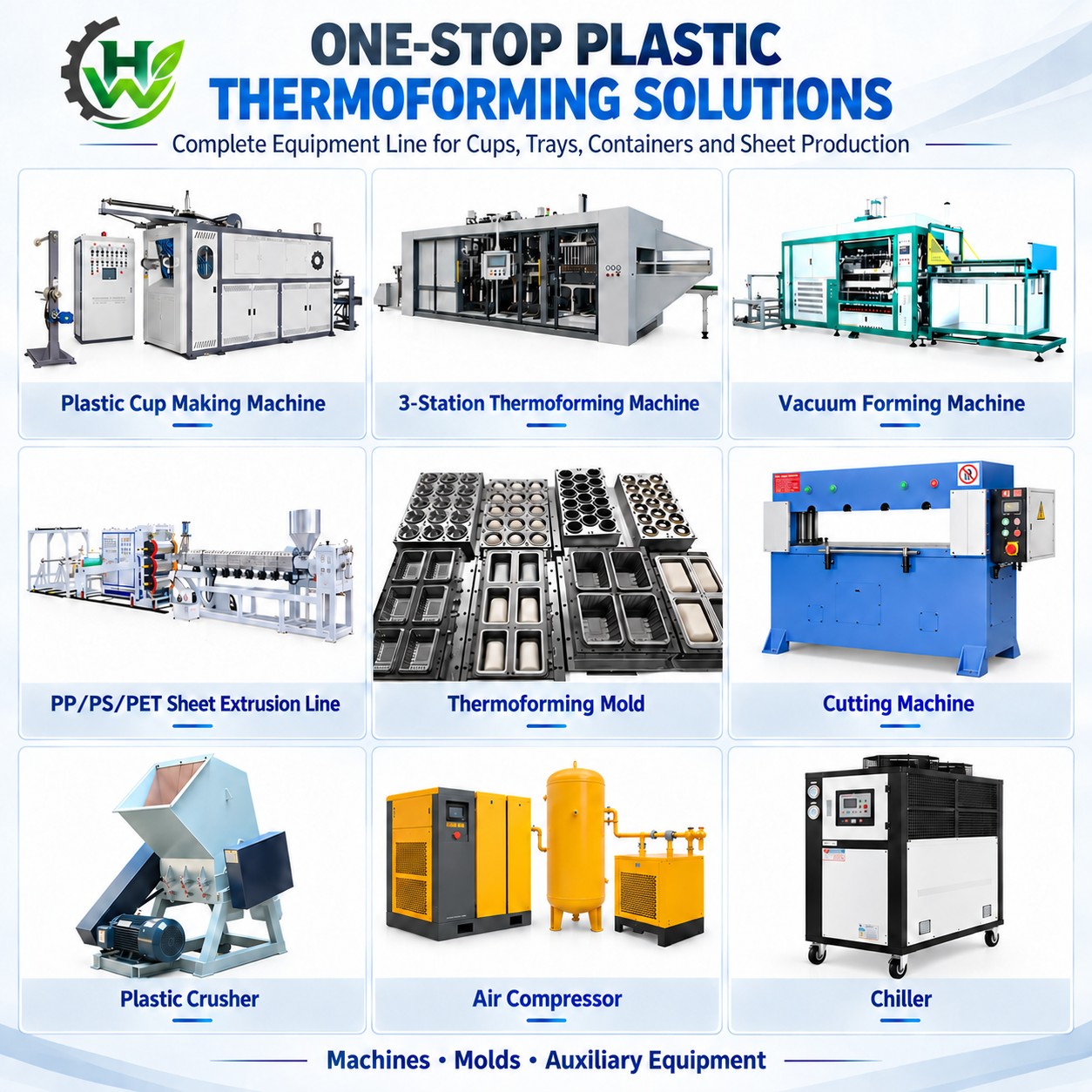
A disposable cup plant links sheet supply, forming, molds, cooling, compressed air, stacking, packing and scrap recovery. If you want to control sheet width, thickness, colour or formulation, add a sheet extrusion line; if your sheet supplier is reliable, the machine, the right mold and matched auxiliary equipment are enough.
Related reading: How to Choose a New Plastic Cup Making Machine · Equipment for a Complete Plastic Cup Production Line · Plastic Cup Production Line Solution · All Cup Making Machines · Cup Molds · VihoX-660-A
Every machine is assembled, wired and run under power before packing. Depending on your order you can review the running video, mold trial video, trial samples, cabinet and component photos, loading images, plus drawings, manuals and the spare-parts list. Factory visits, live video trials and third-party inspection before the balance payment are welcome.
What forming area and depth does the VihoX-750-B offer?
750 × 520 mm or 750 × 560 mm, maximum sheet width 780 mm, forming depth 180 / 220 mm, sheet thickness 0.3–3.0 mm.
Why does this model use an 11 kW stretching servo?
Thicker sheet needs force applied along a controlled path. The servo draws material progressively rather than pushing it to its limit in one stroke, which protects wall distribution and the base corner on deep cavities.
What changes when we run 3.0 mm sheet?
Heating takes longer, stretching force rises and cooling must be more positive, so the cycle drops below what the machine achieves on thin sheet. Tell us the thickness in advance and the settings will be planned around it.
How many cups per hour should we expect?
Theoretical output is cycles per minute × mold cavities × 60; the realistic figure then falls with changeover, adjustment, release faults, stacking interruptions and scrap. Share your cup details for a calculated range.
Which materials can it process, and is HIPS supported?
PP, PS, HIPS, PET, PVC and PLA. HIPS is often chosen for opaque thick-wall cups and bowls because it holds stiffness at higher thickness.
How do Type A, B and C differ?
Type A uses a cylinder upper mold with a hydraulic lower clamp; Type B puts the upper stretching movement on servo; Type C drives both mold movements and the sheet feed by servo.
Should I choose the 750-B or the 750-C?
Take the 750-B when the product is deep or heavy and budget should stay near hydraulic economics; move to the 750-C when long shifts and cycle-to-cycle repeatability outrank the initial outlay.
What do you need from us before quoting?
Cup drawing or sample, top and bottom diameter, height, weight, material and sheet thickness, target capacity, factory voltage, and whether you need one machine or a complete line.
Send your cup drawing, material, sheet thickness, target output and factory voltage. Our engineers will confirm whether the VihoX-750-B fits your product and, if not, which model does — then quote the matched mold and auxiliary equipment with it.
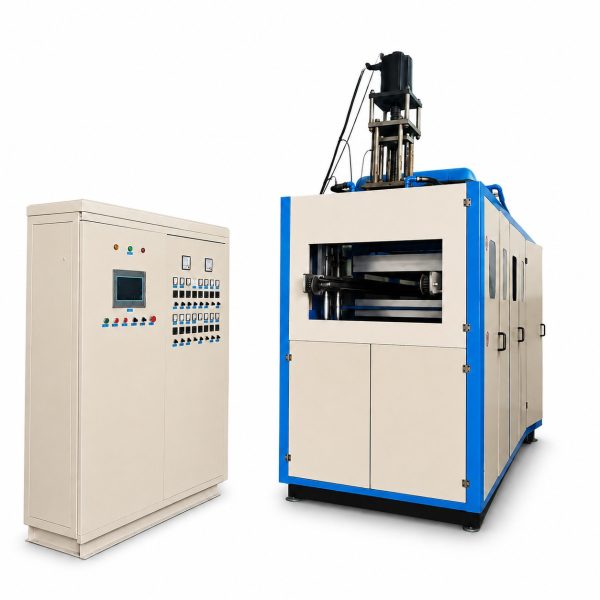
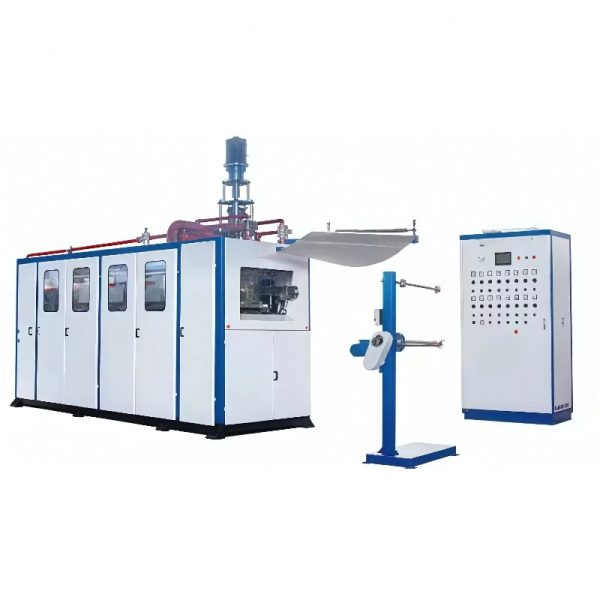
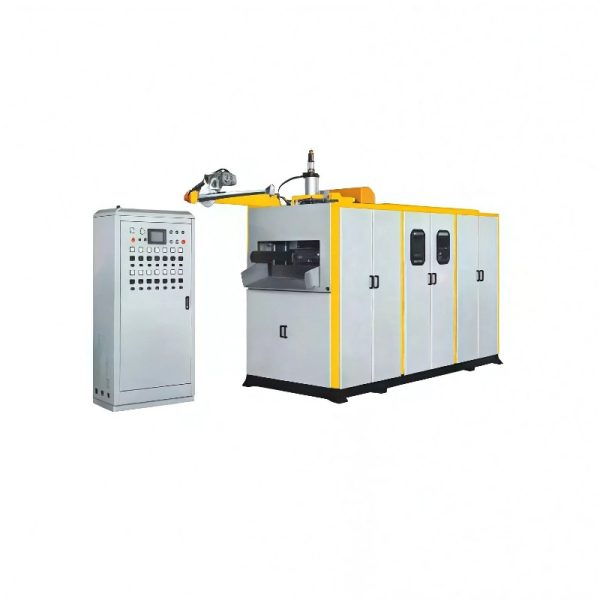
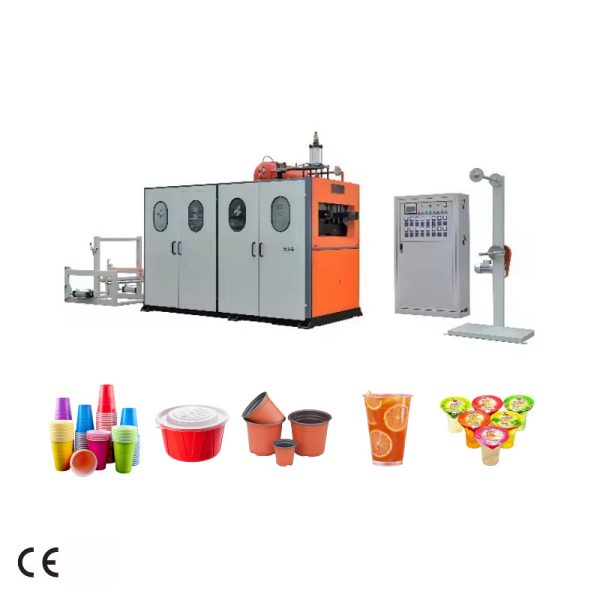
Matched molds and auxiliary equipment — crushers, mixers and recycling units sized to this machine.
See this machine family running in overseas case studies — background, output and on-site photos included.
Request pricing, technical specs or a video machine test — reply within 24 hours.