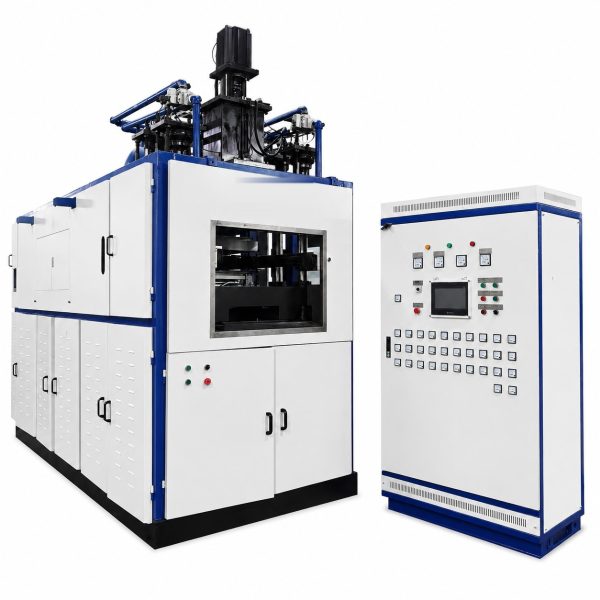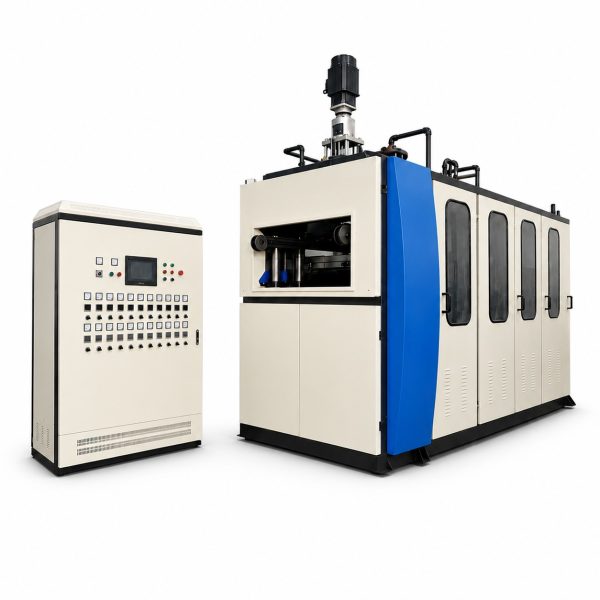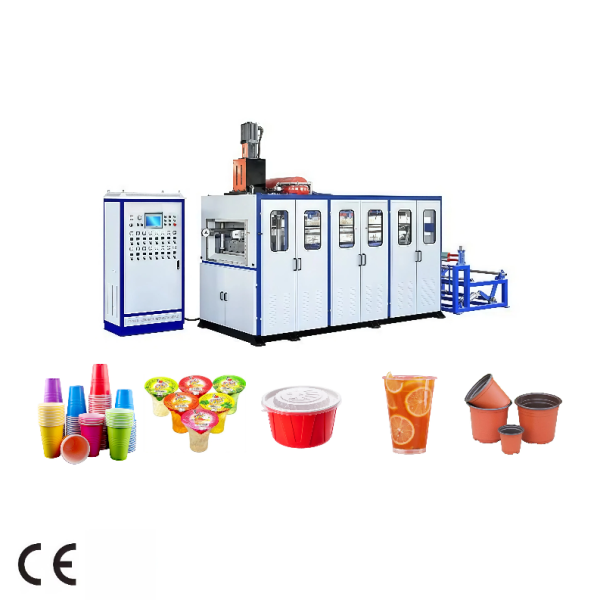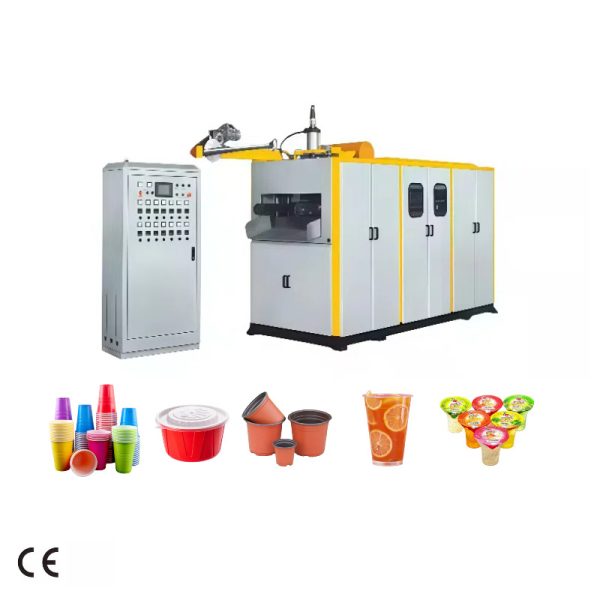
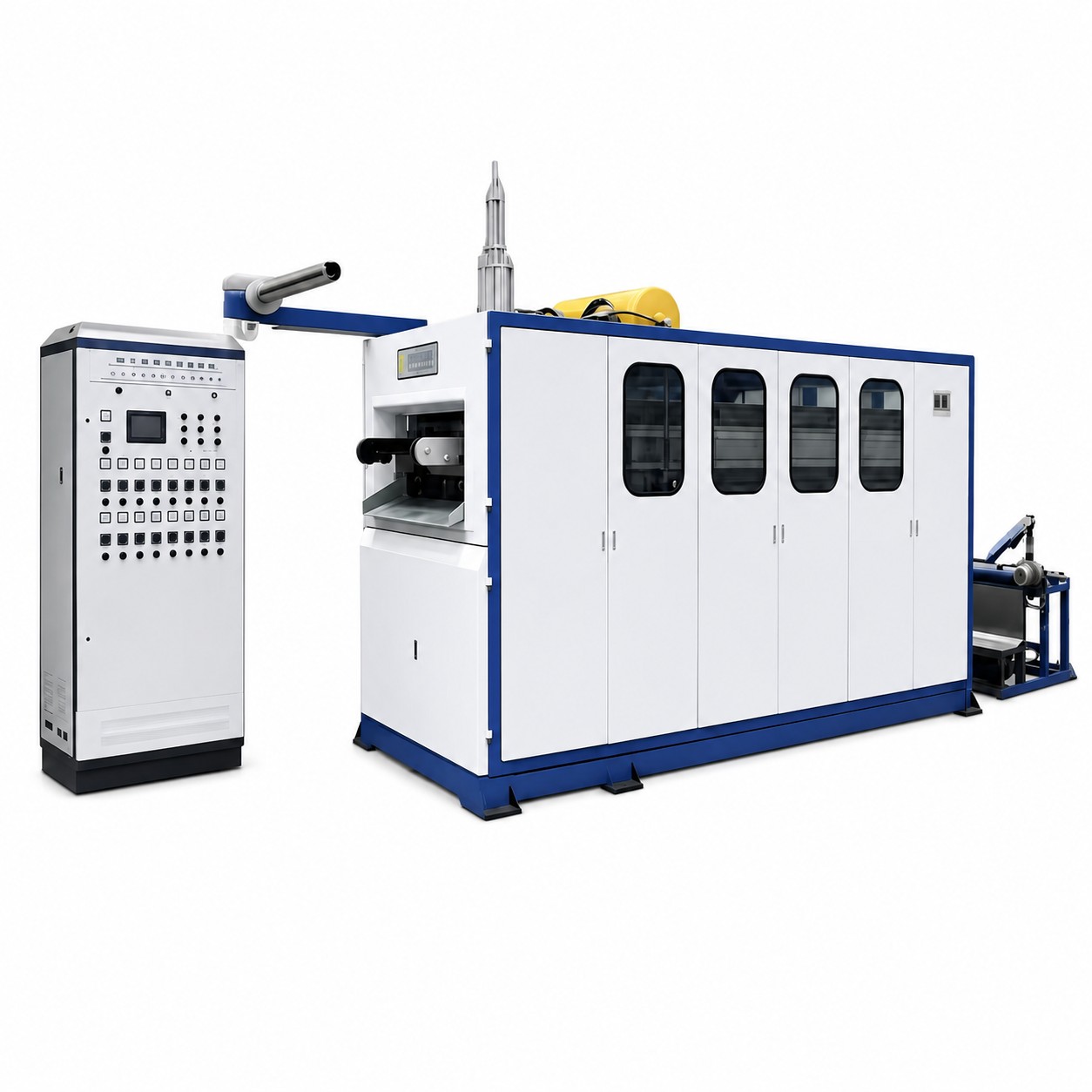
The VihoX-720-A is a Type A automatic plastic cup thermoforming machine with a pneumatic upper mold and a hydraulic lower clamp on a 720 × 420 mm forming table. Sheet roll is heated, formed, cut and stacked.
Its role in the range is output per stroke, not drive sophistication: the wider table accepts molds a 660 mm platform cannot hold, and PE appears here for the first time.
Three drive architectures exist on the VihoX platform, differing in how the plug and clamp motion is generated.
| Type | Upper mold drive | Lower mold drive | Sheet feeding | Best for |
|---|---|---|---|---|
| A (this model) | Pneumatic cylinder | Hydraulic clamp | Standard, non-servo | Medium and large cups, bowls and food containers |
| B | AC servo stretch unit | Hydraulic clamp | Standard, non-servo | Same product sizes, tighter wall control and release |
| C | AC servo | AC servo clamp | Servo-driven | Full-servo production with a repeatable long-run cycle |
For milk tea cups, beverage cups, bowls and meal boxes the forming task is dominated by table area and clamping tonnage rather than a long draw; a pneumatic upper mold presses a large plug across a wide sheet.
Selection boundary: if thin-wall precision on small parts is the goal, the VihoX-660-B adds a 7.5 kW servo on the upper mold; if servo control on both mold halves plus servo feeding is wanted, compare the C-type models.
| Machine Type | Type A (Upper Cylinder + Lower Hydraulic) |
| Forming Area | 720 × 420 mm |
| Hydraulic Motor Power | 18.5 kW |
| Max. Sheet Width | 760 mm |
| Sheet Thickness | 0.3–2.5 mm |
| Max. Forming Depth | 150 / 220 mm |
| Speed | 15–35 cycles/min (reference) |
| Air Pressure | 0.6–0.8 MPa |
| Air Consumption | Approx. 3.8 m³/min |
| Cooling Water (reference) | Approx. 20 L/min |
| Cooling Recommendation | 5 HP Chiller |
| Suitable Material | PP / PS / PET / PVC / PLA / PE |
| Power Consumption | 40–70 kWh (reference) |
| Total Power (Max.) | 155 kW |
| Power Supply | AC380V / 50Hz / 3 Phase / 4-wire (customizable) |
| Machine Dimension | Approx. L7200 × W2250 × H2600 mm |
| Machine Weight | Approx. 8 T |
| Typical Applications | Water cups, milk tea cups, beverage cups, meal boxes, bowls, etc. |
How to read these figures
That list is not a bigger small-cup range; it is a different market. Milk tea and beverage cups are tall and light, so cavity layout must leave room for a clean rim and stable stack, while meal boxes and bowls are broad and shallow, shifting the difficulty to even heating.
Selection boundary — when to look at a larger platform or another type. If your product needs 3.0 mm sheet or a cavity deeper than 220 mm, compare inside the VihoX-750 series. If continuous rhythm and minimum idle energy loss matter most, a C-type full-servo model is the right comparison.
| Material | Typical products | Notes |
|---|---|---|
| PP | Beverage cups, meal boxes, bowls | Broad window, good heat resistance |
| PS | Cups, dessert tubs, containers | Forms and releases easily on wide shapes |
| PET | Clear beverage cups, transparent containers | High clarity; settings follow the sheet |
| PVC | Industrial and special parts | Check local regulations first |
| PLA | Compostable-oriented cups and bowls | Narrow window; drying confirmed by trial |
| PE | Milk tea cups, cold drinks | Softer than PP; needs its own heating and mold clearance settings |
PE is this model’s distinctive addition and a reason buyers step up from a 660 mm table. Tougher and less rigid, it suits products that must survive squeezing and dropping, and it behaves as its own process, not a variant of PP.
A roll of thermoforming sheet is unwound and stepped through the oven. After heating, the web pauses between the two mold halves: the hydraulic clamp seals the wide sheet, the pneumatic upper mold brings the plug down, and vacuum plus pressure draw the sheet against the cooled cavity.
On a 720 mm table the clamp and the heating zones carry most of the responsibility: a large sheet is harder to hold flat and to heat evenly, so this model pairs a wide hydraulic clamp with a 5 HP cooling recommendation.
Here the mold defines the business case more than the machine does. A milk tea cup mold, a bowl mold and a meal box mold are three different exercises: the tall cup needs a controlled plug and generous draft, while the bowl and box need even material distribution.
Plan at order stage for a spare plug set for the mold that runs most often, plus a written process card per mold recording the heating profile with the tool number. A 5 HP chiller covers cooling.
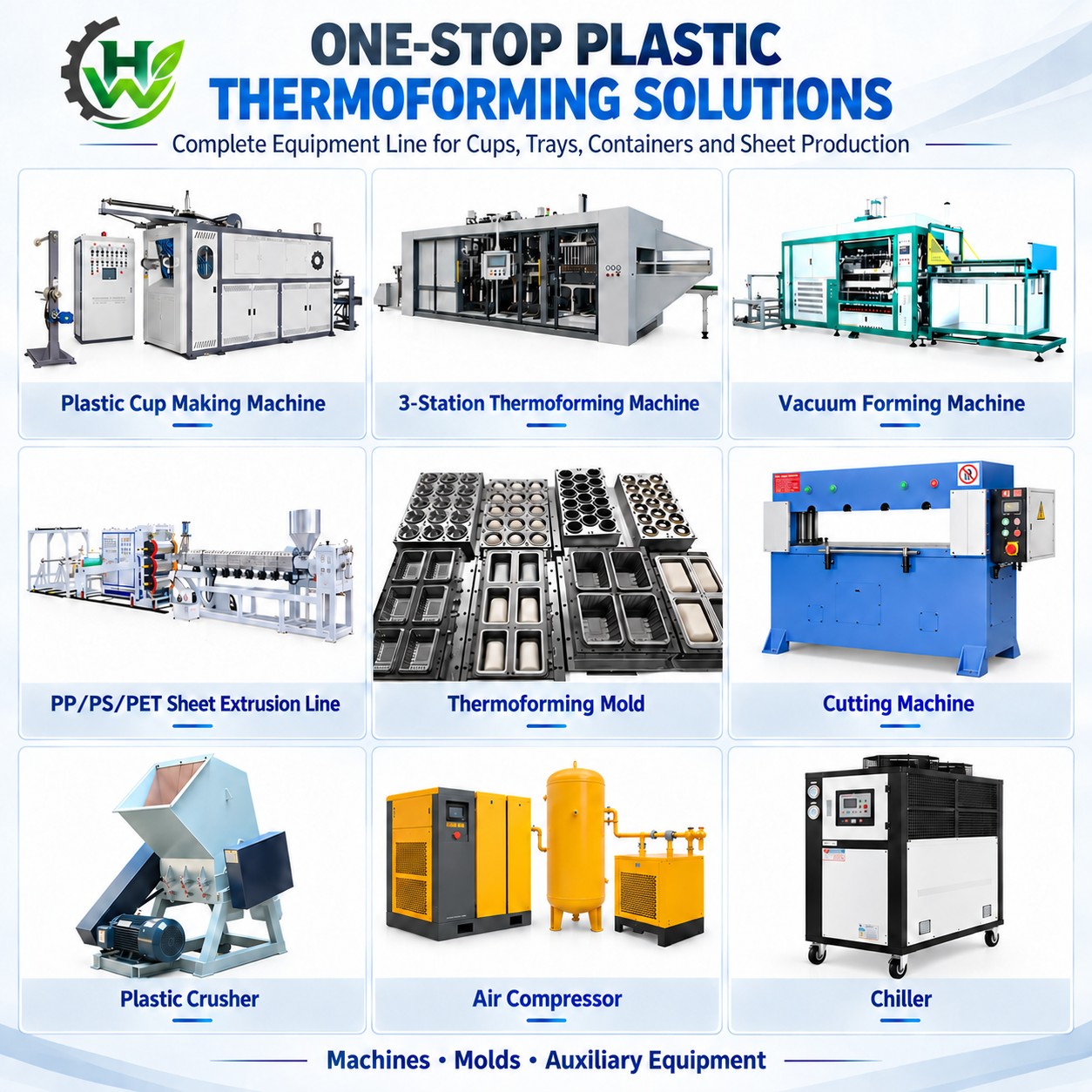
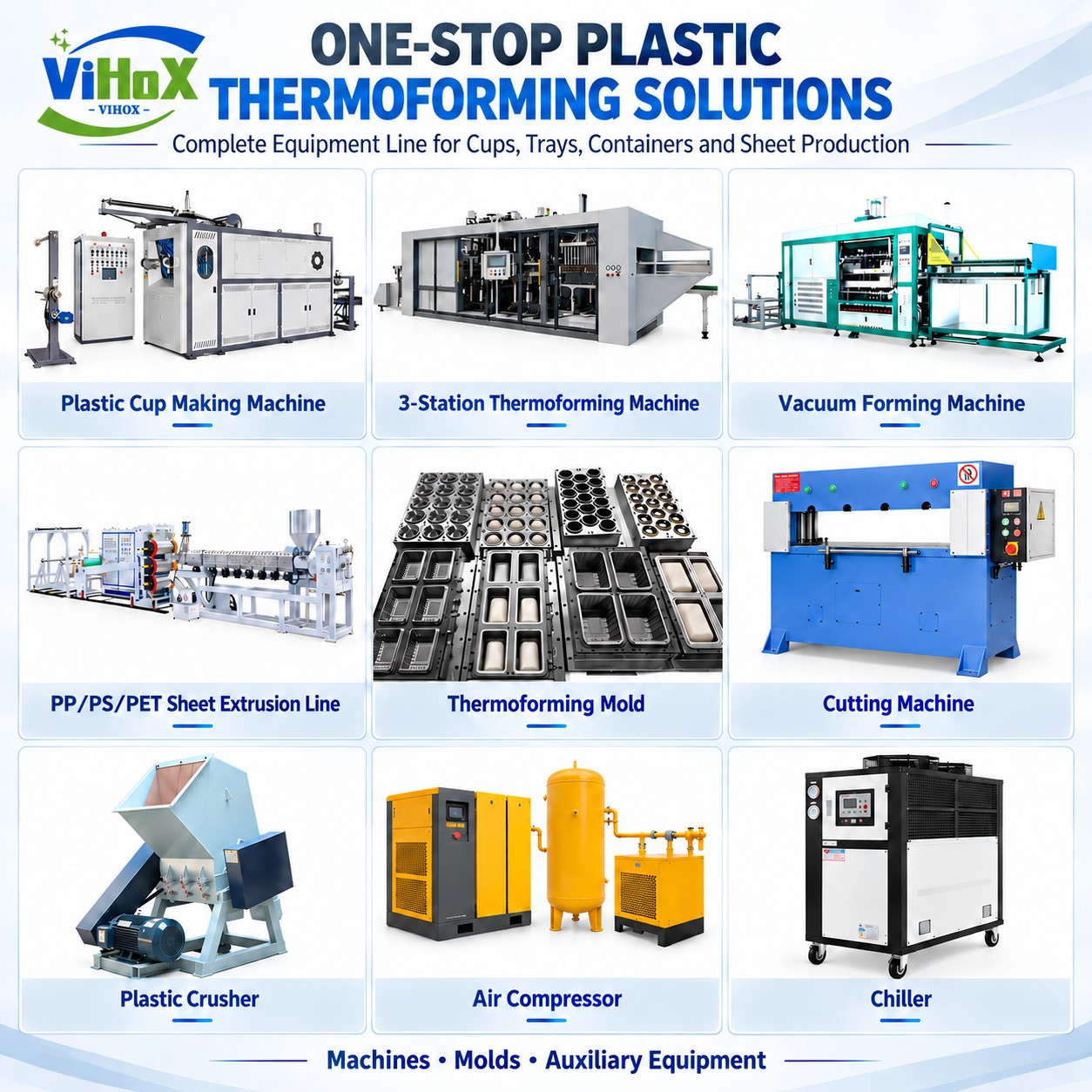
Most buyers of this model are assembling a beverage-and-food packaging line: sheet supply, forming, molds, cooling, air, stacking and packing, plus trim recycling.
Background reading: Matching a Machine to Your Products and Complete Cup Production Line Equipment.
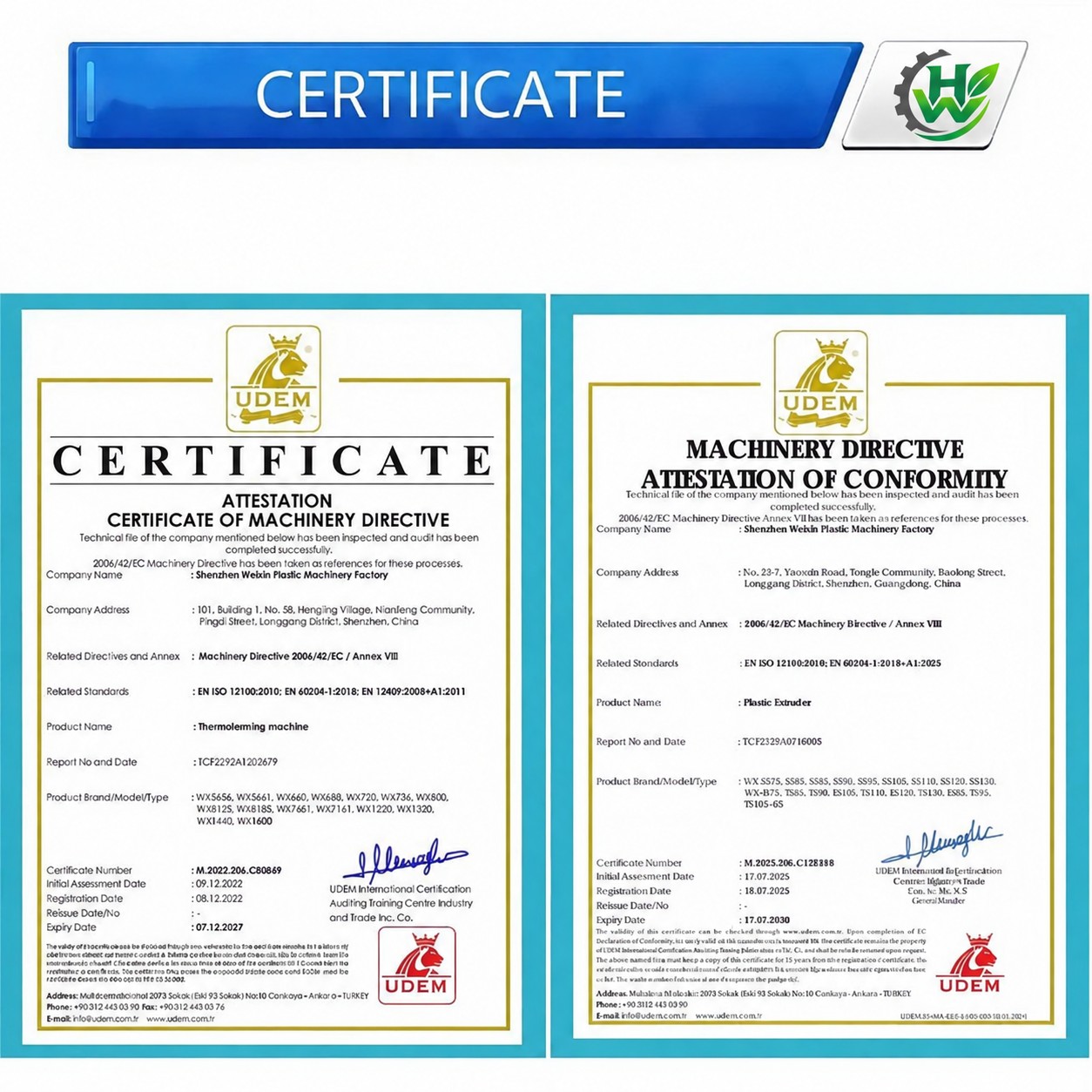
Machines are assembled, wired, powered up and run in our workshop before dispatch, tested with the mold that belongs to the order. Records can include running footage, mold trial footage of your product, cup samples, packing images, drawings and the spare-parts list.
You may also visit the factory, request a live video trial, or engage a third-party inspector first.
What can the VihoX-720-A make that a 660 mm platform cannot?
Three things change at once: a 720 × 420 mm table, a 220 mm depth limit and a 2.5 mm gauge ceiling — which is what allows milk tea cups, bowls and meal boxes.
Does PE need a different setup from PP?
Yes. PE is softer and more flexible, so heating windows, cooling and mold clearance all differ from PP. Treat it as a separate process and confirm it on a trial.
Can one mold run both a meal box and a bowl?
No. Each shape needs its own tool: a deep milk tea cup, a broad bowl and a meal box each require a different plug, draft and cooling layout.
When should I choose the 750 series or a C-type instead?
Move up to the VihoX-750 series when 3.0 mm sheet or a cavity deeper than 220 mm is required; choose a full-servo C type when continuous rhythm matters most.
How many pieces per hour should I expect?
No single figure applies. Expected output follows from the cycle achieved × cavities in your mold × 60, and that cycle depends on product, material and gauge.
Which materials and gauges does it accept?
PP, PS, PET, PVC, PLA and PE sheet from 0.3 mm to 2.5 mm. It consumes finished sheet roll, so granules cannot be fed in.
Is 15–35 cycles/min a production guarantee?
No. It is a reference cycle range under suitable conditions; what the line delivers depends on the product, material, mold and operating conditions.
What do you need from me to prepare a quotation?
Product drawing or photo, top and base diameter, height, unit weight, material and gauge, target capacity and factory voltage.
Describe the container you plan to run and the conditions it will run under. Our engineers will confirm whether the VihoX-720-A fits, then quote it with matched molds.