
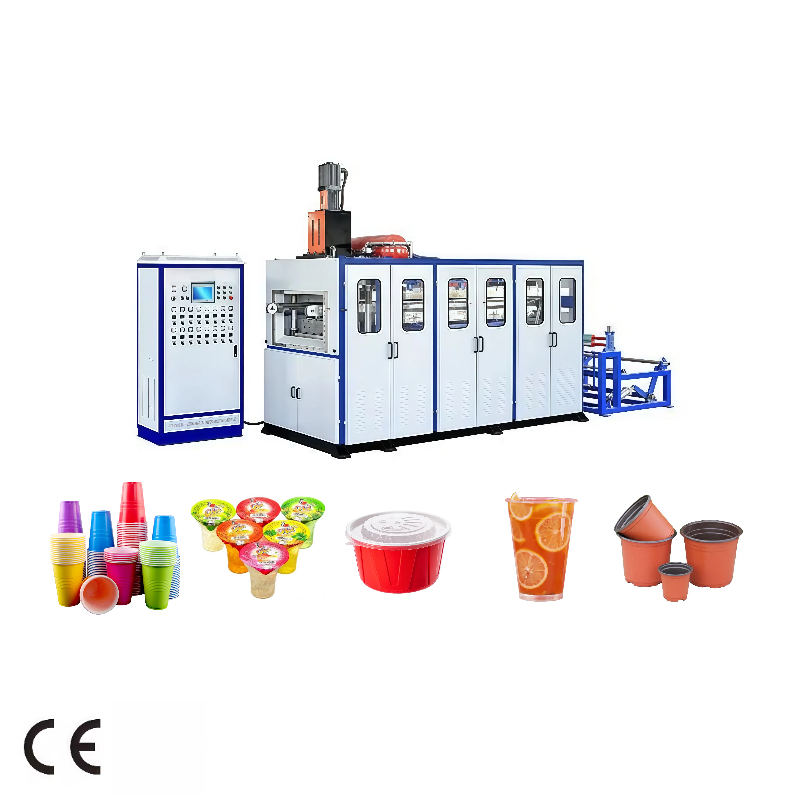
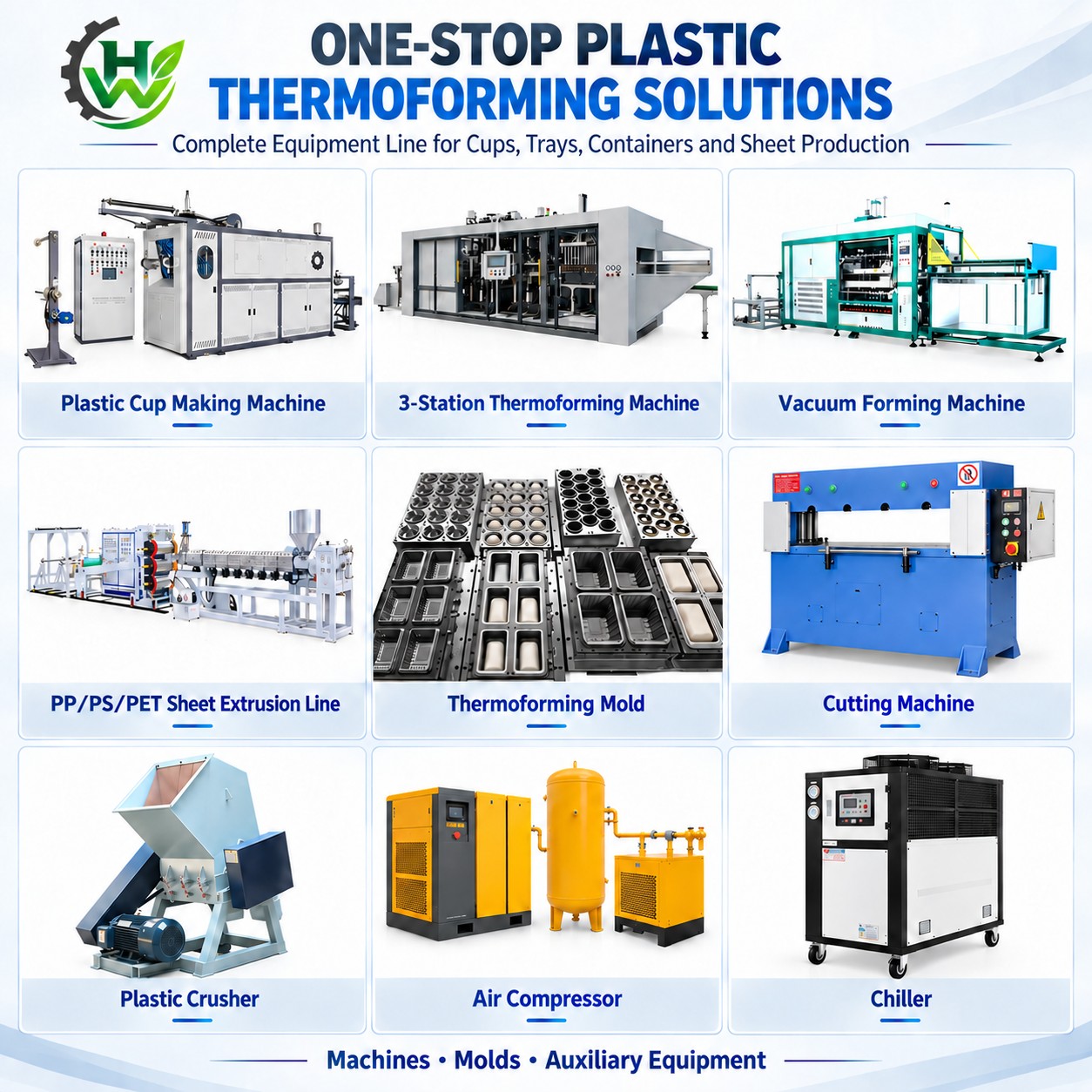
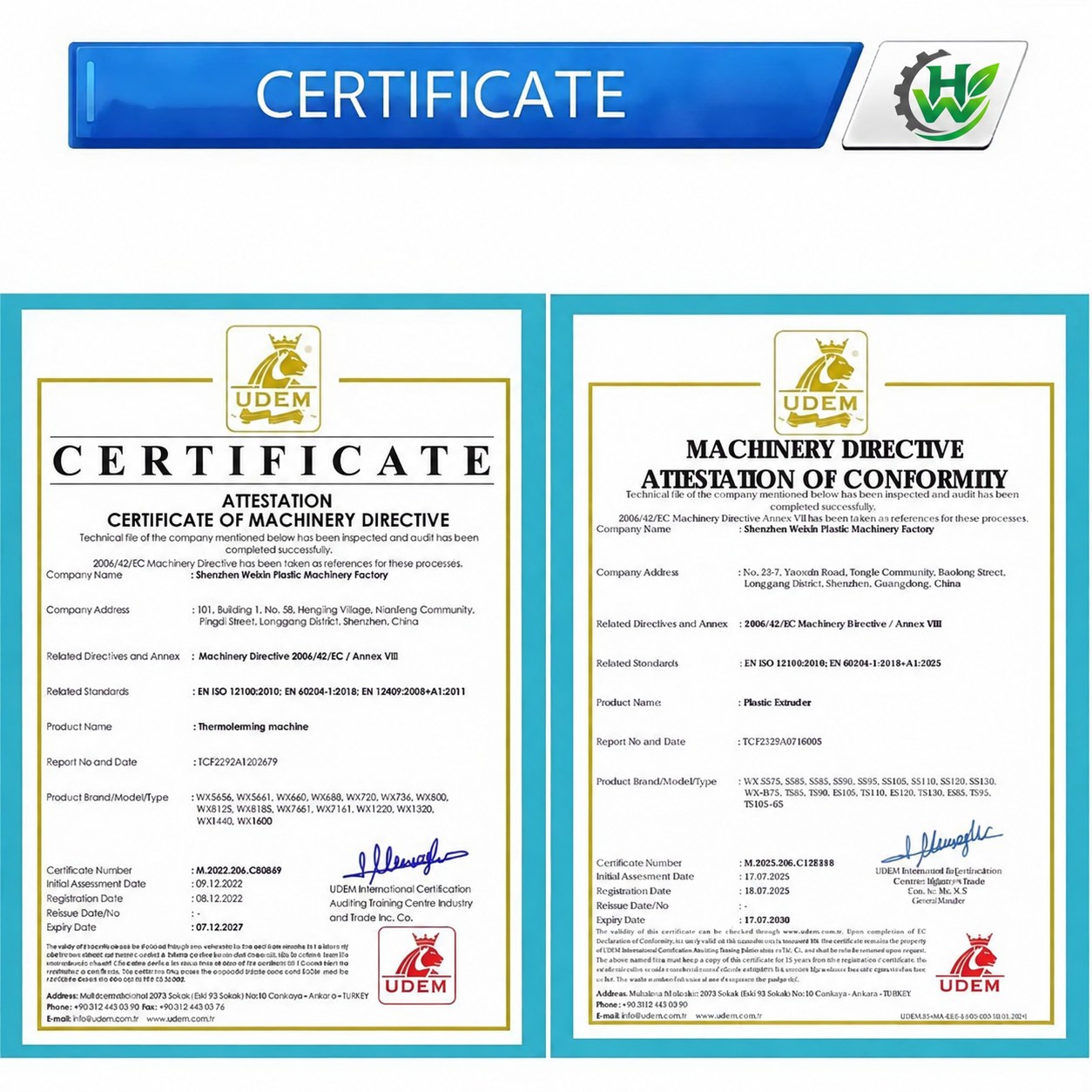
Bought from the factory that builds it: machine, mould and auxiliary equipment quoted as a single project and tested together before loading. Low noise builds that hold their cycle time. CE marking available.
Product Category: Plastic Cup Making Machines
Buying a cup machine from the factory that builds it changes the shape of the project: one party answers for the machine, the mould and the settings, and there is no intermediary between your drawing and the person who cuts the tool. That is how these machines are sold.
The build is also aimed at the two complaints we hear most often from cup plants: noise, and a cycle time that drifts upward through a long shift. Both are addressed in the machine design described below.
| Type | Upper mold drive | Lower mold drive | Sheet feeding | Best for |
|---|---|---|---|---|
| Type A – upper cylinder + lower hydraulic | Cylinder | Hydraulic | Standard | Entry-level volume production; simple structure, low maintenance cost |
| Type B – upper servo + lower hydraulic | Servo | Hydraulic | Standard | Higher forming precision and stability; products with strict wall-thickness requirements |
| Type C – full servo | Servo | Servo | Servo | Full servo control; the most stable cycle and lowest energy loss for long continuous runs |
Noise and cycle stability both come from the drive arrangement. A fully hydraulic forming stroke is loud and generates heat that builds through a shift. Servo motion on the upper mould reduces the hydraulic duty, and the full servo build removes it from the forming cycle entirely, which is why Type C is the quietest of the three and holds its cycle time best in continuous production.
| Parameter | 660 × 320 mm | 720 × 420 mm | 750 × 520 / 560 mm | 850 × 560 mm |
|---|---|---|---|---|
| Max. sheet width | 680 mm | 760 mm | 780 mm | 880 mm |
| Sheet thickness | 0.3–2.0 mm | 0.3–2.5 mm | 0.3–3.0 mm | 0.3–3.0 mm |
| Max. forming depth | 150 / 180 mm | 150 / 220 mm | 180 / 220 mm | 180 / 220 mm |
| Speed | 15–35 cycles/min (reference) | 15–35 cycles/min (reference) | 15–35 cycles/min (reference) | 15–35 cycles/min (reference) |
| Hydraulic motor power | 18.5 kW | 18.5 kW | 18.5 kW | 18.5 kW |
| Total power (max.) | 130 kW | 155 kW | 165 kW | 190 kW |
| Air pressure | 0.6–0.8 MPa | 0.6–0.8 MPa | 0.6–0.8 MPa | 0.6–0.8 MPa |
| Air consumption | Approx. 3.8 m³/min | Approx. 3.8 m³/min | Approx. 3.8 m³/min | Approx. 3.8 m³/min |
| Water consumption | Approx. 20 L/min | – | Approx. 20 L/min | Approx. 20 L/min |
| Cooling recommendation | 3–5 HP Chiller | 5 HP Chiller | 5–10 HP Chiller | 10 HP Chiller |
| Machine weight | Approx. 7 T | Approx. 8 T | Approx. 10 T | Approx. 15 T |
| Typical applications | Water cups, yogurt cups, jelly cups, etc. | Water cups, milk tea cups, beverage cups, meal boxes, bowls, etc. | Water cups, milk tea cups, beverage cups, meal boxes, bowls, etc. | Salad bowls, large-capacity food containers, catering trays |
| Power supply | AC380V / 50Hz / 3 Phase / 4-wire (customizable) | |||
The range is built in four forming areas with the same drive options throughout, so the choice of size does not force a choice of build quality.
There is no trading company in the chain, so the technical conversation happens with the workshop. If a mould needs a change to suit your sheet, or a cycle needs adjusting for a new material, the person who makes the change is the person you are already talking to.
It also means the machine, the mould, the chiller, the compressor, the grinder and the stacker can be quoted as one project with one delivery date, tested together before they leave the yard.
| Material | Typical cups | Notes |
|---|---|---|
| PP | Water cups, hot drink cups, general disposable cups | Good toughness and heat resistance |
| PS | Jelly cups, lightweight food cups | Good thermoforming performance |
| PET | Clear cold drink cups, transparent packaging cups | High transparency; needs suitable sheet quality and temperature control |
| PVC | Industrial and special applications | Confirm local regulations and market requirement before selection |
| PLA | Eco-oriented cups and containers | Narrower processing window; drying and temperature control must be confirmed by trial |
Because the mould is made to order, the machine can be set up for the material you actually buy rather than for a default. PP is the usual choice for general disposable cups, PS for lightweight food cups, PET where clarity is sold as a feature, and PLA for compostable ranges.
A cup plant runs a thermoformer for a full shift next to people who have to work beside it. The sources of noise are the forming stroke and the trim press; reducing the hydraulic share of the forming motion, and enclosing the moving assemblies, is what brings the sound level down.
Cycle stability is largely a cooling question. If the mould temperature creeps up, the cycle lengthens. Sized cooling water flow, a chiller appropriate to the machine and a clean plate circuit are what keep the recorded cycle time valid hour after hour.
A mould, a chiller, an air compressor and a grinder are the usual companions to the machine. Where the project includes its own sheet supply, an extrusion line is placed upstream so the thermoformer is fed directly.
A cup stacker or manipulator is added when the discharge rate passes what operators can pack by hand. It is an option rather than a requirement, and it is sized to the cavity count of your mould.
The table above gives the shared architecture and the parameters that change with size. Individual model pages below carry the complete built parameters for each forming area and drive type.
The machine is commissioned at your plant and the operators are trained on it. After that, moulds, wearing parts and technical answers continue to come from the same factory that built the machine.
Are you the manufacturer or a trading company?
The machines, the moulds and the auxiliary equipment are made by the same factory. Enquiries are answered by the factory, and the machine is built to your order rather than taken from stock.
How much quieter is the servo build?
The full servo build takes the hydraulic unit out of the forming stroke, which removes its share of the noise and of the heat. The exact sound level depends on the mould and the trim arrangement, and is measured during the factory trial.
What keeps the cycle time from drifting during a long shift?
Cooling water flow and mould temperature. The recommended chiller size for each bed is in the table above, and the cooling circuit has to stay clean for the recorded cycle to hold.
Can I visit the factory before ordering?
Yes. Visitors are welcome at the factory in Yuanzhou Town, Huizhou. Tell us in advance so the machines you want to see can be run on the day.
Can a third party inspect the machine before it is loaded?
Yes. Inspection before loading is a normal part of the process, either by you or by an inspection company, and the machine is loaded after the check is complete.
What is included in the price?
The machine as ordered, the mould where one is part of the project, the auxiliary equipment you select, and the factory trial. Freight, duties and local installation costs depend on the destination and are quoted separately.
Do you supply spare parts after the warranty ends?
Yes. Wearing parts, heating elements and replacement moulds are supplied from the factory that built the machine, using the original drawings.
How do I start an order?
Send the cup size or drawing, the material, the output you need and the destination port. From that we confirm the forming area, the drive build and the mould, then issue a quotation with a delivery date.
Send the product, the material and the target output, and you will deal with the factory that builds the machine. The quotation names the forming area, the drive build and the mould.
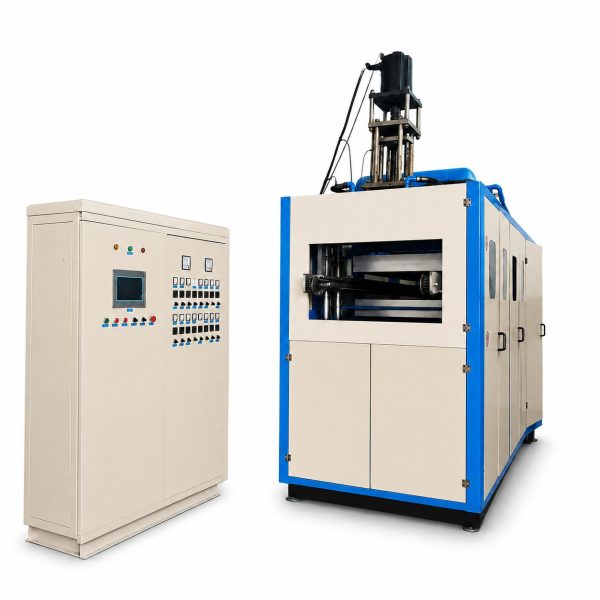
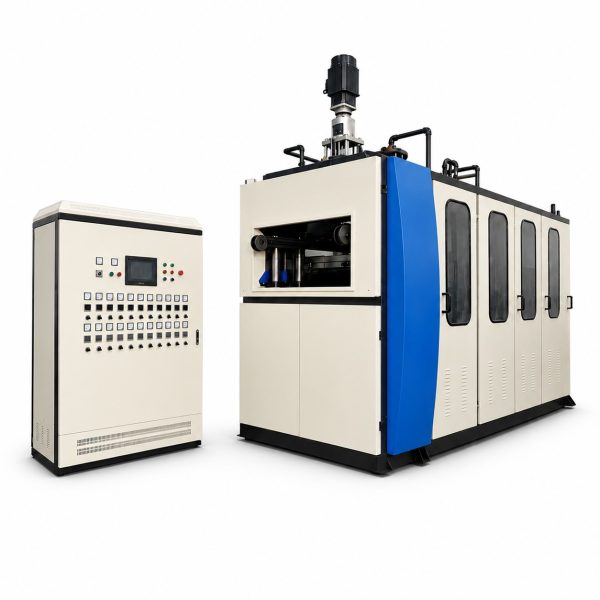
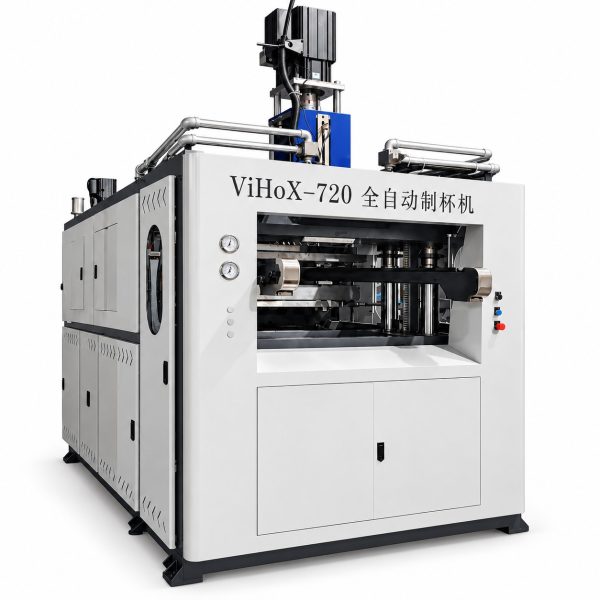
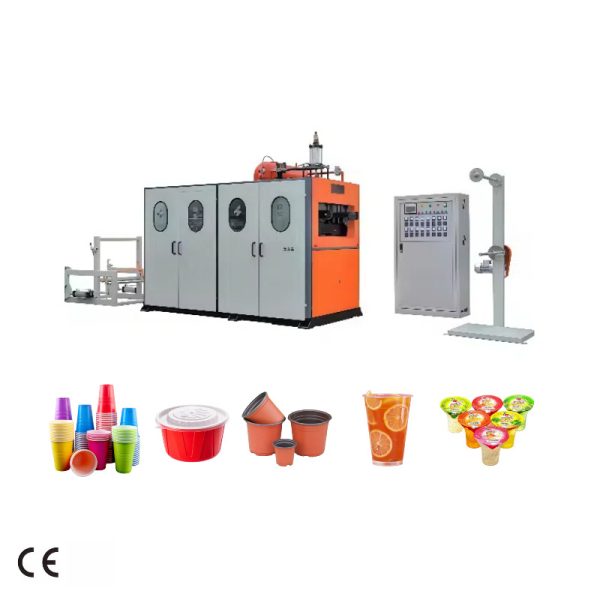
Matched molds and auxiliary equipment — crushers, mixers and recycling units sized to this machine.
See this machine family running in overseas case studies — background, output and on-site photos included.
Request pricing, technical specs or a video machine test — reply within 24 hours.