
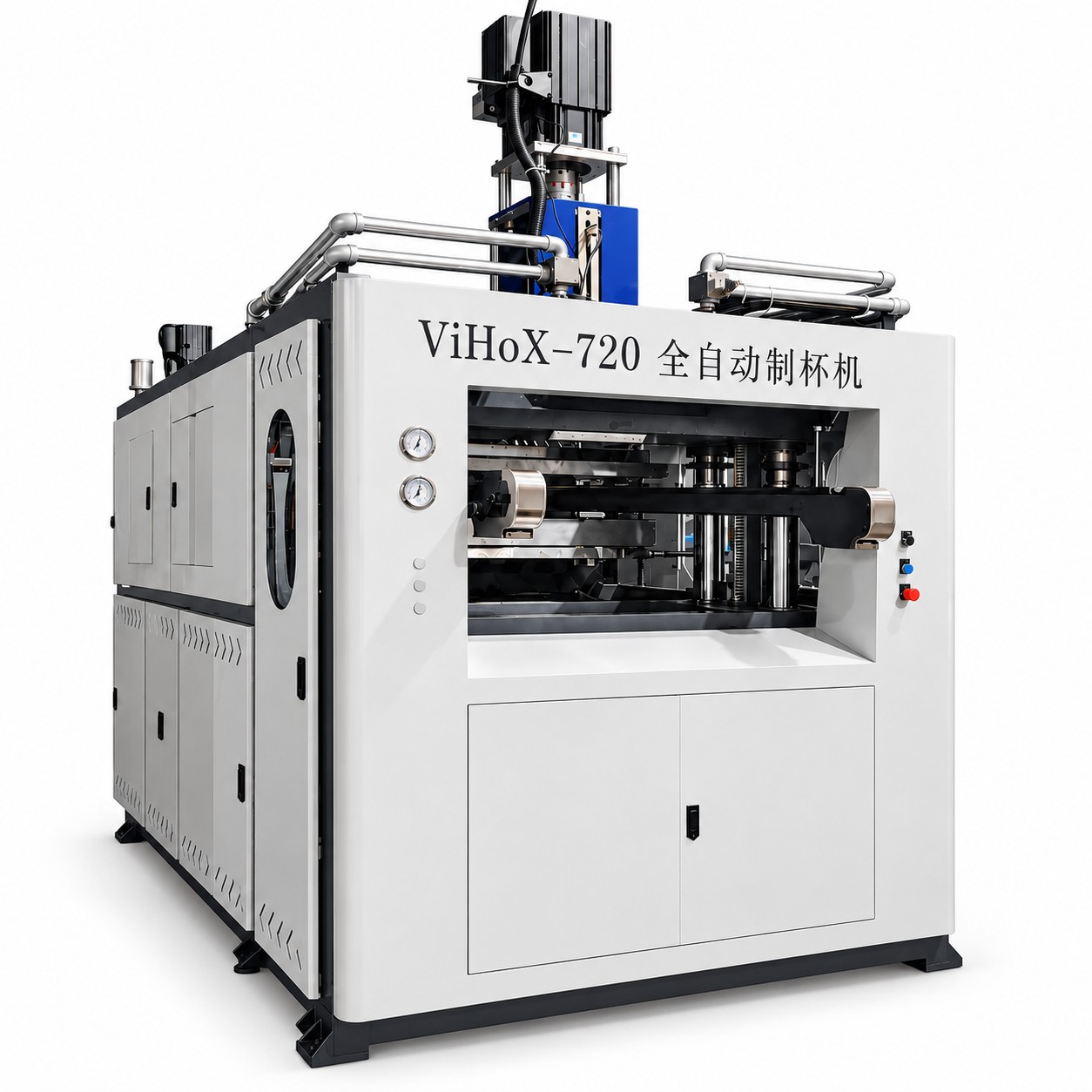
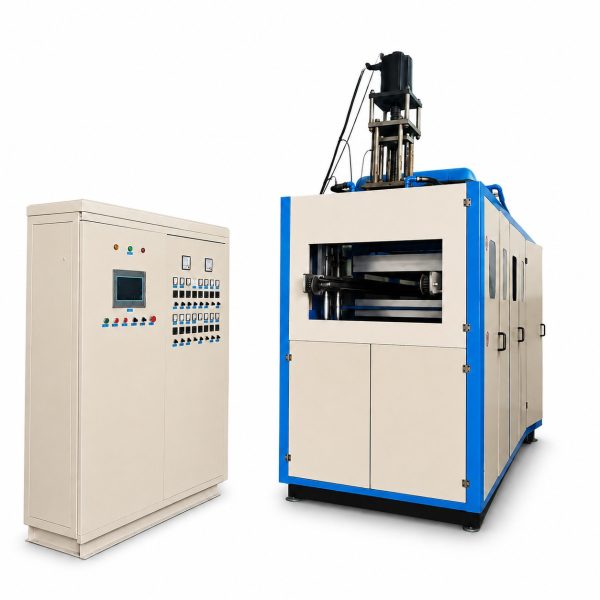
VihoX-720-B Type B automatic plastic cup thermoforming machine: 720×420 mm forming area, 7.5 kW servo upper stretching unit + 18.5 kW hydraulic lower clamp, 0.3–2.5 mm sheet (PP/PS/PET/PVC/PLA/PE), 150/220 mm forming depth, 5 HP chiller, 155 kW total power. Built for even wall thickness and reliable release on thin-wall milk tea and beverage cups. Factory test run before shipment.
Product Category: Plastic Cup Making Machines
VihoX-720-B is a Type B automatic plastic cup thermoforming machine that pairs a 7.5 kW servo-driven upper stretching unit with an 18.5 kW hydraulic lower clamp on a 720 × 420 mm forming area, and turns 0.3–2.5 mm PP, PS, PET, PVC, PLA or PE sheet roll into finished drinking cups, bowls and food containers.
Its Type A sibling shares the same forming platform, so the real difference is not size but what happens to the sheet in the instant before the mold closes. In the medium-diameter, thin-wall class — milk tea cups, large iced-drink cups, takeaway containers — a cup is judged on shoulder strength, bottom thickness, rim flatness and how cleanly it leaves the mold. Those are the points where a programmed servo stretch repeats itself cycle after cycle and a fixed cylinder stroke does not.
Drive configuration changes how the sheet is stretched, not how much floor space the machine occupies.
| Type | Upper mold drive | Lower mold drive | Sheet feeding | Best for |
|---|---|---|---|---|
| B (this model) | Servo upper stretching | Hydraulic | Standard | Repeatable wall distribution on thin-wall cups of medium diameter |
| A | Cylinder | Hydraulic | Standard | Cup programmes where simple mechanics are preferred |
| C | Servo | Servo closing | Servo | Holding a steady cycle through long continuous runs, with lower energy loss |
The 7.5 kW upper stretching servo follows a stretch curve set in the control system instead of travelling a fixed cylinder stroke, so the pre-stretch given to the sheet is repeatable rather than approximate, while the hydraulic lower clamp keeps supplying the closing force that holds the mold sealed as the cavity fills. On a 720 × 420 mm platform that matters, because the cup is wide enough for an unevenly stretched sheet to appear as a thin shoulder, an overweight bottom or a rim that drags on release. Choose this model when thin-wall cups dominate your mix and their wall specification is checked.
| Machine Type | Type B (Upper Servo + Lower Hydraulic) |
| Forming Area | 720 × 420 mm |
| Hydraulic Motor Power | 18.5 kW |
| Upper Stretch Servo Motor Power | 7.5 kW |
| Max. Sheet Width | 760 mm |
| Sheet Thickness | 0.3–2.5 mm |
| Max. Forming Depth | 150 / 220 mm |
| Speed | 15–35 cycles/min (reference) |
| Air Pressure | 0.6–0.8 MPa |
| Air Consumption | Approx. 3.8 m³/min |
| Water Consumption | Approx. 20 L/min |
| Cooling Recommendation | 5 HP Chiller |
| Suitable Material | PP / PS / PET / PVC / PLA / PE |
| Power Consumption | 40–70 kWh (reference) |
| Total Power (Max.) | 155 kW |
| Power Supply | AC380V / 50Hz / 3 Phase / 4-wire (customizable) |
| Machine Dimension | Approx. L7200 × W2250 × H2600 mm |
| Machine Weight | Approx. 8 T |
| Typical Applications | Water cups, milk tea cups, beverage cups, meal boxes, bowls, etc. |
How to read these figures
Cup diameter, height, weight and cavity number come from the mold. Send a drawing and we will confirm whether this platform covers it.
Selection boundaries. Sheet thicker than 2.5 mm, or a 180–220 mm deep cavity required together with that heavier gauge, belongs to the VihoX-750-A / VihoX-750-B / VihoX-750-C family, which covers 0.3–3.0 mm and 180 / 220 mm. Budget-driven volume production of small cups — water, yogurt, jelly — starts instead at the VihoX-660-A or VihoX-660-B.
| Material | Typical products | Notes |
|---|---|---|
| PP | Water cups, hot-drink cups, milk tea cup bodies | Balanced toughness and heat resistance; a workhorse for this platform |
| PS | Lightweight drink cups, dessert cups | Forms readily, so it suits layouts with a higher cavity count |
| PET | Clear cold-drink cups, transparent food packaging | Clarity is only as good as heating control; drying and temperature settings matter |
| PVC | Industrial and dedicated items | Confirm destination regulations before committing a mold |
| PLA | Compostable-oriented cups and containers | Narrow processing window; sheet condition and forming temperature established by trial |
| PE | Opaque and coloured cups, tubs and containers | Soft and tough; PE is listed for the 720 platform, so confirm mold and heating design at quotation stage |
Process flow: sheet roll unwinding → feed index → oven heating → servo stretch forming → punch cutting → cup stacking → counting and packing.
A thermoforming line runs at the speed of its least stable station, and here the servo stretch steadies the hardest one to see: the moment of forming. Because the upper mold follows a programmed motion rather than a fixed stroke, the same stretch reaches the same sheet area on every cycle, holding wall distribution and release behaviour steady.
Molds for this machine are designed around the 720 × 420 mm forming area, a 760 mm maximum sheet width and depths of 150 mm or 220 mm. Tooling built for a 660 mm platform will not transfer across: platen size and cavity pitch differ.
Cavity count is not a free choice: the layout must leave enough sheet for even heating, a controlled draw and a clean cut, so a modest layout that releases reliably outruns an ambitious one that must be slowed down. Molds are built to your cup dimensions and output, and we flag a cavity number that is too tight for the depth requested.
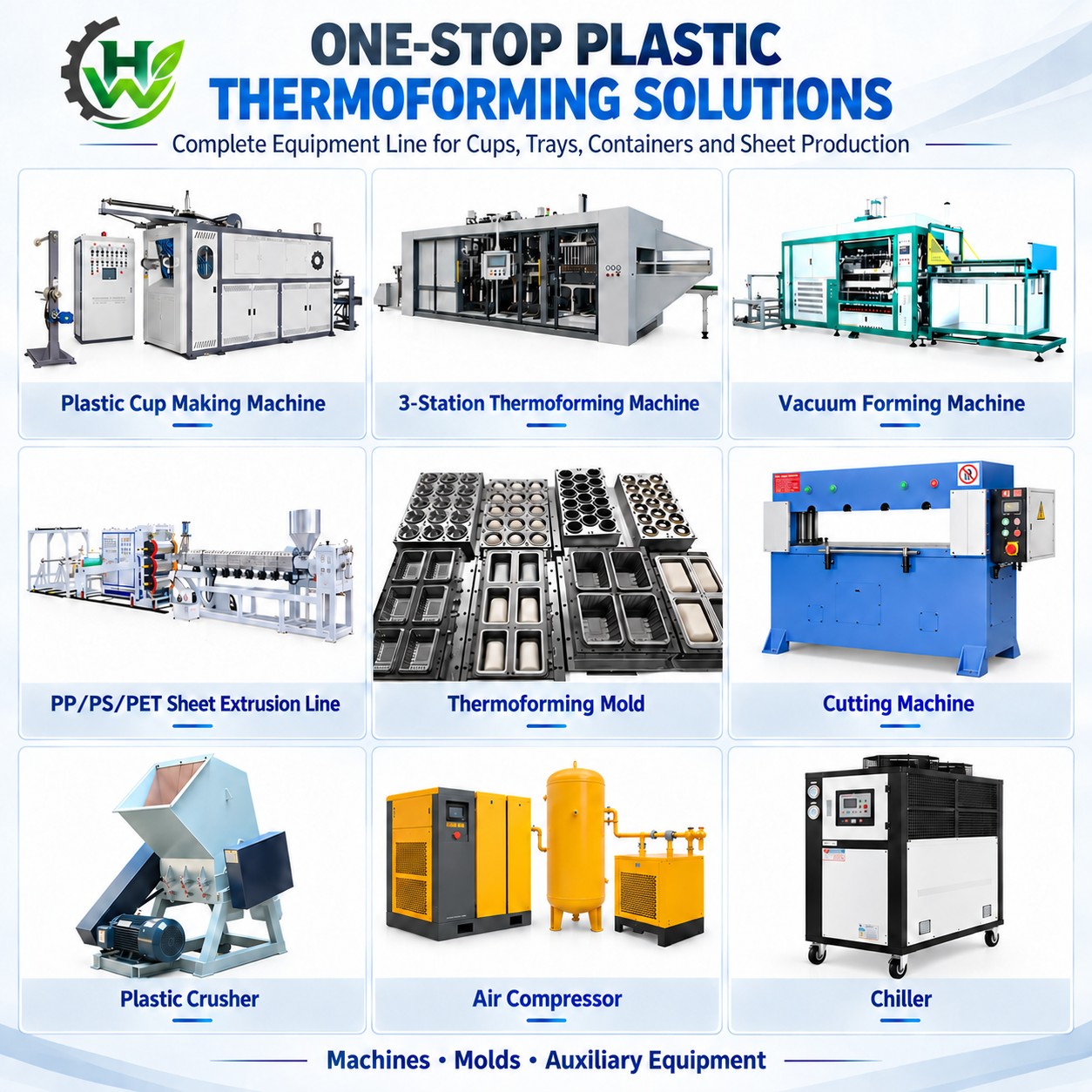
Auxiliary equipment normally means a 5 HP chiller, an air compressor sized to 0.6–0.8 MPa and approximately 3.8 m³/min against the real duty cycle, plus stacking and packing equipment matched to your automation level. Existing plant equipment can be reused where suitable.
Line stability depends on what sits above and below the press: sheet supply upstream, cooling, air, stacking, packing and scrap handling downstream. Where sheet roll already arrives to specification, the cup machine and a correctly designed mold carry the project. In-house control of sheet gauge, width or colour points instead to a sheet extrusion line.
See also: how to compare plastic cup making machines before you order and what equipment a complete cup production line needs.
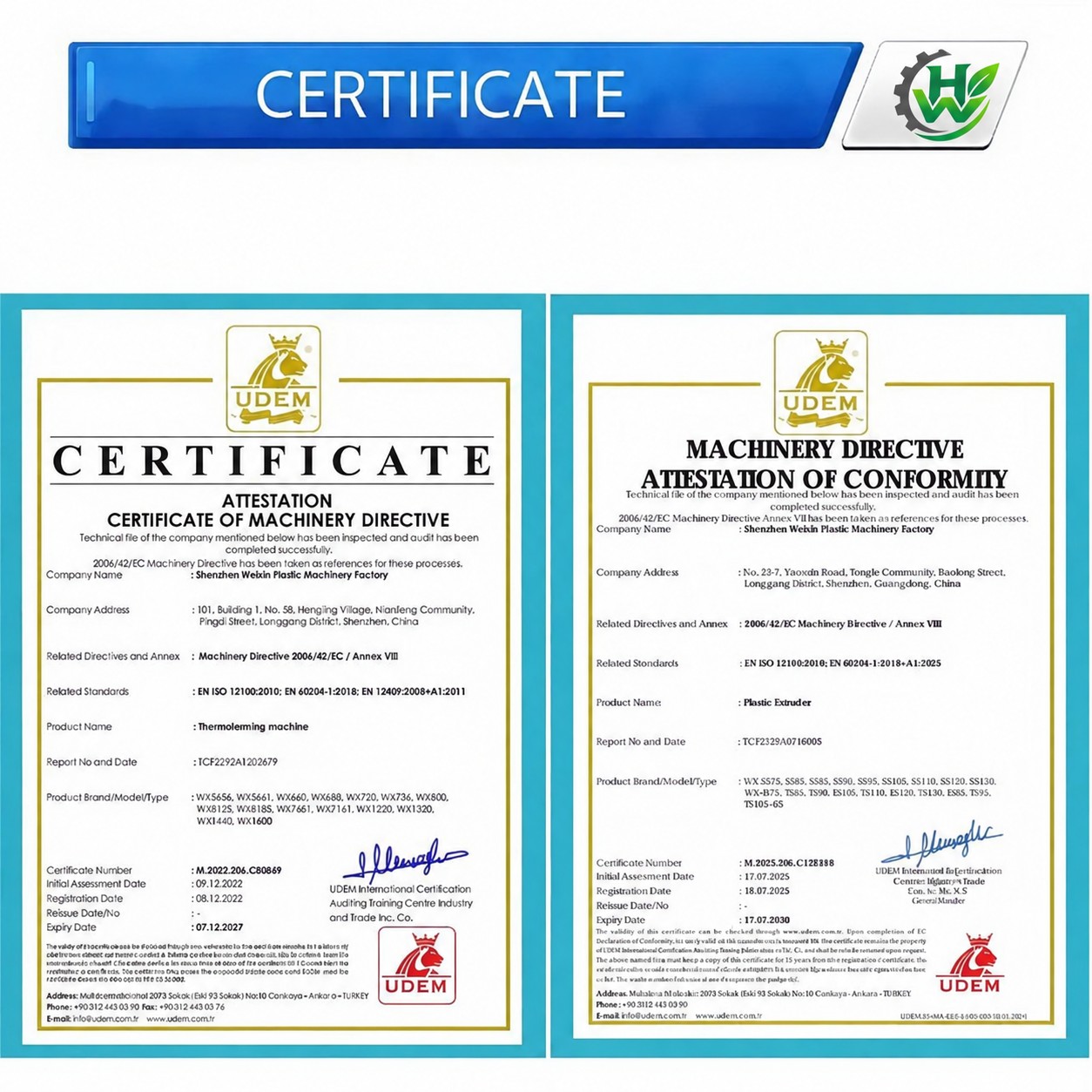
Every machine is run under test before dispatch, and the record is shared with the buyer: running footage, mold trial footage, the cups that came off the mold, photos of the electrical cabinet and main components, packing and loading images, plus drawings, manuals and the spare-parts list. Buyers may visit the factory, request a live video test, or appoint a third-party inspector before settlement. CE documentation is available for relevant machines.
What is the forming area of the VihoX-720-B?
720 × 420 mm, taking sheet up to 760 mm wide and 0.3–2.5 mm thick, with forming depths of 150 / 220 mm.
What does the 7.5 kW servo upper stretching unit change in daily production?
It replaces a fixed-stroke cylinder with a programmed stretch motion, so pre-stretch is identical every cycle: steadier wall thickness, cleaner release and fewer mid-shift corrections on thin-wall products.
How many cups per hour will it make?
No single figure can be quoted honestly. Theoretical pcs/hour = actual cycles/min × mold cavities × 60, less changeover, adjustment, release pauses, stacking stops and rejects.
Can it run PE as well as PP and PET?
Yes — the material list is PP, PS, PET, PVC, PLA and PE. PE behaves differently from the rigid polymers, so mention it at enquiry stage and the heating and mold design will be prepared accordingly.
Do I need a chiller, or can I use my own cooling water?
A controlled cooling supply is required; a 5 HP chiller is the usual match here, with cooling water of approximately 20 L/min. If you already have chilled water of suitable temperature and flow, share the figures and we will confirm.
Is 15–35 cycles/min a production figure I can plan capital around?
It is a reference cycle band under suitable conditions, not a promised output. Plan from a trial with your own cup, sheet and material.
How is Type B different from Type A and Type C?
Type A uses a cylinder upper mold with a hydraulic lower clamp; Type B keeps that clamp and moves the upper mold to a servo, adding stretch repeatability; Type C puts both mold halves under servo control with servo sheet feeding.
What should I prepare before asking for a quotation?
The cup drawing, top and bottom diameter, height, weight, material and sheet gauge, target capacity, factory voltage and country.
Send the cup drawing or sample photo, cup size and weight, material, sheet thickness, target capacity, factory voltage and country. Our team will confirm whether the VihoX-720-B suits the product and reply with a factory-direct quotation covering machine, mold and auxiliary equipment.
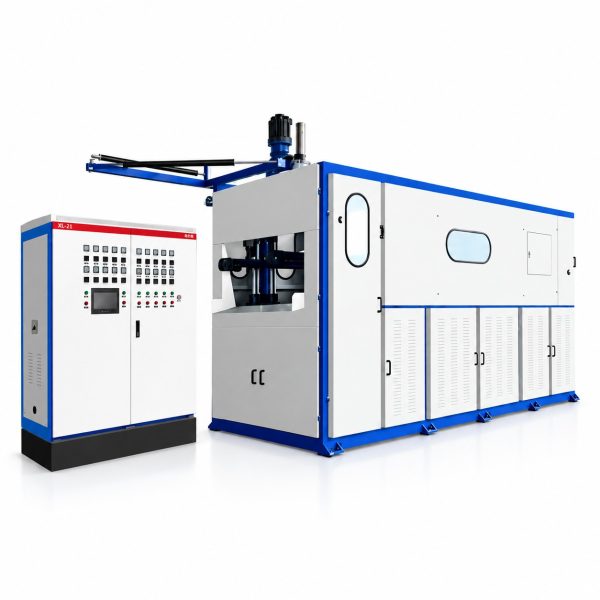
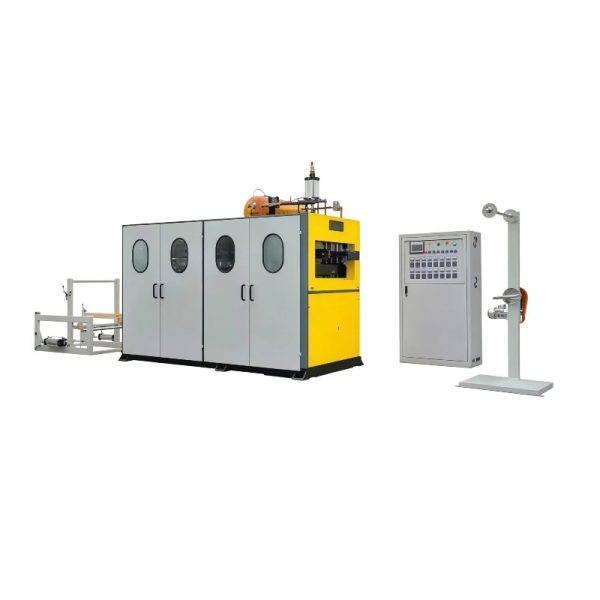
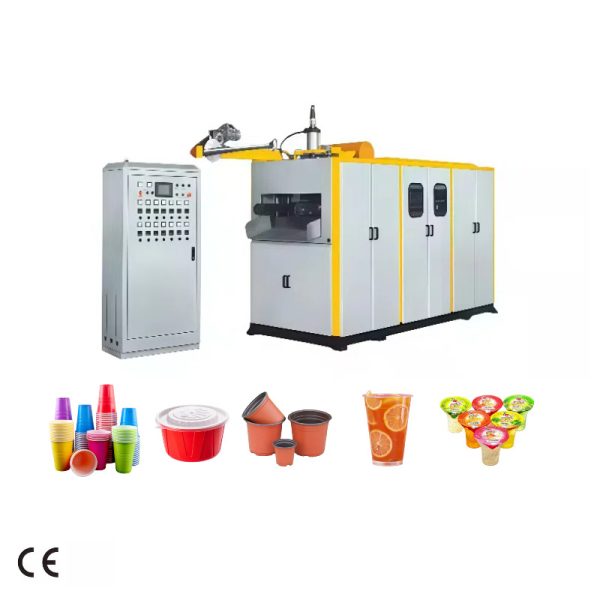
Matched molds and auxiliary equipment — crushers, mixers and recycling units sized to this machine.
See this machine family running in overseas case studies — background, output and on-site photos included.
Request pricing, technical specs or a video machine test — reply within 24 hours.