
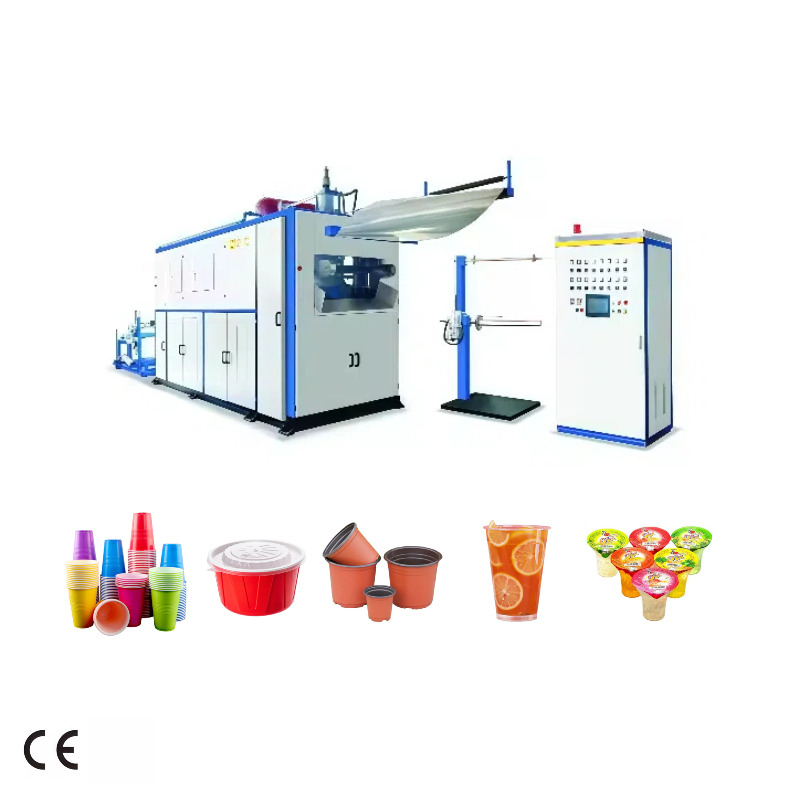
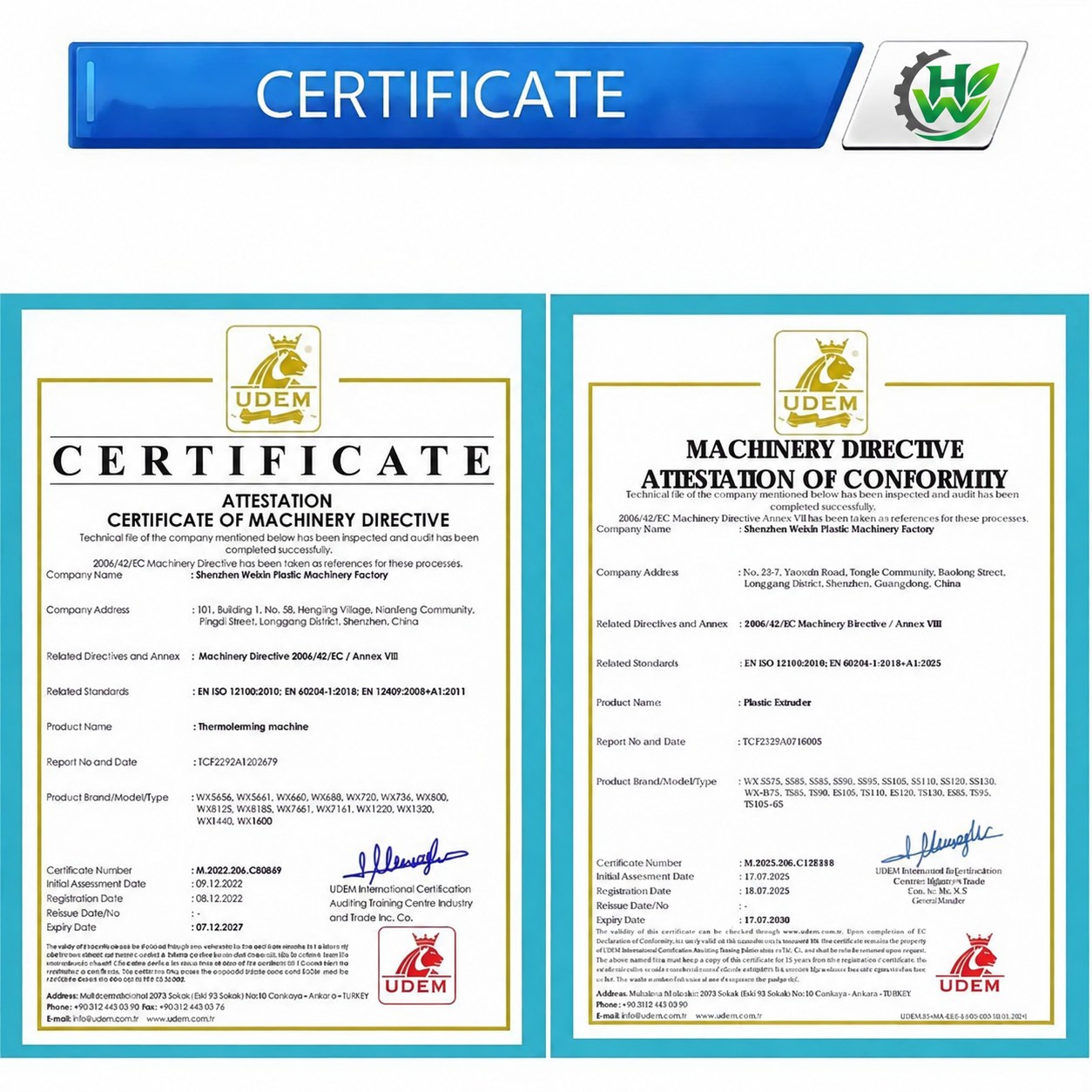
Automatic cup and container thermoforming built around your food container drawing: forming area, drive type and mould are matched to the tray or cup you need to produce from PP, PS or PET sheet. Machines are assembled, wired and test-run in our own factory before loading. CE marking available.
Product Category: Plastic Cup Making Machines
When a packer needs a steady supply of food containers rather than the lowest possible unit cost, the machine has to hold its wall thickness shift after shift. This page covers the VihoX automatic cup line as it is configured for food containers and commercial packaging work.
Every unit we ship is assembled, wired and test-run in our own factory in Yuanzhou Town, Huizhou before it is loaded. What follows is the same information our engineers use when they size a machine against a container drawing.
| Type | Upper mold drive | Lower mold drive | Sheet feeding | Best for |
|---|---|---|---|---|
| Type A – upper cylinder + lower hydraulic | Cylinder | Hydraulic | Standard | Entry-level volume production; simple structure, low maintenance cost |
| Type B – upper servo + lower hydraulic | Servo | Hydraulic | Standard | Higher forming precision and stability; products with strict wall-thickness requirements |
| Type C – full servo | Servo | Servo | Servo | Full servo control; the most stable cycle and lowest energy loss for long continuous runs |
The drive arrangement is the first decision, because it fixes how repeatable the wall thickness will be once the machine is running production. For food containers, where a packing line rejects any tray that will not nest or seal, Type B is the usual starting point; Type C is chosen when the same mould runs continuously for months.
| Parameter | 660 × 320 mm | 720 × 420 mm | 750 × 520 / 560 mm | 850 × 560 mm |
|---|---|---|---|---|
| Max. sheet width | 680 mm | 760 mm | 780 mm | 880 mm |
| Sheet thickness | 0.3–2.0 mm | 0.3–2.5 mm | 0.3–3.0 mm | 0.3–3.0 mm |
| Max. forming depth | 150 / 180 mm | 150 / 220 mm | 180 / 220 mm | 180 / 220 mm |
| Speed | 15–35 cycles/min (reference) | 15–35 cycles/min (reference) | 15–35 cycles/min (reference) | 15–35 cycles/min (reference) |
| Hydraulic motor power | 18.5 kW | 18.5 kW | 18.5 kW | 18.5 kW |
| Total power (max.) | 130 kW | 155 kW | 165 kW | 190 kW |
| Air pressure | 0.6–0.8 MPa | 0.6–0.8 MPa | 0.6–0.8 MPa | 0.6–0.8 MPa |
| Air consumption | Approx. 3.8 m³/min | Approx. 3.8 m³/min | Approx. 3.8 m³/min | Approx. 3.8 m³/min |
| Water consumption | Approx. 20 L/min | – | Approx. 20 L/min | Approx. 20 L/min |
| Cooling recommendation | 3–5 HP Chiller | 5 HP Chiller | 5–10 HP Chiller | 10 HP Chiller |
| Machine weight | Approx. 7 T | Approx. 8 T | Approx. 10 T | Approx. 15 T |
| Typical applications | Water cups, yogurt cups, jelly cups, etc. | Water cups, milk tea cups, beverage cups, meal boxes, bowls, etc. | Water cups, milk tea cups, beverage cups, meal boxes, bowls, etc. | Salad bowls, large-capacity food containers, catering trays |
| Power supply | AC380V / 50Hz / 3 Phase / 4-wire (customizable) | |||
The line is built in four forming areas. Step up a size when the finished container needs a larger blank, or when you want more cavities per cycle at the same cycle time.
Food packaging buyers tend to arrive with a finished container already drawn: a rim profile that has to seal, a stack height that has to match a carton, a wall that has to survive a chilled chain. We work from that drawing back to the forming area and the mould rather than from a stock machine size.
Because the container is usually part of a filled and sealed pack, the two things that matter most in practice are rim consistency and dimensional repeatability between cavities. Both are set by the mould and the clamping arrangement, not by the machine frame alone.
| Material | Typical cups | Notes |
|---|---|---|
| PP | Water cups, hot drink cups, general disposable cups | Good toughness and heat resistance |
| PS | Jelly cups, lightweight food cups | Good thermoforming performance |
| PET | Clear cold drink cups, transparent packaging cups | High transparency; needs suitable sheet quality and temperature control |
| PVC | Industrial and special applications | Confirm local regulations and market requirement before selection |
| PLA | Eco-oriented cups and containers | Narrower processing window; drying and temperature control must be confirmed by trial |
Material choice changes the temperature window more than it changes the machine. If a food container has to run in PLA or in a mono-material PET, tell us at quotation stage so the heating zones and the cooling recommendation are set for that sheet rather than for PP.
Sheet is fed from the roll, heated in zones until it softens, then formed between the upper and lower mould halves. The formed web indexes forward, is cut or punched out, and the finished stack leaves the machine. Trim is reground and returns to the extruder.
In-line extrusion, where your own sheet line feeds the thermoformer directly, is the configuration most packaging plants choose: it removes the cost of buying sheet and gives you control of the sheet thickness that ends up in the container wall.
The mould is the part of the project that decides whether the container works. We make the mould to your container drawing, run it on the machine before shipment, and send you the formed samples together with the setting sheet that produced them.
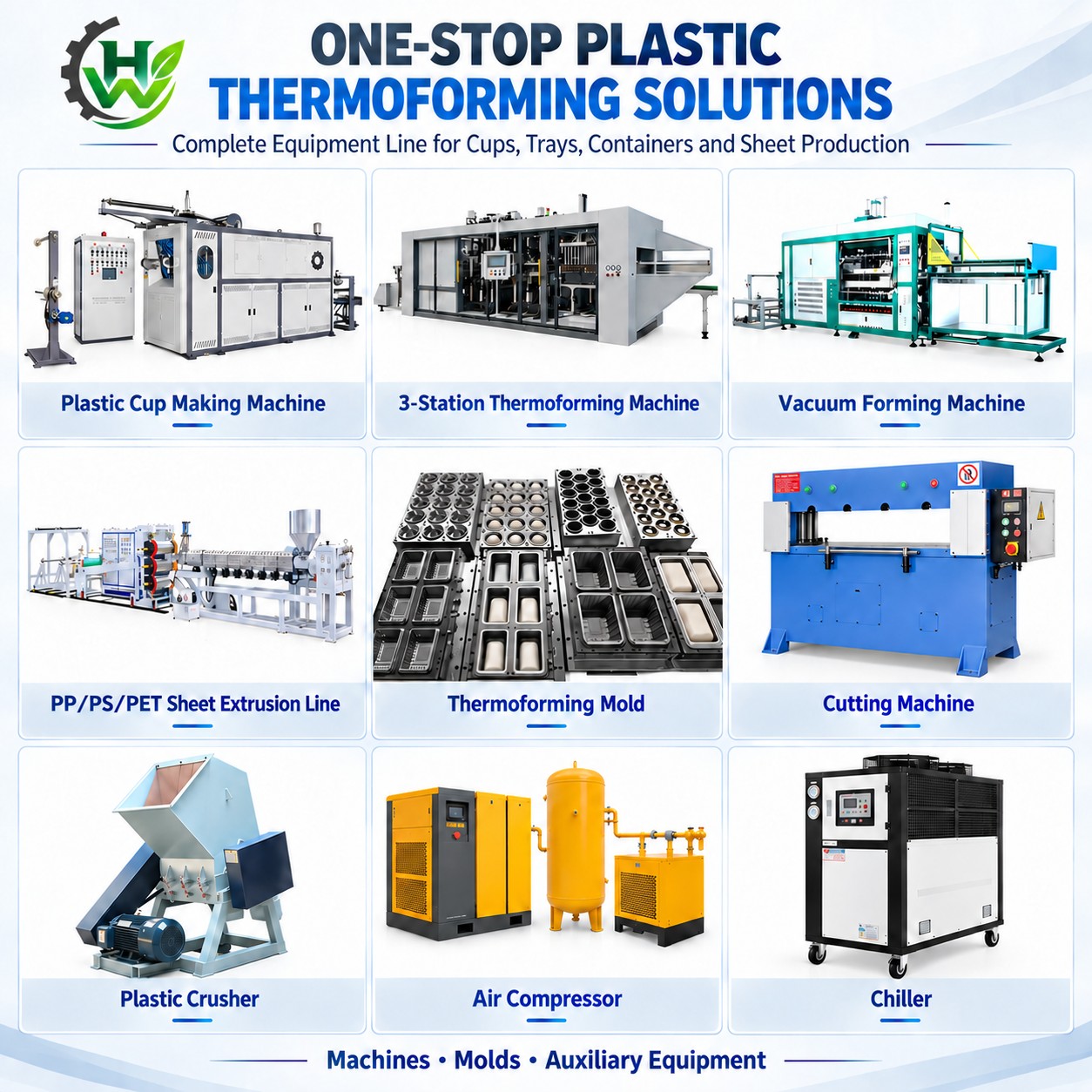
Around the machine you will normally need a sheet extrusion line, a water chiller sized to the hydraulic unit, an air compressor, a grinder for trim, and a stacker or manipulator if the container cannot be packed by hand at the cycle rate.
Once the container drawing and the hourly requirement are fixed, one of the nine VihoX cup machines will fit the job. The models below differ by forming area and drive type; the parameters on each page are the ones we build to.
Before the machine leaves the factory it runs your mould and your material, and we record the settings. On site we commission the line, train the operators and hand over the maintenance schedule. Spare parts and wear items are supplied from the same factory.
What size machine do I need for a food container with a 150 mm rim?
A 660 × 320 mm bed forms that container four-up in most layouts, and remains the least expensive way to get into production. Move to 720 × 420 mm if you expect to add a larger container to the same machine later.
Will the machine run a container and its lid on one bed?
Yes, providing both moulds fit the forming area. Container and lid are normally run as two separate moulds, with the lid forming on a shallower draw.
Can the machine be fed by our own sheet line?
It can, and that is the usual arrangement for a packaging plant. The thermoformer is placed directly after the extruder so the sheet is formed while it is still at temperature, which also improves wall uniformity.
How do you guarantee the same wall thickness on every cavity?
Wall thickness is set by the mould, the clamping force and the heating profile together. We run your mould before shipment and record the setting sheet, so the machine arrives with a known starting point rather than with a general recommendation.
What utilities does the machine need?
Compressed air at 0.6–0.8 MPa, cooling water at roughly 20 L/min, and a three-phase AC380V 50Hz supply. Electrical supply can be built to your local standard on request.
How many containers per hour should we expect?
The forming cycle is 15–35 cycles per minute for reference only. Real output is the cycle time multiplied by the number of cavities in your mould, and is confirmed on your own mould before shipment.
Do you supply the mould as well as the machine?
Yes. Mould design and manufacture are done in the same factory, which is why a container drawing is usually the fastest route to a firm quotation.
What is the lead time and what happens after delivery?
Lead time is confirmed per order once the mould and the line configuration are fixed. After delivery we commission the line on site, train the operators, and continue to supply moulds, spare parts and technical support from the factory.
Send us the container drawing, the material and the number of pieces you need per hour. You will get a quotation that names the forming area, the drive type, the mould and the auxiliary equipment, rather than a list of options.
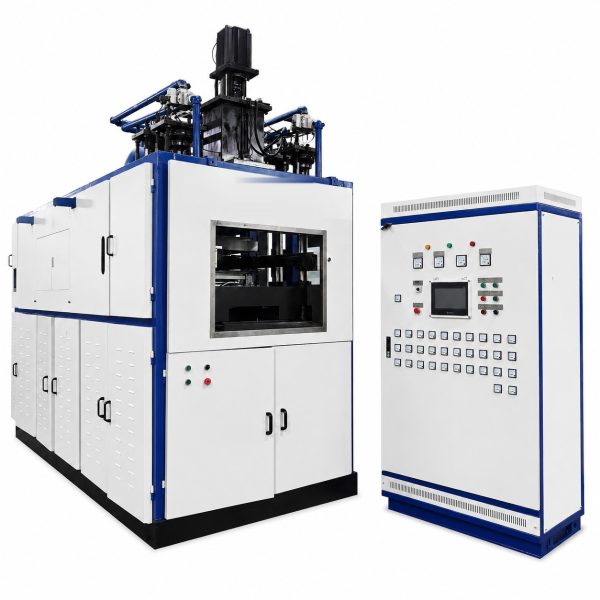
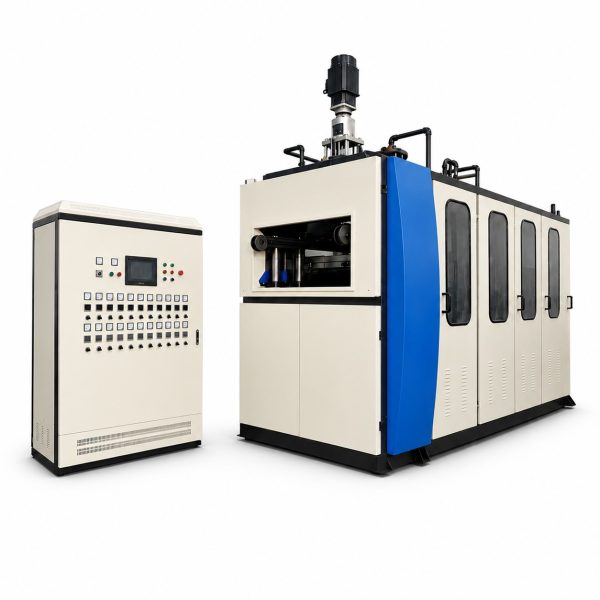
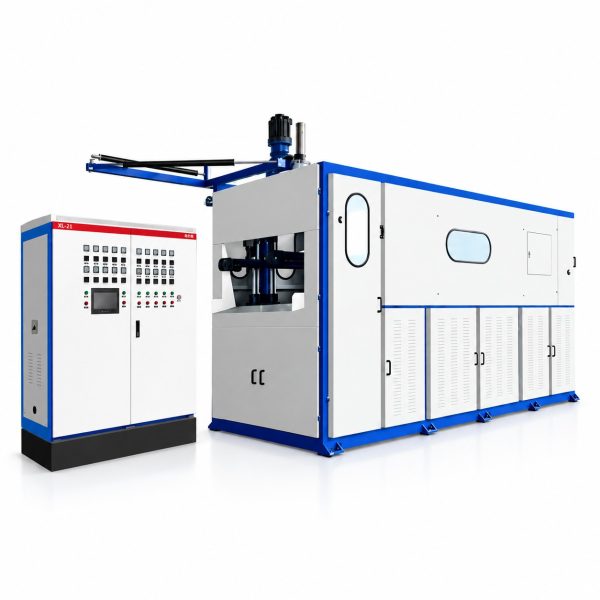
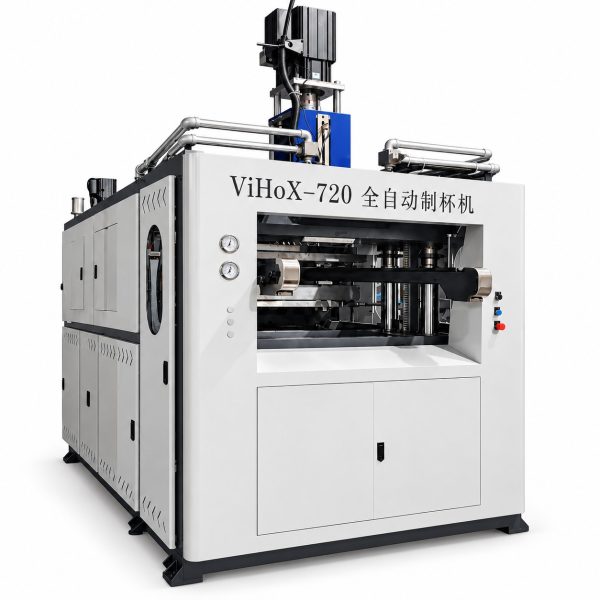
Matched molds and auxiliary equipment — crushers, mixers and recycling units sized to this machine.
See this machine family running in overseas case studies — background, output and on-site photos included.
Request pricing, technical specs or a video machine test — reply within 24 hours.