Product Category: Auxiliary Equipment
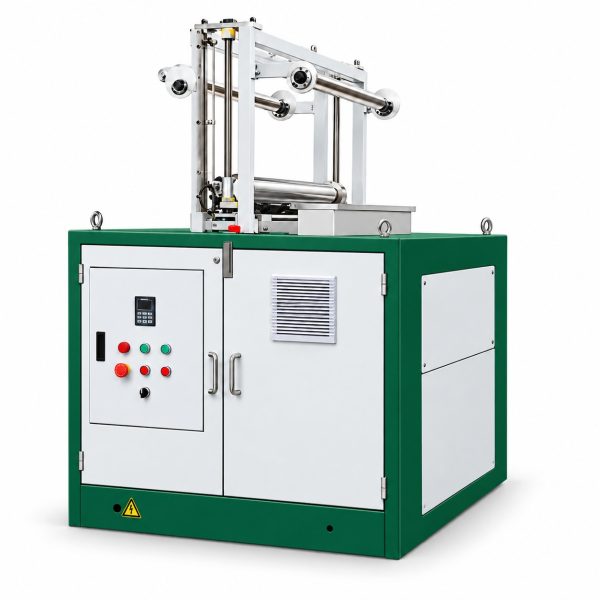
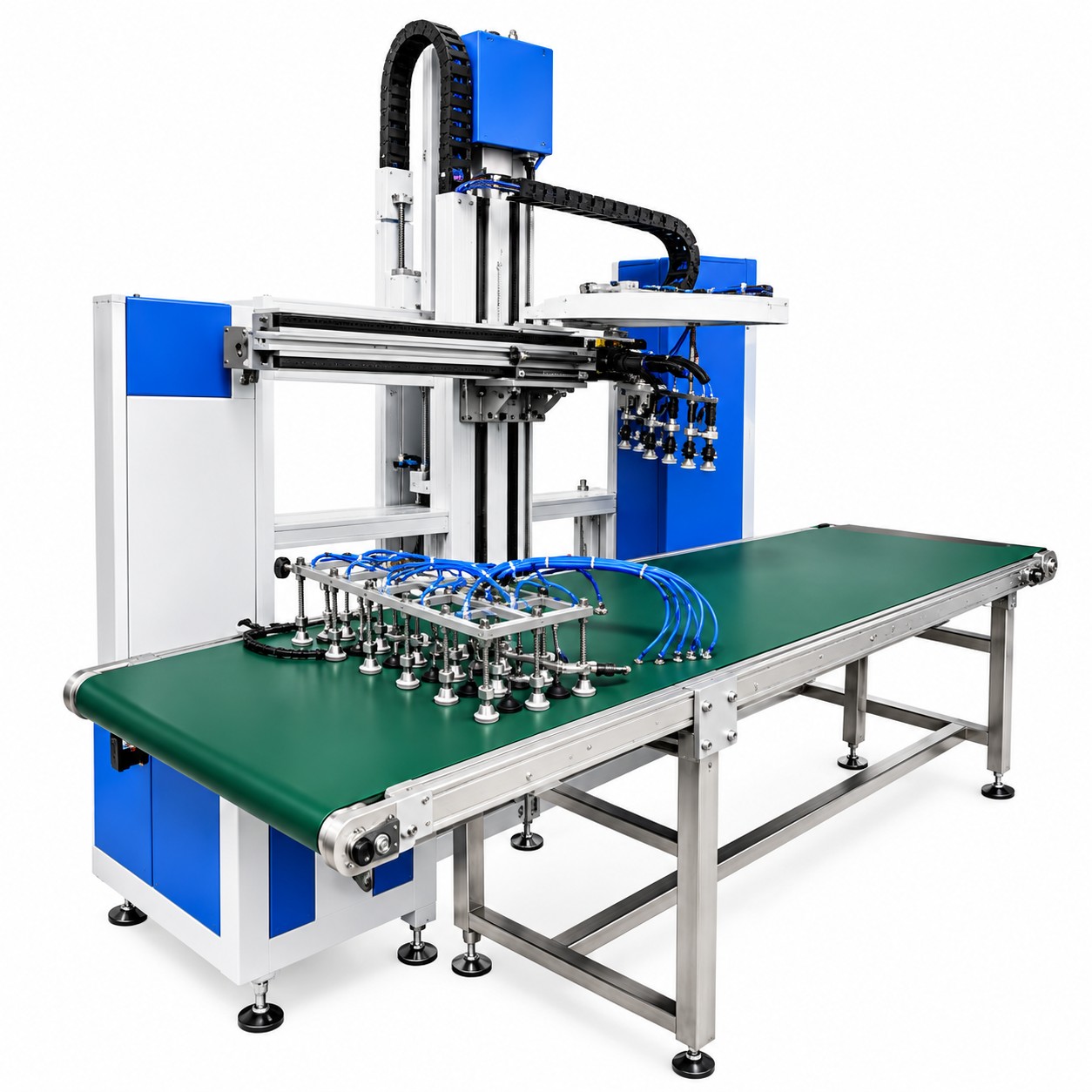
On a cup line the operation that decides labour cost is the moment formed cups leave the mould. The VihoX servo take-out robot takes that moment over: it lifts the finished cups from the forming station, transfers them clear of the machine, changes their orientation as required and places them onto the stacker or conveyor. Because every motion is servo driven, the pick position repeats exactly from one cycle to the next.
Three servo axes do the work. The arm axis, rated about 0.75 kW, swings the gripper into and out of the mould area; the lifting axis at about 1.0 kW raises the pick head through a vertical stroke of approximately 1400 mm; and a separate 0.4 kW motor drives the discharge conveyor. Combined robot servo power is quoted at roughly 1.8 kW. Crosswise travel reaches about 650 mm and the head carries a payload of up to 3 kg, which covers the multi-cavity mould layouts used across our cup machine range.
A take-out robot cannot simply be bolted onto an existing line. Gripper pitch, suction cup count, stacking channel arrangement and the direction cups leave the machine all follow the mould itself. Cup top diameter, cup height and channel quantity are therefore quoted as customized rather than fixed, and the stacking arrangement is synchronised with the host cup machine so the two run as one system.
The robot needs clean, dry air at 0.6 to 0.8 MPa and consumes roughly 0.5 m³/min, a figure worth checking when the plant’s air system is being planned: a 10HP VihoX screw compressor with about 0.9 m³/min of usable air covers the robot with margin to spare. Control runs on a PLC with servo drives and a touch screen; servo brands may be specified as Mitsubishi, Delta or Inovance to match the spares you already keep, and pneumatic components come from established suppliers such as SMC. Supply is AC380V at 50 or 60 Hz, with other voltages on request.
| Robot Specification | VihoX TR660 Rating | Line-Level Effect |
|---|---|---|
| Machine type | Servo cup take-out robot | Automates the mould-to-conveyor hand-off |
| Recommended cup machine | VihoX-660 / 720 / 750 / 850 series | Fits all four cup machine platforms |
| Drive method | Servo driven, three axes | Repeatable pick position every cycle |
| Robot payload | Up to approx. 3 kg | Handles multi-cavity mould layouts |
| Vertical stroke | Approx. 1400 mm | Clears the tallest forming tooling |
| Crosswise stroke | Approx. 650 mm | Reaches the conveyor without extra handling |
| Robot servo power | Approx. 1.8 kW (reference) | Arm 0.75 kW plus lifting 1.0 kW |
| Conveyor motor | Approx. 0.4 kW | Driven separately from the robot axes |
| Air pressure | 0.6-0.8 MPa | Standard shop air, no special supply |
| Air consumption | Approx. 0.5 m³/min | Within a 10HP compressor’s usable output |
| Control system | PLC + servo + touch screen | Brands selectable to match your spares |
| Power supply | AC380V / 50-60 Hz | Other voltages customizable |
| Footprint | Robot approx. 1100×1500×1800 mm; conveyor approx. 3000×850×900 mm | Plan floor space for both units |
| Machine weight | Approx. 600 kg | Standard forklift placement |
The robot carries a reference rating of up to 30 cycles per minute against a standard mould layout. Treat that as an indication of capability rather than a production guarantee. Real output depends on cup geometry, cavity count, travel distance and the downstream stacker, so we confirm the figure against your actual mould before quoting.
It is built to the mould layout rather than a fixed catalogue size, so compatibility depends on the tooling. Send us the mould drawing and the direction cups leave the machine.
The number of cavities in the mould and the cup size. A single-cavity tool needs far fewer pick points than a multi-cavity stack.
Orientation change is part of the transfer motion, so cups arrive at the stacker facing the right way without a separate flipping device.
About 0.5 m³/min at 0.6 to 0.8 MPa, which a small screw compressor covers comfortably.
Yes. Mitsubishi, Delta and Inovance are offered so the robot can be aligned with the spares you already stock.
No. It is a reference figure against a standard layout, and the real rate depends on your mould, cup geometry and downstream equipment.
The robot is synchronised with the host machine, so its cycle follows the former rather than running independently.
Mechanical setting is quick. Most of the time goes into teaching pick positions and proving the hand-off with your actual mould.
Send us your mould layout, cup dimensions and the direction of pick-out, and we will confirm the gripper arrangement and the reference cycle rate for your line. The robot is normally specified together with our cup making machines and feeds directly into a cup stacker.
Talk to the factory: +86 147 7547 6896 · VihoX, Shenzhen, China
The robot is normally followed by a cup stacker and an automatic counting and packing machine, which together remove manual handling from the end of the line. It is fed by the cup making machines it serves, and its 0.5 m³/min air demand is met by a 10HP PM VSD compressor.
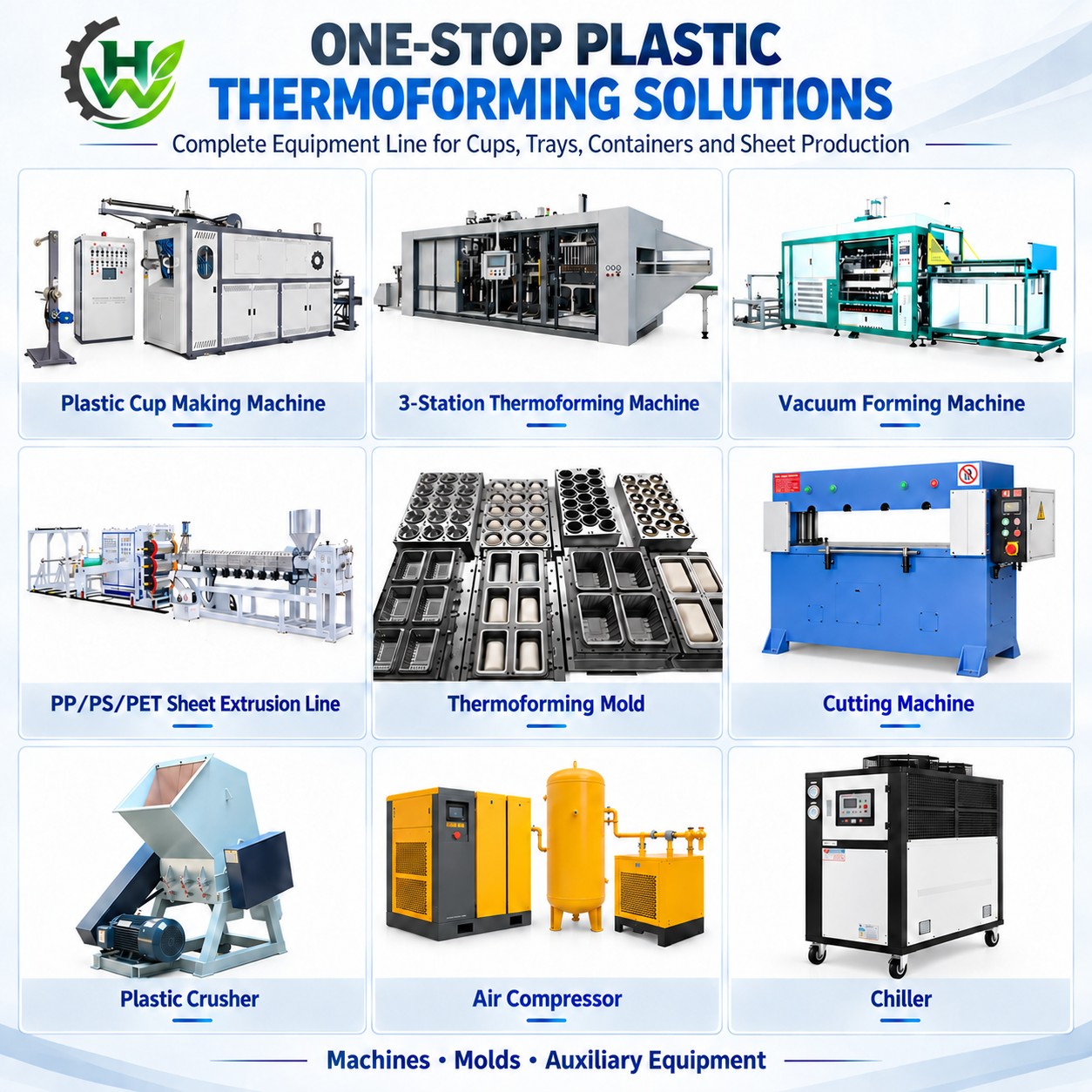
Matched molds and auxiliary equipment — crushers, mixers and recycling units sized to this machine.
See this machine family running in overseas case studies — background, output and on-site photos included.
Request pricing, technical specs or a video machine test — reply within 24 hours.